
High Hairline: Is It Natural or Receding? Causes and Treatment Options
 ChatGPT
 Claude
 Perplexity
 Grok
 Gemini


A high hairline is a front hairline that sits further back on the scalp than average, usually leaving four or more fingers of forehead between the brows and the hair. Photos can make a forehead look bigger than in the mirror, and then you start asking, “Was my hairline always this high, or is it moving back?”
People with a high hairline often have a tall forehead with a rounded or flat edge, sometimes with a widow’s peak or softer temples. It is usually natural when it stays in the same position from your teens, with thick, even hair along the edge. However, if it has moved from its original position and is now full of thinner, shorter hairs at the temples or a deeper M shape, it might be a receding hairline. In women, an even, rounded edge is often natural, while recession may signal tight hairstyles, hormonal changes, or scarring that needs diagnosis.
Men and women develop high hairlines for different reasons. Here, we will explain how to distinguish natural high hairlines from hair loss, their causes, flattering haircuts and hairstyles, treatments for active hair loss, and procedures that lower a hairline that’s too high.
Quick Insights
- A high hairline is natural when it has sat in the same place since your teens and the hair along its edge is thick and usually needs no treatment.
- Mature and receding hairlines are different from a high hairline. A mature hairline shifts 1 to 2 cm in your late teens or twenties and then stays put, while a receding one keeps moving, shows thin short hairs at the temples, and needs a diagnosis.
- Two dated photos taken 6 to 12 months apart are the most reliable home check, because a hairline that has not moved is not receding.
- Styling can balance a high hairline with a textured crop, quiff, or fringe for men and curtain bangs, wispy bangs, or a soft side part for women.
- Minoxidil and finasteride slow active hair loss but cannot lower a hairline that was always high, because no dormant follicles sit there.
- A hair transplant lowers the hairline gradually over 9 to 12 months, while hairline lowering surgery moves it at once but leaves a scar.
- See a doctor first if your hairline is still moving, the hair along the edge is getting thinner, or you are also losing eyebrow hair.
High hairline key facts at a glance
| Measure | Typical figure | What it means |
|---|---|---|
| Brow-to-hairline distance | 5-6.5 cm | Above this range may look like a long forehead. |
| Finger-width check | 4+ fingers | Quick home check; hand sizes vary. |
| Mature hairline shift | 1-2 cm, once | A normal one-time change that stops progressing. |
| Best gap between comparison photos | 6–12 months | Helps track hairline changes. |
| Minoxidil results | 3–6 months | Visible improvement; gains may fade after stopping. |
| Finasteride hair-count gain vs. placebo | 9% at 1 year; 24% at 2+ years | For men with pattern hair loss; not recommended for women who could become pregnant. |
| Hair transplant result becomes visible | 9–12 months | Full results develop gradually after surgery. |
| Average forehead reduction from hairline lowering surgery | 1.6 cm average reduction | For stable hair and a loose scalp; leaves a scar. A 2022 review reported complications below 1%. |
What Counts as a High Hairline?
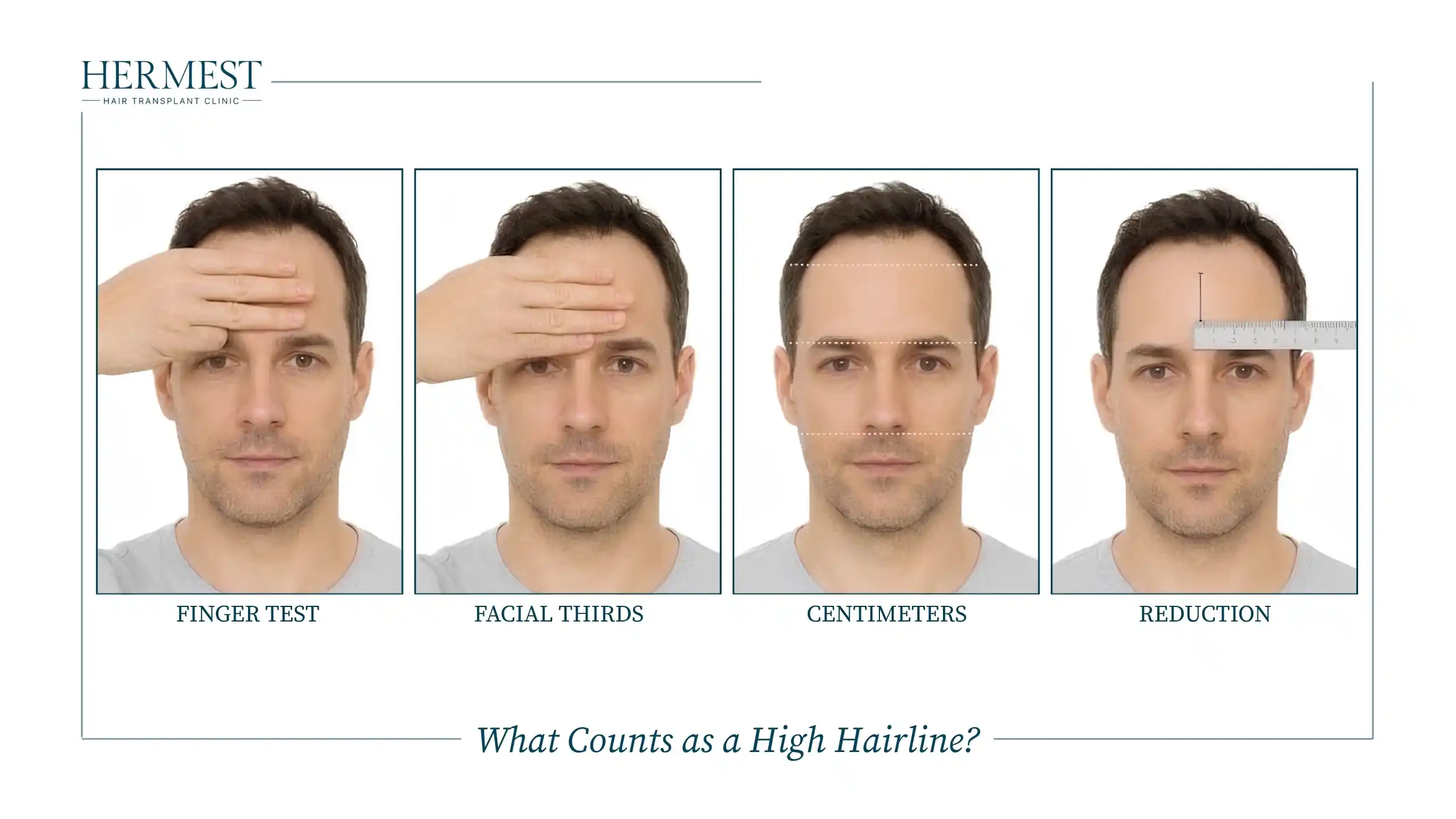
A high hairline is a hairline that starts further back on the scalp than average, so more of the forehead shows. It describes position, not hair follicle health. Some people are born with it, some reach it through the normal shift from a teenage to an adult hairline, and some reach it through hair loss. Three quick measurements help you describe your own hairline accurately.
- Finger test: Lay fingers flat above your eyebrows. Three fingers up to the hairline is typical; four or more usually reads as high. Hand size varies, so treat this as a starting point rather than a verdict.
- Facial thirds: Compare the distance from brow to hairline with the distance from brow to the base of your nose. If the upper stretch is clearly longer, the hairline looks high.
- Centimeters: As a working range, a brow-to-hairline distance of about 5 to 6.5 cm is typical, and surgeons who perform forehead reduction usually describe anything above that as a long forehead. These figures are estimates, because faces differ.
Dr. Ahmet Murat says:When a patient says their forehead is too big, I look at the whole face first, starting with brow position, jaw width, and eye spacing. Four fingers of forehead can look balanced on one face and high on another. Sometimes a haircut answers the question.
Do not trust your selfies, as a phone held close and slightly below the face stretches the forehead, which is why many people find their selfies look worse than the mirror. Take the reference photo from arm’s length or have someone shoot it at eye level from about two metres.
What Matters? Height or Shape of Hairline
The key difference is progression. A naturally high hairline stays relatively stable, while a receding hairline gradually moves backward. Height alone does not indicate hair loss.
Hairline height and shape are different traits. Shape can offer clues about whether a hairline is natural or receding. Our guide to types of hairlines covers the main patterns. A high hairline can be:
- Rounded or bell-shaped: A soft, curved edge, common in women.
- Straight: A flat, even line seen in both sexes.
- Widow’s peak: An inherited V-shaped point at the center.
- M-shaped: Deepening or uneven temple corners that can indicate recession, especially in men.
Men more often worry about balding, while women may focus on facial balance. Female pattern hair loss also tends to preserve the frontal hairline.
Is Your Hairline High, Mature, or Receding?
A high hairline is a fixed starting point that has been there since youth. A mature hairline is the one-time shift from a rounded teenage line to an adult one, usually about 1 to 2 cm, which then stops. A receding hairline is ongoing loss of follicles at the front and temples.
| High hairline (natural) | Mature hairline | Receding hairline | |
|---|---|---|---|
| What it is | An inherited starting point set further back | A normal one-time shift from the juvenile line | Progressive loss of hair at the front and temples |
| When it shows | Present in childhood or the teens | Late teens to about 30 | Any time after puberty, often the 20s and 30s |
| Movement | None | Moves once, then stops | Keeps moving over months and years |
| Shape | Even, often rounded or straight | Mild, even M or slightly squared corners | Deepening M, U or V shape, often uneven |
| Hair at the edge | Thick, full-length hairs | Thick, full-length hairs | Finer, shorter, wispy hairs at the temples |
| Norwood stage (men) | Stage 1 to 2 | Stage 2 | Stage 3 and above |
| In women | Common; usually round or bell-shaped | Small, even rise | Points to traction, hormonal change or scarring alopecia rather than ordinary pattern loss |
| Treatment needed | None | None | Yes, if you want to slow it |
For men, the Norwood scale shows how far the hairline has moved, and the first three stages matter most here.
- Stage 1 is a juvenile line with no recession, and it is normal.
- Stage 2 is a mild, symmetrical recession at the temples, which is the mature hairline and is also normal.
- Stage 3 is the first stage counted as true hair loss, with corners that deepen into a clear M.
Our guide to the M-shaped hairline shows what each stage looks like, and the early signs of a receding hairline cover what to watch for.
The temples are where recession shows first, and the reason is hormonal.
- Temples go first because follicles there and at the crown are the most sensitive to DHT (dihydrotestosterone), the hormone behind male pattern baldness.
- Shrinking follicles grow shorter, finer hairs under DHT until they stop producing visible hair.
- It is common, with NCBI’s StatPearls reporting about 50% of Caucasian men affected by age 50 and about 80% by age 70.
For a deeper side-by-side, see our page on mature hairline vs receding hairline.
Dr. Ahmet Murat says:In your early twenties, don’t judge the middle of your hairline; watch the temples. If the corners show thin, short, wispy hairs, bring dated photos to a consultation now. A temple that stays unchanged for a year is the best reassurance.
Why Is My Hairline So High?
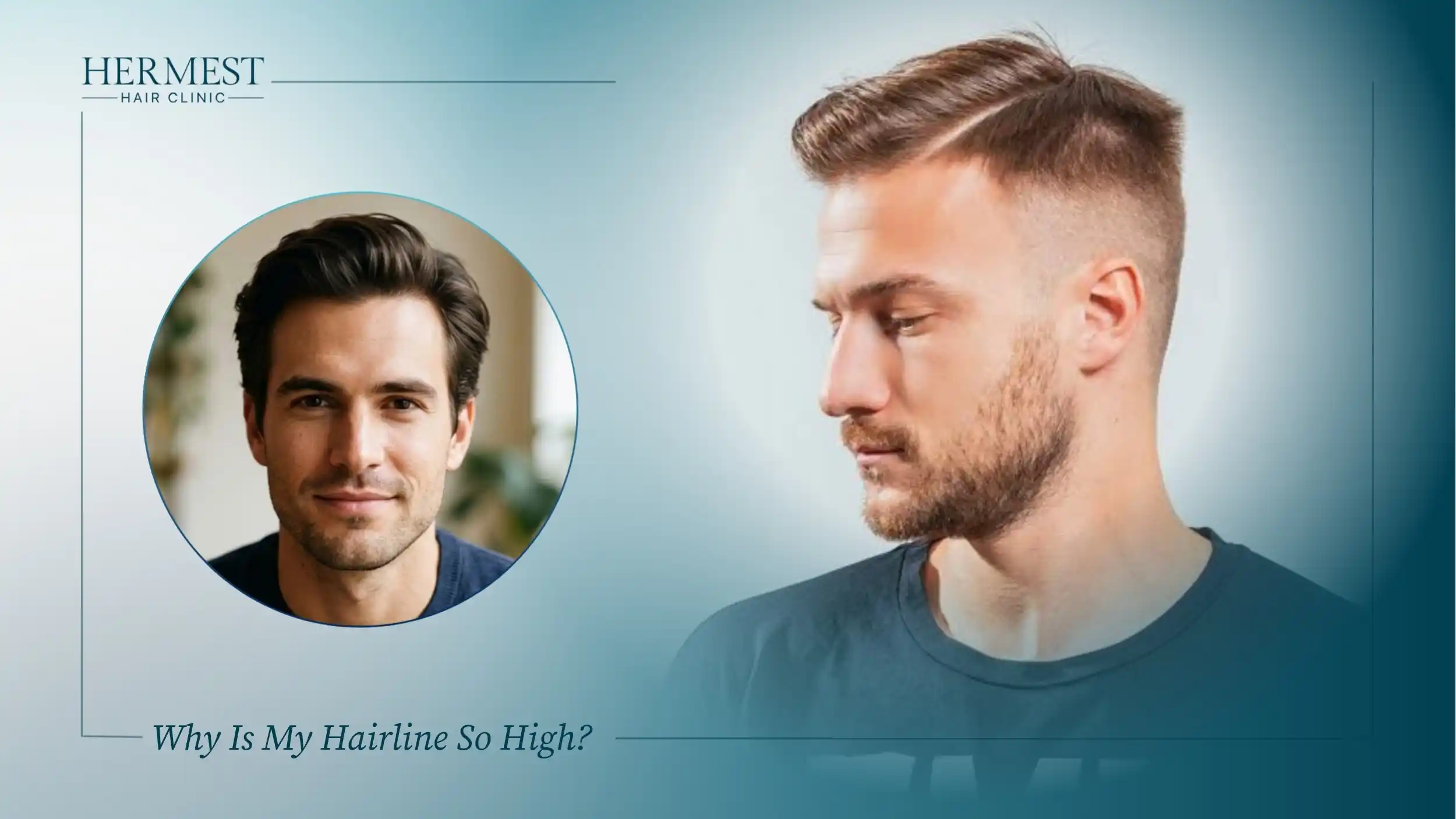
A hairline sits high for one of three reasons. Either you inherited it, your hairline completed its normal maturation, or hair follicles at the front have been lost to something active, such as DHT sensitivity, constant tension, hormonal change, or a scarring condition. Our overview of the causes of hair loss covers the wider picture beyond the hairline.
What causes a high hairline in both men and women?
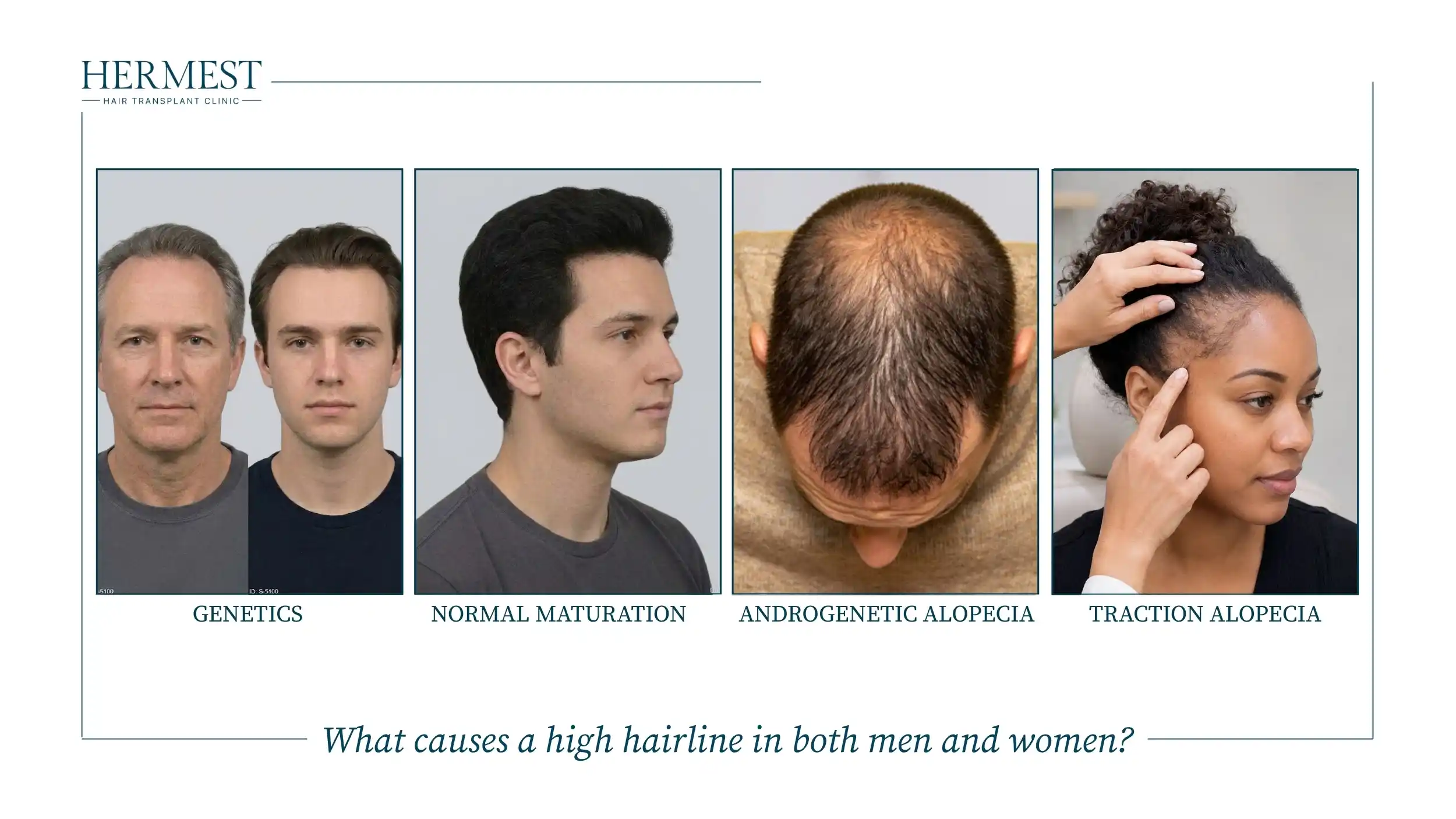
- Genetics: The position where your follicles stop is set by your genes. NCBI’s StatPearls notes that sons of balding fathers carry a 5 to 6 times higher relative risk of baldness, and the same family resemblance applies to hairline height.
- Normal maturation: The juvenile hairline moves back about 1 to 2 cm in the late teens or twenties and then settles. It is a change in shape rather than a loss of hair.
- Androgenetic alopecia: Follicles inherited with high sensitivity to DHT shrink over successive growth cycles, which is why the first sign is shorter, finer hair at the temples rather than a sudden gap. It is the most common cause of a moving hairline in men.
- Traction alopecia: Tight ponytails, braids, buns, extensions, and tight headwear pull on the follicles at the edge. It takes years of regular tension, and early on it recovers once the tension stops. After long exposure, the follicles can scar, and the loss becomes permanent.
- Scarring alopecias: Conditions such as frontal fibrosing alopecia and lichen planopilaris destroy follicles through inflammation. DermNet describes frontal fibrosing alopecia as a band of hair loss along the front and sides of the scalp, often preceded by eyebrow thinning.
- Scalp inflammation: Itching, burning, or flaking along the hairline may be harmless, but persistent symptoms deserve a diagnosis. See our pages on burning scalp and hair loss and follicular eczema.
- Prior surgery: A coronal brow lift, where the incision runs across the top of the scalp, can raise the hairline by design or by side effect.
Why do some women have a high or receding hairline?
Ordinary female pattern hair loss tends to thin the crown and widen the part while sparing the front edge, according to the Ludwig classification used in dermatology. A woman whose frontal line is moving back is therefore often dealing with a different trigger. Here are the common ones:
| Trigger | Clue you may notice | Outlook | Sensible next step |
|---|---|---|---|
| Tight styles and extensions | Thin, broken hairs at the temples and edge, soreness | Often recovers if caught early | Loosen styles, rotate partings |
| Pregnancy and postpartum | Shedding at the front three to six months after delivery | Usually regrows | Wait, check iron and thyroid |
| Low iron or thyroid imbalance | Diffuse shedding, tiredness, dry hair | Reversible once corrected | Blood tests with your doctor |
| PCOS | Thinning with irregular cycles or acne | Manageable with treatment | Hormone review |
| Menopause | Gradual thinning, finer hair | Ongoing, treatable | Dermatology review |
| Frontal fibrosing alopecia | Smooth band along the hairline, thinning eyebrows | Permanent loss, can be slowed | Early dermatology referral |
| Medication side effect | Shedding that started after a new prescription | Often reverses | Ask your prescriber before stopping |
| Genetically high hairline | Same height since childhood, normal density | Stable | Styling or a procedure if you want it lowered |
For women, the cause decides the plan; check out why a female receding hairline at the temples occurs or book a free hair analysis to know if thinning is an issue.
Dr. Ahmet Murat says:For women with a high or moving hairline, I ask about the last year before anything else, including pregnancy, crash diets, new medication, tight styles. Then bloodwork, with ferritin and thyroid first. Treat the cause first; a transplant placed into an active problem rarely holds.
Which popular claims about high hairlines are true?
Here are myths about high hairlines in the “looksmaxxing” community and facts from hair restoration surgeons:
| Claim | Verdict | Why |
|---|---|---|
| “A high hairline means high testosterone.” | False | Pattern loss depends on how strongly your follicles respond to androgens, not on how much testosterone you have. Men with normal levels go bald. |
| “Baldness only comes from your mother’s side.” | Partly true | The androgen receptor gene sits on the X chromosome and comes from your mother, but several other genes from both parents contribute. |
| “Wearing hats makes the hairline recede.” | Mostly false | Loose hats do not. Very tight, constant pressure can add traction, which is a separate cause. |
How Can You Tell at Home If Your High Hairline Is Natural?
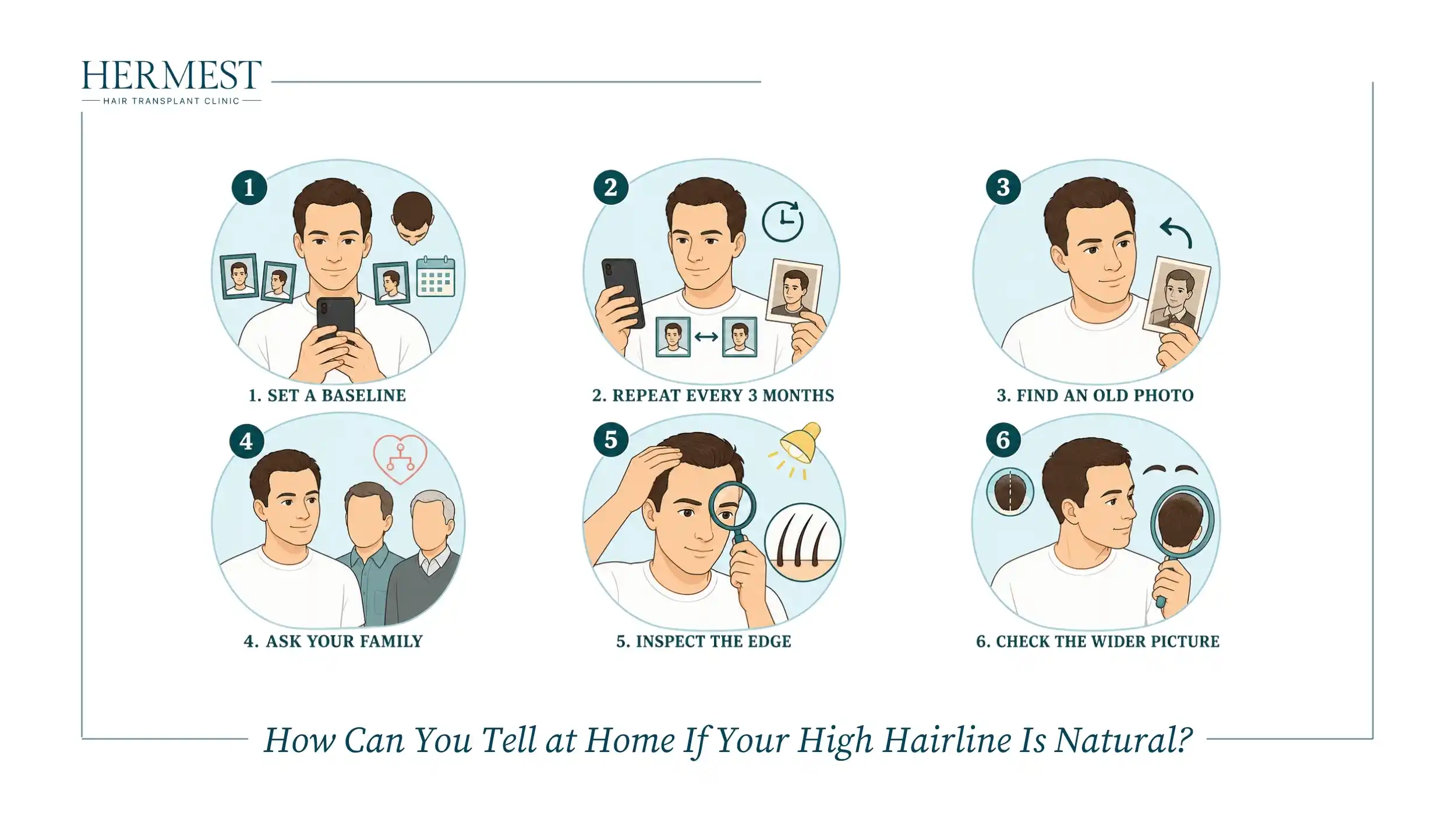
Compare it with itself over time. A natural high hairline looks the same in photos taken a year apart and the same as it did in your teens, while a receding one shifts, thins, or changes shape. A mirror glance cannot show a few millimeters of recession, but a simple photo routine can.
- Set a baseline: In the same bright, even light, pull your hair back and take three photos, one straight on and the others at 45 degrees to each side. Add a top-down shot of the crown. Date them.
- Repeat every three months, and compare at 6 to 12 months: Use the same distance, the same light, and the same hair position. Hold the old photo beside the new one and check whether the temples have deepened or the middle has moved.
- Find an old photo: A school or passport photo from your mid-teens shows your starting point. If your hairline looked high then, it is probably inherited.
- Ask your family: Look at relatives of both sides at your age, not today. A father or grandfather who had a high line at 25 and still has a full head of hair at 60 is a reassuring sign.
- Inspect the edge close up: Lift the front hair and look under strong light. Thick, full-length hairs along the edge point to stability. Short, thin, pale hairs where thicker ones used to grow point to miniaturization, the shrinking of the follicle that comes with DHT sensitivity.
- Check the wider picture: Men should look at the crown for thinning, and women at the width of the parting. Women should also check the eyebrows, since thinning brows alongside a moving hairline is a recognised warning sign of frontal fibrosing alopecia.
One side sitting higher than the other is common and is not a verdict on its own. A cowlick, a habitual side part, or years of sleeping on one side can make one half look higher. Asymmetry that has always been there is usually harmless, while asymmetry that appeared recently is worth a closer look. What matters is whether the border has moved.
Dr. Ahmet Murat says:Judge your hairline on dry, unstyled hair. Wet or product-heavy hair clumps together and makes the line look higher than it is, so take every comparison photo in the same condition.
What Is the Best Haircut for a Man With a High Hairline?
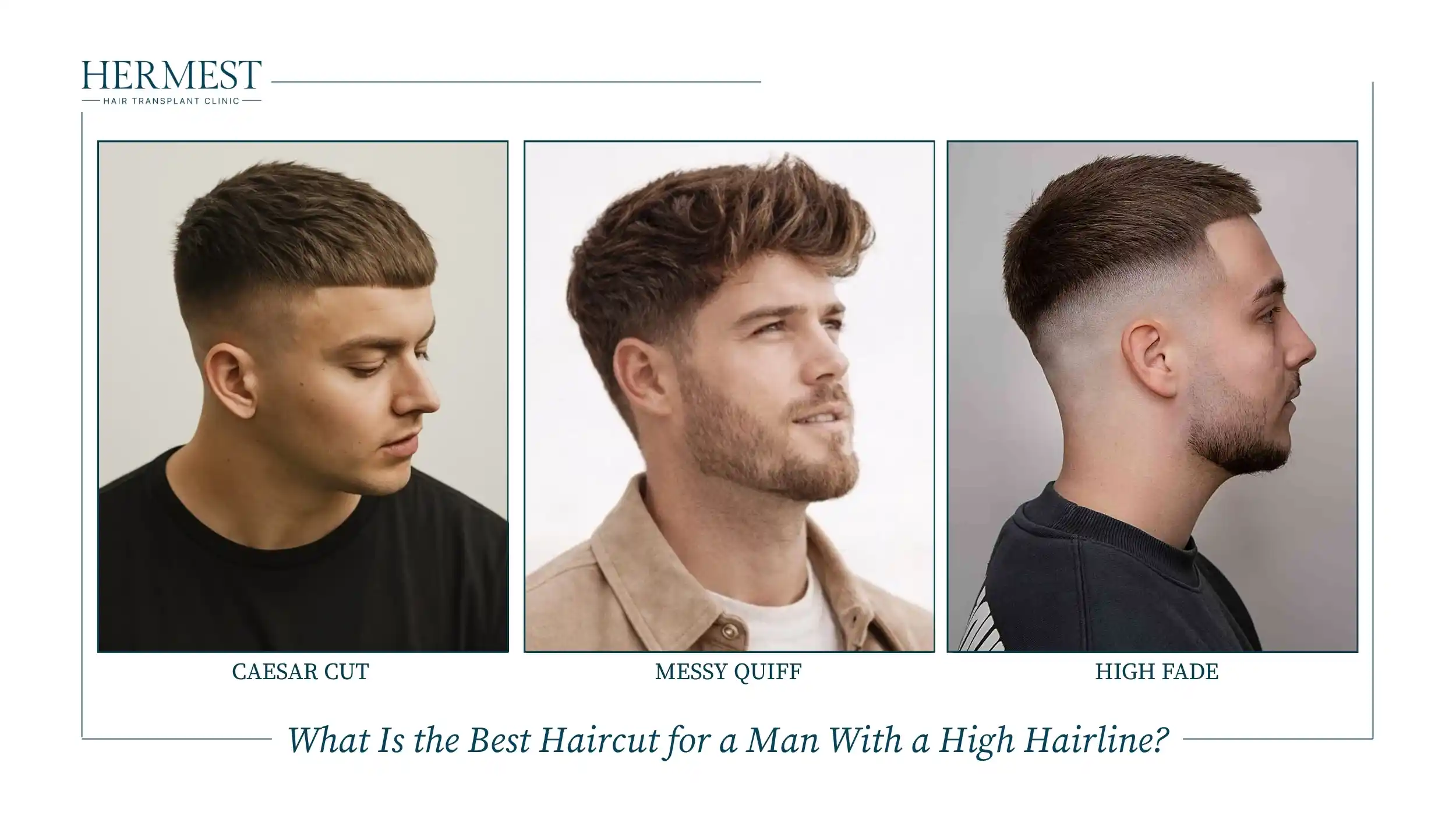
The best haircuts for a high hairline keep length and texture at the front so the hair falls forward over the upper forehead, while the sides stay short and tidy. A textured crop with a fringe is the most reliable starting point. After inspection, if you have a stable high hairline, we usually recommend styling hair that suits you instead of direct forehead reduction. To know which version suits you, understand your hair type, face shape, and, if your hairline is receding, how stable the temples are:
| Haircut | Why it works | Suits | Watch out for |
|---|---|---|---|
| Textured crop with a forward fringe | Choppy length combed forward covers the top of the forehead and blurs the edge | Straight, wavy or thick hair, most face shapes | Needs enough length at the front to reach the brows |
| Caesar cut | A short, even fringe cut straight across, with very low upkeep | Wavy or thicker hair | Looks severe on very fine hair |
| Messy quiff, styled forward and sideways | Volume draws the eye to the style rather than the hairline | Thick hair with some length | A quiff pushed straight up exposes more forehead |
| Side part with a longer top | The sweep across the front softens the height | Straight or wavy hair | Needs a natural parting direction |
| Low taper or low fade with a longer top | Keeps contrast low around the temples | Most men, including early recession | Needs a tidy-up every 3 to 4 weeks |
| High fade or high taper | Strong, clean shape | A dense, stable hairline | Exaggerates receding temples |
| Buzz cut | Short length narrows the contrast between hair and forehead | Even density, symmetrical hairline | Shows every irregularity in the edge, so start with a guard of 6 to 13 mm (a number 2 to 4) |
For recession specifically, our guide to the best haircut for a receding hairline and thinning hair goes further.
Understand your face shape for the perfect high hairline haircut choice:
Hair type and face shape change the choice:
- Straight hair: A fringe lies flat and covers cleanly, so go for a crop or a side part. Fine straight hair looks thin when cut too long at the front, so keep it short and textured.
- Wavy hair: Waves add natural volume at the front, which makes a Caesar cut or a loose crop effective with little styling.
- Curly hair: Curls cover generously. A curly fringe over a taper works well, and our guide to the types of curly hair helps you pick products by curl pattern.
- Long or oval face: Choose a fringe and keep the sides slightly fuller, and avoid extra height on top.
- Round or square face: Some height at the front balances the face, as long as the hair is brushed forward rather than straight back.
A few choices work against you, such as hair slicked straight back without volume, a razor-sharp line-up pushed high on the forehead, and tight styles that scrape hair backward.
Dr. Ahmet Murat says:Go easy on the razor. A very sharp, very high line-up makes a natural hairline look like recession. Ask your barber for a softer, slightly textured edge, and keep length on top so the hair falls forward.
What Are the Best Hairstyles for a High Hairline in Women?
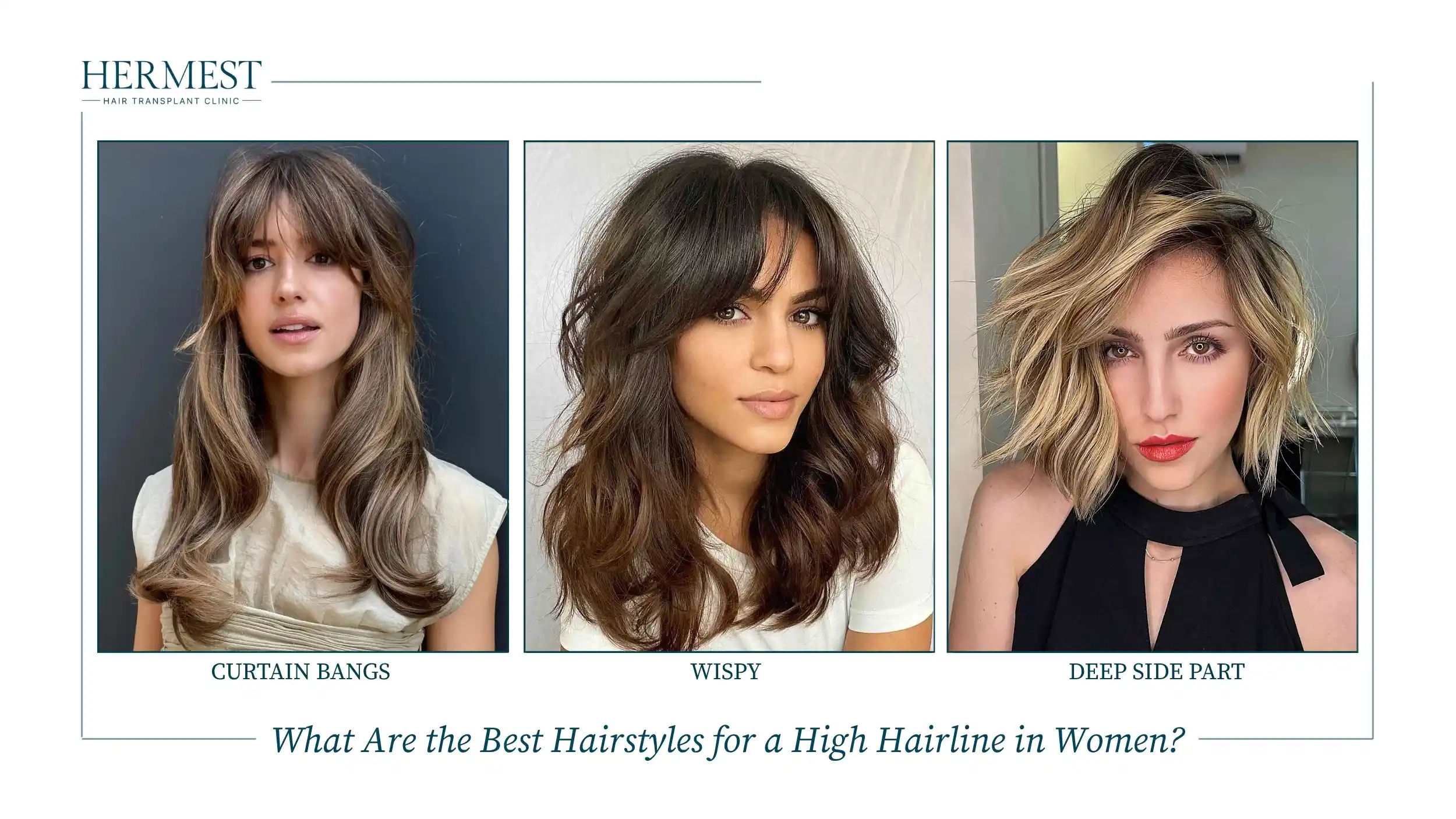
The best hairstyles for a high female hairline frame the face with soft, light fringe or layers rather than a heavy block of hair. Curtain bangs, wispy side-swept bangs, and a deep side part do most of the work.
| Hairstyle | Why it works | Watch out for |
|---|---|---|
| Curtain bangs | Part in the center and sweep to each side, framing the forehead and cheekbones | Cut them light; heavy bangs add friction at the edge |
| Wispy or side-swept bangs | Cover the upper forehead with a soft line, easy to grow out | Needs regular trims to avoid poking into the eyes |
| Deep side part | Hair sweeps across the forehead and breaks up its height | Switch the side now and then to avoid constant tension on one area |
| Face-framing layers on a bob or lob | Movement around the face draws attention to the lower half | Layers that start above the cheekbone can reveal the temples |
| Soft waves | Volume at the roots makes the hairline look fuller | Curling irons used daily damage fragile hair at the edge |
| Loose updo with pulled-out strands | Keeps hair up without a harsh pull | Avoid slicked-back buns, which expose and stress the front edge |
Temporary extras can help on days when styling alone is not enough. A root-matched thickening spray or hairline powder fills thin spots at the temples, and a wide, soft headband worn slightly forward shortens the forehead. Our page on hairstyles for balding women lists more cuts for thinning at the front.
Can You Lower a High Hairline Without Surgery?
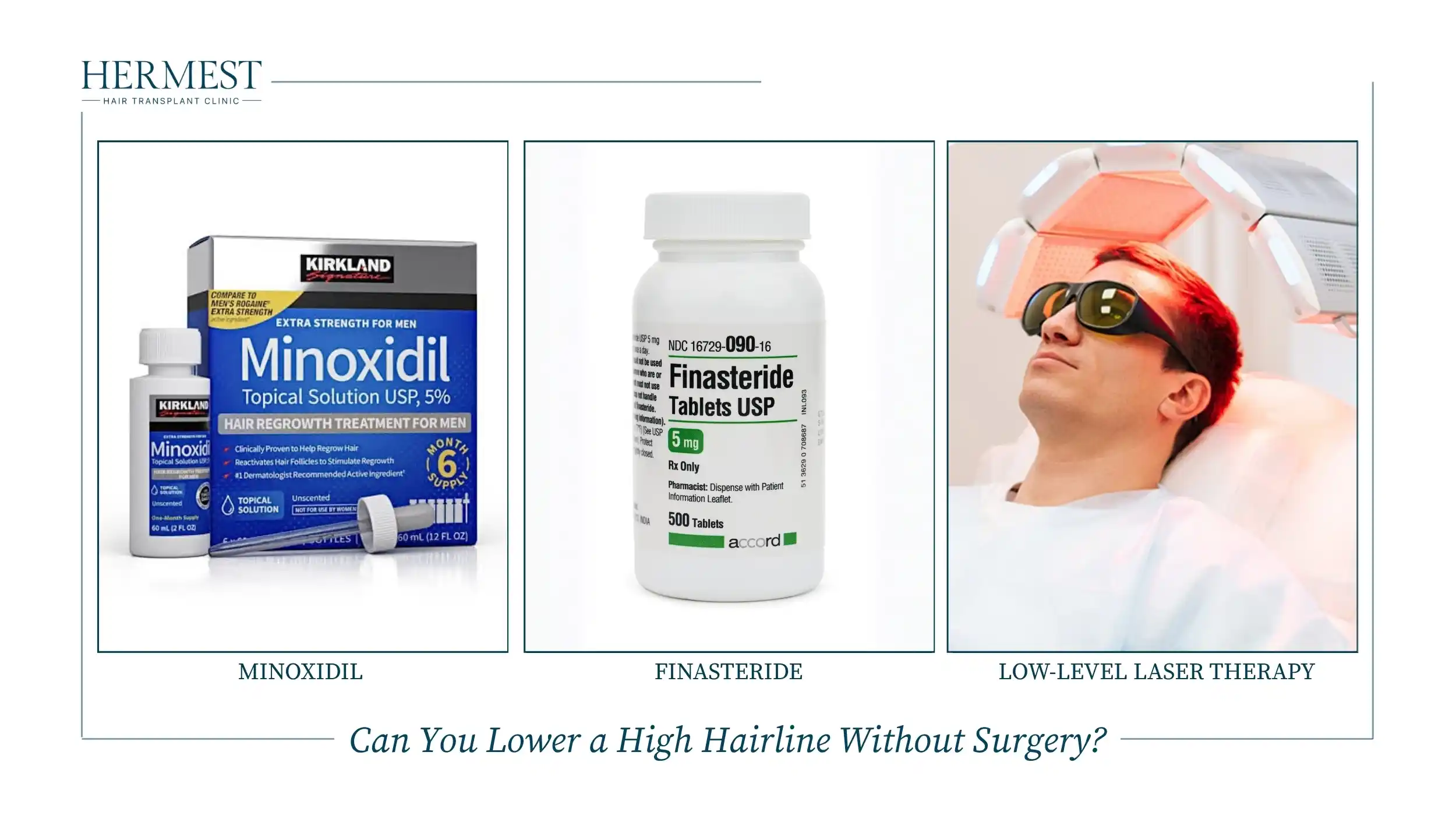
If the hairline has always been high, no. Creams, pills, lasers, and home routines cannot lower it. They act on shrinking follicles, and skin that never grew scalp hair has nothing to revive. They help when the hairline is actively receding, and you want to keep or thicken what remains.
Which treatments work for an actively receding hairline?
- Minoxidil (men and women): A topical treatment sold over the counter. It extends the growth phase of weakened follicles and thickens fine hairs. Expect a temporary increase in shedding in the first weeks and visible change after 3 to 6 months. A 2017 meta-analysis in the Journal of the American Academy of Dermatology found minoxidil more effective than placebo in men, and 2% minoxidil more effective than placebo in women. The gains last only while you keep using it.
- Finasteride (men): A daily tablet that lowers DHT. A systematic review in JAMA Dermatology (published in its earlier name, Archives of Dermatology) found that finasteride raised hair counts by about 9% at one year and about 24% at two years or more compared with placebo, with a higher risk of sexual side effects. It is not recommended for women who could become pregnant.
- Spironolactone and low-dose oral minoxidil (women): Prescription options a dermatologist may use when hormones drive the loss. They need blood pressure and potassium monitoring, so they are not self-prescribed.
- Low-level laser therapy: FDA-cleared caps, helmets, and combs use low-level light to stimulate hair growth. A meta-analysis of seven clinical trials found increased hair density in men and women using these devices compared with inactive devices. Results typically require several months of regular use.
- PRP (platelet-rich plasma): Your own concentrated platelets injected into the scalp. It is usually an add-on to medication, with mixed evidence on how much it contributes alone.
- Fixing the trigger: Correcting iron or thyroid problems, loosening tight styles, and reviewing medicines can let a hairline recover when those were the cause.
If a doctor sees no active loss, medication is unnecessary. If there is active loss, starting early matters, because it is easier to keep follicles than to regrow ones that have stopped producing hair.
Dr. Ahmet Murat says:If you are in your twenties and still losing hair, I start medication before any surgery. A transplant gives you a new line, but only finasteride or minoxidil protects the hair behind it.
Oral minoxidil, originally a blood-pressure tablet, is now prescribed at very low doses for hair loss. It can cause fluid retention, a faster heartbeat, and unwanted facial hair, so it is a doctor-supervised option and never one to start on your own.
Do natural and home remedies lower a hairline?
| Remedy | Verdict | What the evidence says |
|---|---|---|
| Scalp massage | Harmless, unproven | Small studies only. It may feel good but cannot move a hairline. |
| Forehead and scalp exercises | No effect | Muscle movement does not change where follicles sit. |
| Rosemary oil | Limited evidence | One small six-month trial compared it with 2% minoxidil and found similar results. Larger trials are lacking, and it does nothing for a natural high hairline. |
| Microneedling | Adjunct only | Small trials show better results when combined with minoxidil in active pattern loss. It does not create new hairlines. |
| Biotin and diet changes | Only if you are deficient | Correcting a real deficiency helps. No diet moves a hairline. |
| Hair fibers and thickening sprays | Cosmetic | Instant camouflage that washes out. Useful for events and thin patches. |
| Scalp micropigmentation | Cosmetic, long-lasting | Pigment placed in the skin mimics short hair stubble. It fades over years, needs touch-ups, and suits short hair best. |
| Wigs, toppers, hair systems | Cosmetic | Can look convincing, but need maintenance and can irritate the scalp if worn for long hours. |
Can a Hair Transplant Lower a High Hairline?
Yes. A hair transplant can lower a naturally high hairline and can rebuild one that has receded, in men and in women. Surgeons move follicles from the donor area at the back and sides of the scalp, which keep growing for life, and place them along the front in a new line. The claim that a transplant only replaces lost hair and cannot create a lower line is outdated, because the grafts grow wherever they are placed. What limits the result is donor supply, hair stability, and good design, not the history of the forehead.
How does a hairline transplant lower the line?
The hair restoration surgeon first measures the face and draws the new hairline with you, then harvests grafts (natural groups of one to four hairs) from the donor area and implants them in the front. A natural border is irregular and soft, built from single-hair grafts at the very edge, with two- and three-hair grafts placed behind to add density. A ruler-straight line looks artificial because no natural hairline is perfectly straight.
How far the line can move is a design decision. As a professional estimate, most designs lower the line by about 1 to 2 cm and soften the temples, and a hairline-only session uses from several hundred to roughly 2,000 grafts or more depending on width and temple work. Going lower needs more grafts and risks a line that looks wrong at 50 or 60.
Dr. Ahmet Murat says:Young men often ask me for the hairline they had at sixteen. I say no. A hairline placed too low looks wrong at forty and uses grafts you may need later if loss continues. We design for the face you’ll have at fifty.
Who is a good candidate, and who should wait?
- Adults with a naturally high, stable hairline: Good candidates when they have sufficient donor hair, realistic expectations, and no ongoing hair loss. Surgery can lower the hairline without needing to account for significant future recession.
- Men under 25: Usually better off waiting because male pattern baldness may still be developing. Medication and regular monitoring can help clarify the future hairline before surgery. Age alone does not rule out a transplant.
- People with active hairline recession: Should usually stabilize hair loss before surgery. A transplant performed too early may leave transplanted hair at the front while natural hair behind it continues thinning.
- Women with a high hairline: Often good candidates, particularly when the hairline is genetic or the result of old traction, after any hormonal or nutritional trigger has been corrected. Our page on hair transplants for women covers the differences in design and shaving.
- People with scarring alopecia: Should postpone surgery until the condition is inactive and a specialist confirms that transplantation is appropriate. Some conditions, including frontal fibrosing alopecia, can recur and damage transplanted follicles.
The ISHRS 2025 Practice Census found that 95% of first-time patients in 2024 were between 20 and 35, so the question is common, but timing still depends on the pattern. See our page on the best age for a hair transplant for the reasoning.
Dr. Ahmet Murat says:A woman’s hairline needs a softer edge than a man’s, with single fine hairs at the border, a rounded shape, temples left slightly higher. Lowering it is a design job more than a graft-count job, and the no-shave option lets many women keep their length.
Which method suits a hairline: FUE or DHI?
Both work for hairlines, and neither changes the principle. In FUE hair transplant, grafts are extracted one by one and implanted into channels opened in the recipient area. In DHI hair transplant, the grafts are loaded into a pen-like implanter and placed directly, which gives close control over angle and depth and often needs little or no shaving of the top.
Ask who designs the line and who performs the extraction, and check the facility’s operating permit. In Turkey, that means the Ministry of Health permit for hair transplant units and the practitioner’s certificate. The ISHRS 2025 Practice Census reported that repairs after procedures done in unlicensed settings averaged 10% of members’ repair cases, up from 6% in 2021.
What does a hairline transplant cost at Hermest?
Hermest prices each method as a flat, all-inclusive package covering surgery, hotel, airport transfers, and aftercare, with no per-graft fee. The prices below were listed on the clinic’s site in October 2026 and are confirmed after a free hair analysis.
| Package | From (EUR) | From (USD) |
|---|---|---|
| Sapphire FUE | €2,890 | $3,390 |
| DHI | €3,490 | $4,090 |
| UNIQUE FUE® | €4,250 | $4,980 |
For a full breakdown, see the exact hair transplant cost.
Not sure whether your hairline is high, mature, or receding? Men can send photos for a free hair analysis and have the temples and donor area assessed before any decision. Women can start with a free analysis too, and see how the process differs on the female hair transplant page.
Hairline Lowering Surgery vs Hair Transplant: Which Fits You?
Hairline lowering surgery (also called forehead reduction or scalp advancement) moves your existing hairline forward in one operation, while a transplant builds a new one graft by graft. Surgery gives an immediate change with a scar. A transplant takes about a year, leaves no scar on the forehead, and can reshape the temples. Our page on hairline lowering surgery covers the operation in more detail, but here’s a quick overview:
| Factor | Hairline lowering surgery | Hair transplant |
|---|---|---|
| How it works | A strip of forehead skin is removed, and the scalp is advanced and fixed forward | Follicles from the donor area are implanted along a new hairline |
| Result timing | Immediate | Gradual, final result at 9 to 12 months |
| Typical change | Mean 1.6 cm in a 2022 meta-analysis of 801 patients | Designed, usually about 1 to 2 cm plus temple reshaping (estimate) |
| Scar | A fine line at the hairline, often camouflaged as hair grows through it | None on the forehead; tiny dots in the donor area |
| Temples | Cannot change their shape | Can be filled and rounded |
| Scalp requirement | A loose, flexible scalp and thick hair | Enough donor hair |
| Hair loss status | Must be stable; later recession exposes the scar | Must be stable or planned around |
| Repeatability | Repeat surgery in the same area is rarely advised | Can be topped up later |
The evidence behind surgery is reassuring. A 2022 systematic review and meta-analysis in Facial Plastic Surgery & Aesthetic Medicine pooled retrospective studies of forehead reduction, found a mean reduction of 1.6 cm and reported a complication rate below 1%, though all included studies were retrospective. A 2026 retrospective series of 820 consecutive cases in Aesthetic Plastic Surgery reached a similar conclusion about reliability and patient satisfaction.
Dr. Ahmet Murat says:Hairline lowering surgery suits a specific person, someone with stable hair, a loose scalp, a uniformly high forehead. If the temples are thinning, the scar ends up exposed within years. Settle the hair-loss question first, then choose the procedure.
Which procedure fits which situation? Clinical Advice
Use the matrix to see which route usually fits your situation:
| Your situation | Usually the better fit |
|---|---|
| Naturally high hairline, loose scalp, thick stable hair, want an immediate change | Hairline lowering surgery, accepting a scar |
| Naturally high hairline, wants no forehead scar, happy to wait about a year | Hair transplant |
| Temples are bare or need rounding | Hair transplant |
| Tight scalp or fine hair along the front | Hair transplant |
| Receding hairline with ongoing loss | Stabilize with medication, then a planned transplant; surgery is rarely suitable |
| Woman with a genetically high forehead and good scalp flexibility | Either; women are often better surgical candidates because scalps tend to be more flexible |
| Man or woman under about 25 with an unsettled pattern | Styling and observation first |
| Scarring alopecia such as frontal fibrosing alopecia | Treat the condition first; neither procedure is advised until it is inactive |
Some people combine the two, with surgery for an immediate overall drop, then a small transplant to soften the scar or fill the temples.
What Do Results and Recovery Look Like After Lowering a Hairline?
Surgery looks finished on day one but takes months to settle, while a transplant looks unfinished for months and then fills in. Here’s the usual course of each, so you can plan around work, events, and photos:
| Time after procedure | Hair transplant | Hairline lowering surgery |
|---|---|---|
| Days 1 to 3 | Swelling of the forehead, small scabs in the treated area | Swelling and bruising across the forehead, stitches in place |
| Days 7 to 14 | Scabs shed; most people return to desk work | Stitches removed; tightness along the scalp |
| Weeks 2 to 6 | Transplanted hairs shed (shock loss) while the follicles stay in place | Scar pink and visible; numbness or tingling common |
| Months 3 to 4 | New growth starts, thin and wispy | Scar begins to fade; sensation returns gradually |
| Months 6 to 9 | Hair thickens, and the hairline fills in | Scar mostly pale; hair growing through it in many cases |
| Months 9 to 12 | Final density and shape in most people | Final position; scar fully matured |
| Up to 18 months | Full maturation, mainly in thicker areas | Not applicable |
The shedding phase worries many people, and it is normal, because only the visible hair shaft falls out, and the follicle underneath begins a new growth cycle. Our hair transplant aftercare guide covers washing, sleeping position, and activity limits for the first weeks. For surgery, the scalp relaxes a little during the first months, so surgeons plan for some give rather than promising a fixed number of millimeters.
When Should You See a Doctor About a High Hairline?
See a doctor when the hairline is moving, the hair at the edge is thinning, or the skin along it is changing. A stable, thick, symmetrical high hairline needs no appointment. These signs call for one.
- Visible movement: The line is clearly higher or the temples clearly deeper than in photos from 6 to 12 months ago.
- Wispy hairs at the temples: Short, thin, pale hairs where thick hairs used to grow.
- Skin symptoms: Itching, burning, redness, flaking, or tenderness along the hairline, or shiny, smooth skin where hair used to grow.
- Eyebrow thinning in women: Especially with a band of recession across the front, which can indicate frontal fibrosing alopecia.
- Early onset with family history: Noticeable recession before 30 with relatives who went bald.
- Pulling habits: If you pick or pull at the hairline without meaning to, our article on trichotillomania explains how it presents and what helps.
A dermatologist or trichologist can examine the scalp with a dermoscope, a handheld magnifier that shows follicle size, and order blood tests such as ferritin and thyroid function. Bring dated photos, a list of your medicines, and notes on relatives with hair loss.
FAQs
No. A high hairline does not predict baldness. Watch for recession, finer temple hairs, and family history. A stable hairline with thick edges is usually normal.
What Should You Do About a High Hairline?
Start with the photo check. If the hairline is stable, thick at the edge, and unchanged since your teens, it is a feature of your face, and a cut or style is all it needs. If it is moving, get a diagnosis first, because the cause decides whether medication, a procedure, or nothing fits. If it is stable and you want it lower, a transplant (gradual, with temple reshaping) or lowering surgery (immediate, with a scar) are the two options, and your scalp, hair, and age decide between them.
If you would like a clinician’s read on your own hairline, men and women can send photos for a free hair analysis. Dr. Ahmet Murat and Dr. Nesim Tüğen lead Hermest’s medical team and can tell you whether a procedure, medication, or no treatment makes sense.
Sources
- ISHRS 2025 Practice Census results
- Androgenetic alopecia, StatPearls (NCBI Bookshelf)
- Forehead Reduction: A Systematic Review and Meta-Analysis of Outcomes, Facial Plastic Surgery & Aesthetic Medicine, 2022
- Forehead Reduction: A Retrospective Study of 820 Consecutive Cases, Aesthetic Plastic Surgery
- Efficacy and Safety of Finasteride Therapy for Androgenetic Alopecia: A Systematic Review, Archives of Dermatology (JAMA Dermatology), 2010
- The effectiveness of treatments for androgenetic alopecia: A systematic review and meta-analysis, Journal of the American Academy of Dermatology
- FDA-approved home-use low-level light/laser therapy devices for pattern hair loss: systematic review and meta-analysis
- Frontal fibrosing alopecia, DermNet
- Female pattern alopecia: current perspectives, International Journal of Women’s Health, 2013
- Hermest hair transplant prices (checked October 2026)