

M-Shaped Hairline: Causes, Balding Signs & Treatment Options
 ChatGPT
 Claude
 Perplexity
 Grok
Grok
 Gemini


An M-shaped hairline can mean very different things depending on the person standing in front of the mirror. For some men, it reflects normal maturation. For others, it signals early androgenetic alopecia and progressive temple recession. That uncertainty creates anxiety fast.
Most people notice the change gradually. The temples appear sharper. The forehead looks wider in photos. Hairstyles stop sitting the same way they used to. Then comes the question: “Am I balding?”
The answer is not always easy. A mature M shaped hairline may stay stable for years without meaningful progression. A receding M hairline, however, often continues thinning gradually and may involve miniaturization behind the frontal edge. The difference is important.
According to StatPearls – Androgenetic Alopecia, male pattern hair loss commonly begins with bitemporal recession and frontal hairline changes caused by follicular miniaturization over time. That process rarely happens overnight.
At Hermest Hair Clinic, many patients arrive after spending months comparing old photos, researching Norwood scales, and trying to decide whether their hairline looks “normal”.
Often, the emotional stress becomes larger than the actual recession initially.
Dr. Ahmet Murat says many patients assume every M-shaped pattern automatically means baldness. At Hermest, the team evaluates density, miniaturization, donor quality, and progression history together before labeling the pattern as active hair loss.
This guide explains:
- what creates an M-shaped pattern
- when it may indicate balding
- how to recognize progression
- treatment possibilities
- transplant planning considerations
- when professional evaluation becomes worthwhile
Hairline changes rarely follow identical timelines. That nuance matters more than internet panic.
Quick Insights
- Mild temple recession can be completely normal.
- Progression matters more than shape alone.
- Miniaturized hairs often signal active androgenetic alopecia.
- Crown thinning alongside temple recession deserves closer evaluation.
- Minoxidil and finasteride may help stabilize progression.
- Hair transplantation requires careful donor planning.
- Natural temple design matters more than aggressive lowering.
What Is an M-Shaped Hairline?
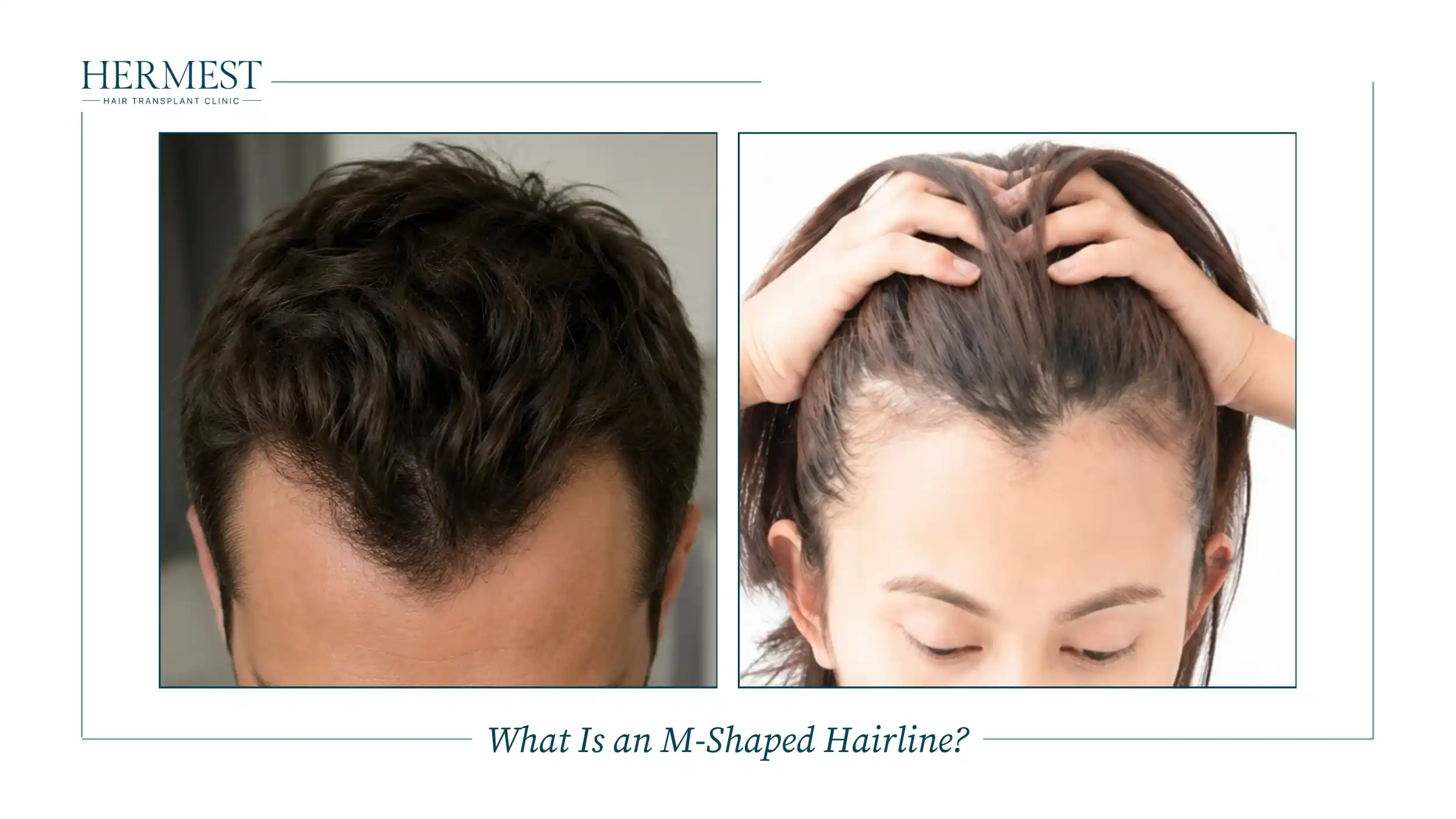
An M hairline usually describes a frontal pattern where the temples recede more noticeably than the center. This creates a shape resembling the letter “M” across the forehead.
The appearance can vary dramatically.
Some men develop only mild temple recession. Others experience deeper corners with visible thinning behind the frontal edge. The shape alone does not automatically confirm baldness.
This is where many become misleading.
Why do the temples recede first?
Temple follicles tend to be more sensitive to DHT, the androgen linked to androgenetic alopecia. Over time, genetically susceptible follicles gradually miniaturize.
The hairs become:
- thinner
- shorter
- weaker
- less pigmented
This often begins around the temporal corners before spreading further.
According to American Academy of Dermatology, male pattern hair loss commonly starts with recession near the temples or thinning at the crown.
That overlap creates confusion between normal maturation and active loss.
Is a widow’s peak the same as an M-shaped pattern?
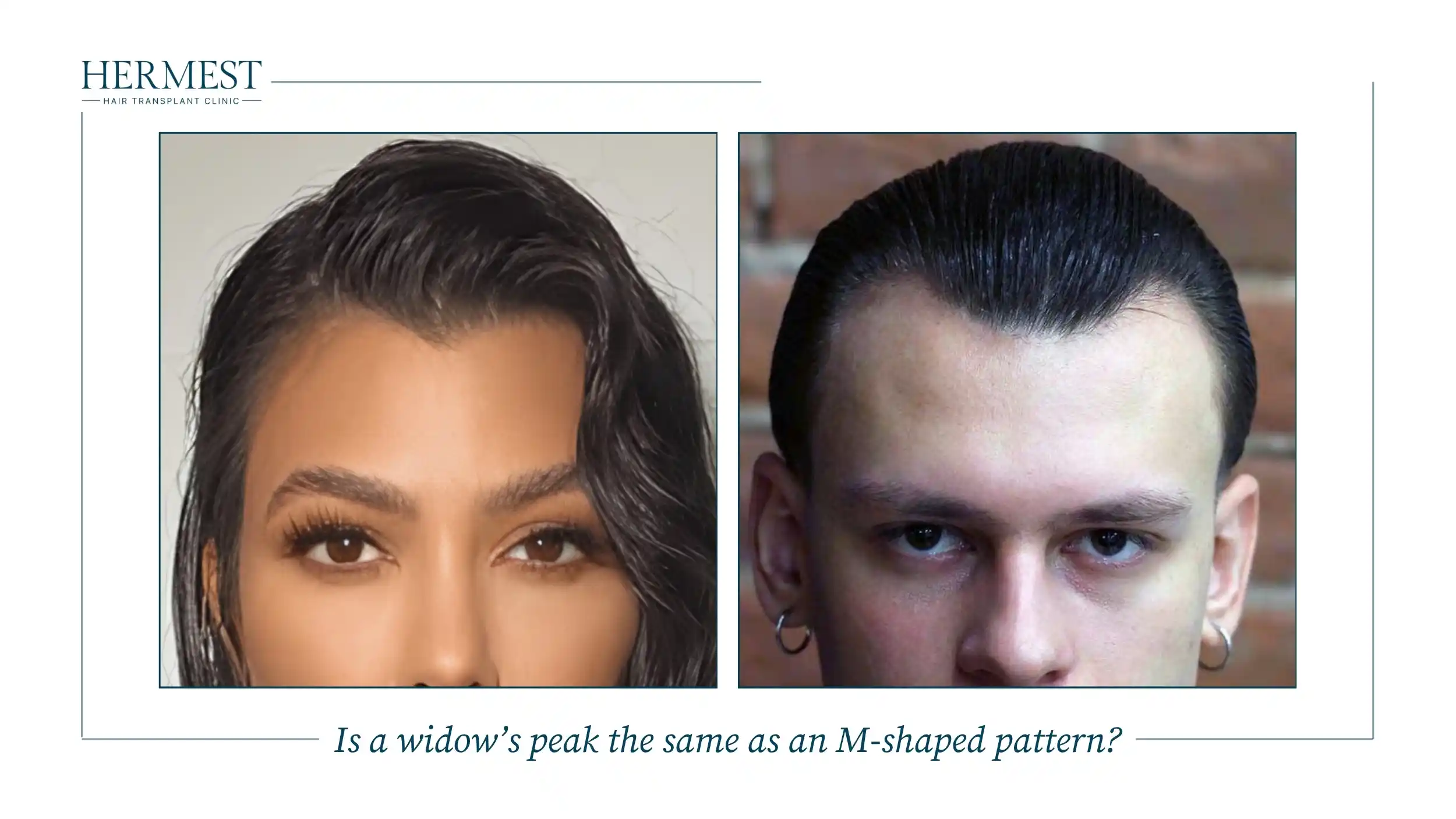
Not necessarily.
A widow’s peak refers to a central point extending lower at the middle of the hairline. Some people naturally have this feature without recession.
An M-shaped hairline male pattern usually involves temple recession creating wider frontal corners.
The two may overlap visually sometimes, but they are not identical concepts.
Can an M-shaped hairline be normal?
Yes. Another major content gap competitors fail to explain clearly.
A stable mature hairline may naturally create a mild M appearance without progressive balding. The important distinction is whether density and recession continue worsening over time.
A mature pattern generally remains:
- relatively stable
- symmetrical
- dense behind the edge
A progressively thinning pattern behaves differently.
Dr. Ahmet Murat says shape alone rarely tells the full story. At Hermest, scalp examination focuses heavily on density quality and miniaturization patterns behind the frontal line instead of judging temple angles alone.
This is why identical-looking hairlines can behave completely differently over several years.
Is an M-Shaped Hairline Always Balding?
No. This is probably the biggest misconception online.
Many men develop mild temporal recession naturally during adulthood without progressing into significant baldness. Others experience aggressive recession beginning from a very similar-looking starting point.
The challenge is recognizing progression early.
What is the difference between a mature and receding pattern?
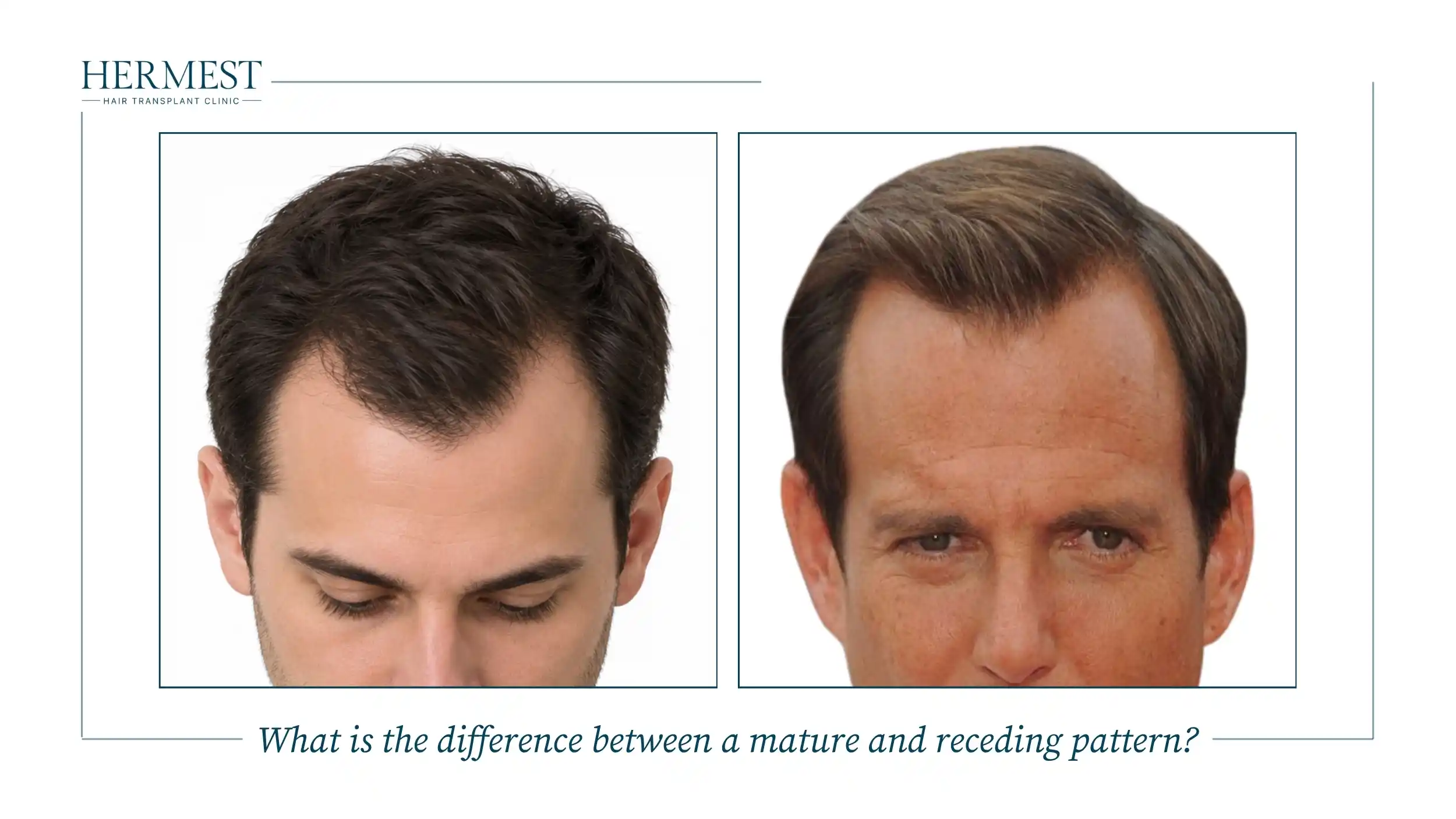
A mature M shaped hairline usually stabilizes after modest temple movement. Density behind the frontal line remains relatively strong.
A receding M hairline often shows:
- ongoing temple deepening
- miniaturized hairs
- thinning behind the edge
- widening scalp visibility
- possible crown involvement
Progression matters more than shape alone.
This nuance is missing across most competitor content.
How does the Norwood scale relate to M-shaped recession?
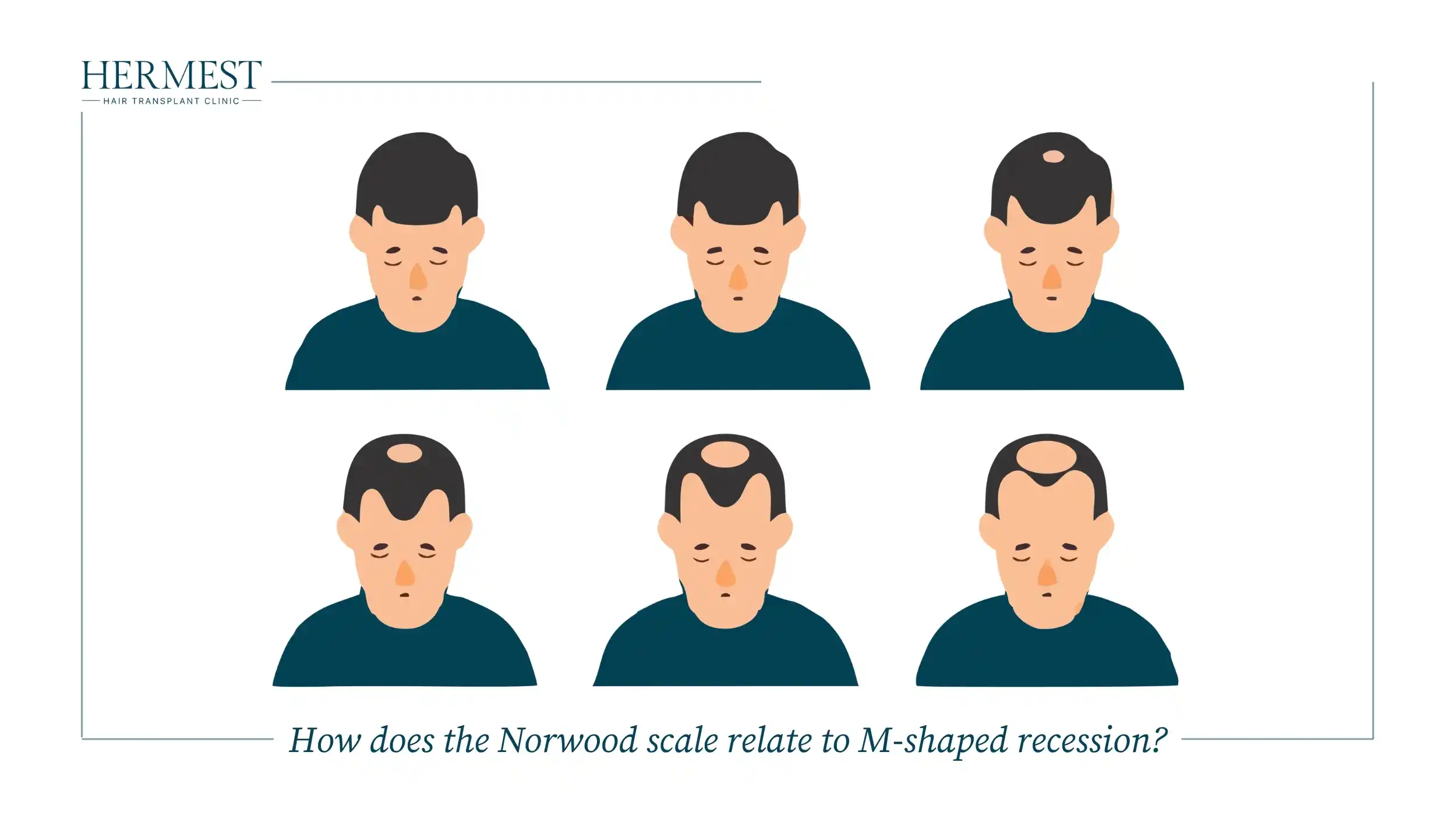
The Norwood scale classifies male pattern hair loss progression. Early Norwood stages frequently involve temple recession forming an M-like appearance.
Still, Norwood numbers do not predict destiny perfectly.
Some men remain stable around Norwood 2 for decades. Others progress steadily into more advanced thinning patterns.
According to British Association of Dermatologists, androgenetic alopecia progression varies significantly depending on genetics and hormonal sensitivity.
That variability frustrates patients understandably.
What signs suggest active progression?
Certain changes deserve closer attention:
- visible thinning behind temples
- increasing recession within months
- crown density loss
- miniaturized short hairs
- stronger family history
At Hermest, patients are usually encouraged to compare standardized photos over time rather than analyzing daily mirror changes emotionally.
Dr. Ahmet Murat says patients often obsess over whether their hairline “looks M-shaped” instead of asking whether it is actively changing. At Hermest, progression tracking becomes more important than labeling the shape itself.
That perspective often reduces unnecessary panic quickly.
What Causes an M-Shaped Hairline?
Most cases of hairline recession come down to genetics and hormone sensitivity. Yet many patients search for simpler explanations first.
Stress. Shampoo. Hats. Hair products.
Those factors may affect scalp condition temporarily, but classic temple recession usually follows a different biological pattern.
How do genetics and DHT influence temple recession?
The main driver behind many M hairline baldness patterns is androgenetic alopecia.
Certain follicles are genetically sensitive to DHT, or dihydrotestosterone. Over time, DHT shortens the hair growth cycle gradually. Affected follicles miniaturize and produce weaker hairs.
This process often starts near the temples first.
According to StatPearls – Androgenetic Alopecia, androgenetic alopecia commonly presents with frontal and bitemporal recession in men.
The progression usually happens slowly. That makes early changes difficult to recognize emotionally.
Can stress cause an M-shaped pattern?

Stress may trigger diffuse shedding temporarily through conditions like telogen effluvium. Still, stress alone rarely creates classic temple recession with progressive miniaturization.
This distinction matters enormously.
Diffuse shedding typically affects broader scalp areas evenly. An M-shaped hairline usually follows recognizable frontal recession patterns linked to follicular sensitivity.
Online discussions often blur these two situations together incorrectly.
Can women develop M-shaped recession too?
Yes, though the pattern may appear differently.
Women sometimes develop temporal thinning or frontal recession related to:
- hormonal shifts
- genetics
- traction hairstyles
- androgen sensitivity
The pattern often appears more diffuse compared to classic male recession.
This topic receives surprisingly little attention online despite strong search demand.
Why do some men recede earlier than others?
Genetics influence timing heavily.
Some men notice changes during their late teens or early twenties. Others maintain stable hairlines for decades.
At Hermest, family history, donor quality, miniaturization patterns, and crown density are all evaluated together during assessment rather than focusing only on the frontal edge.
Dr. Ahmet Murat says patients often search for one single “cause” behind temple recession. In reality, genetic sensitivity, hormonal influence, and long-term progression patterns usually interact gradually over many years.
Hairline changes rarely come from one isolated trigger alone.
How to Tell If Your Hairline Is Receding
This is the question most patients actually want answered.
Not “What is an M-shaped hairline?” But: “Is mine getting worse?”
The answer usually depends on progression, density quality, and time.
Why comparing old photos matters
Memory becomes unreliable with gradual hair changes.
Many men feel certain they are balding aggressively until they compare standardized photos from several years earlier. Others discover obvious progression they underestimated completely.
Lighting changes perception enormously.
For better tracking:
- use dry hair
- compare similar lighting
- keep identical angles
- review photos every few months
Daily mirror checking usually increases anxiety more than accuracy.
What are miniaturized hairs?
Miniaturization is one of the strongest signs of active androgenetic alopecia.
Affected hairs become:
- thinner
- shorter
- lighter
- weaker over time
These fine hairs often appear behind the frontal line before obvious baldness develops.
Competitor articles barely explain this properly.
They focus heavily on hairline shape while ignoring follicle quality behind the edge.
Does crown thinning matter too?
Absolutely.
An isolated mature hairline often remains stable without crown involvement. Temple recession combined with crown thinning raises stronger suspicion for progressive male pattern loss.
This combination matters clinically.
When should you monitor more carefully?
Closer observation becomes worthwhile if you notice:
- rapid temple changes
- widening forehead appearance
- increased scalp visibility
- family history of baldness
- diffuse thinning patterns
Dr. Ahmet Murat says many patients evaluate recession emotionally instead of structurally. At Hermest, the team studies density transitions, miniaturization zones, and donor stability rather than relying on the frontal silhouette alone.
A hairline rarely tells the full story by itself.
Can an M-Shaped Hairline Grow Back?
This is where expectations become complicated.
Some patients hope temple recession can reverse completely with products alone. Others assume nothing can help once the corners start thinning.
Neither extreme is fully accurate.
The possibility of improvement depends largely on:
- progression stage
- follicle miniaturization
- genetics
- treatment consistency
- donor quality
- age
Earlier intervention usually creates more options.
Can minoxidil regrow temple areas?

Minoxidil may help improve density in some patients, especially during earlier stages of recession.
Results vary significantly.
Some men notice:
- thicker miniaturized hairs
- reduced shedding
- partial temple filling
- improved density texture
Others experience minimal frontal response.
This variability gets hidden constantly in marketing-heavy content online.
Temple areas often respond less dramatically than crown regions. Still, stabilization alone may become valuable long term.
Does finasteride help an M-shaped hairline?
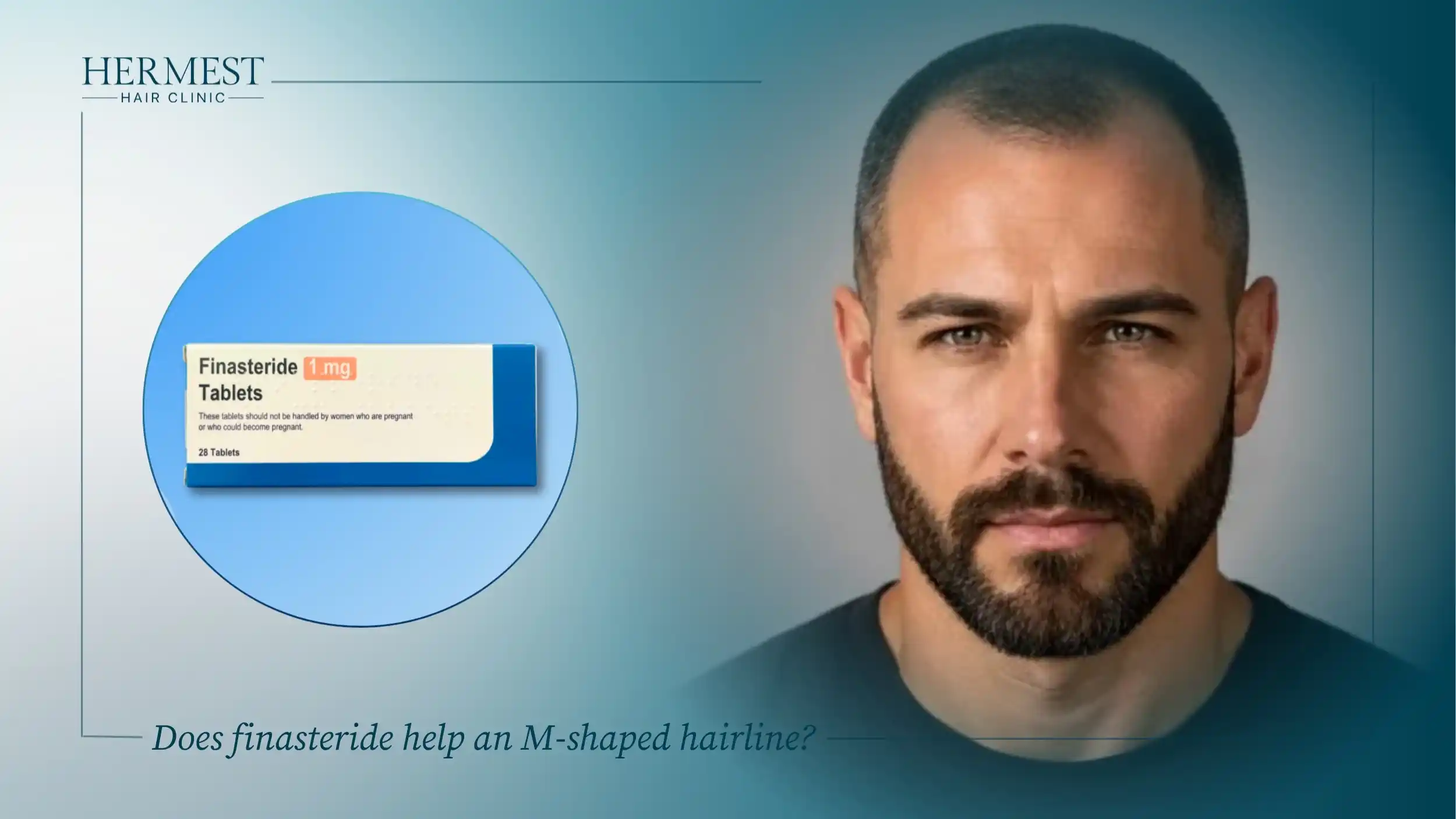
For many men with androgenetic alopecia, finasteride remains one of the most studied medical treatments.
According to FDA information regarding approved hair loss therapies, finasteride works by reducing DHT activity associated with male pattern hair loss progression.
The main goal is usually slowing or stabilizing progression.
Some patients experience visible thickening. Others mainly preserve existing follicles.
Both outcomes can matter clinically.
What about PRP and supportive therapies?
Supportive treatments such as PRP may improve scalp environment and support weakened follicles in selected patients.
At Hermest, regenerative approaches are usually discussed as complementary support rather than miracle reversal methods.
This distinction matters.
When does surgery become more realistic?
If temple recession progresses significantly or follicles become permanently inactive, medications alone may not restore meaningful density.
This is where hair transplant for M-shaped hairline restoration becomes more relevant.
At Hermest, surgical planning focuses heavily on:
- natural temple transitions
- donor preservation
- age-appropriate density
- future recession prediction
Dr. Ahmet Murat says many patients focus entirely on regrowing lost corners while ignoring ongoing progression behind them. At Hermest, stabilization and long-term donor strategy guide treatment decisions before transplantation is planned.
The goal is sustainable naturalness. Not temporary illusion.
Hair Transplant for M-Shaped Hairlines
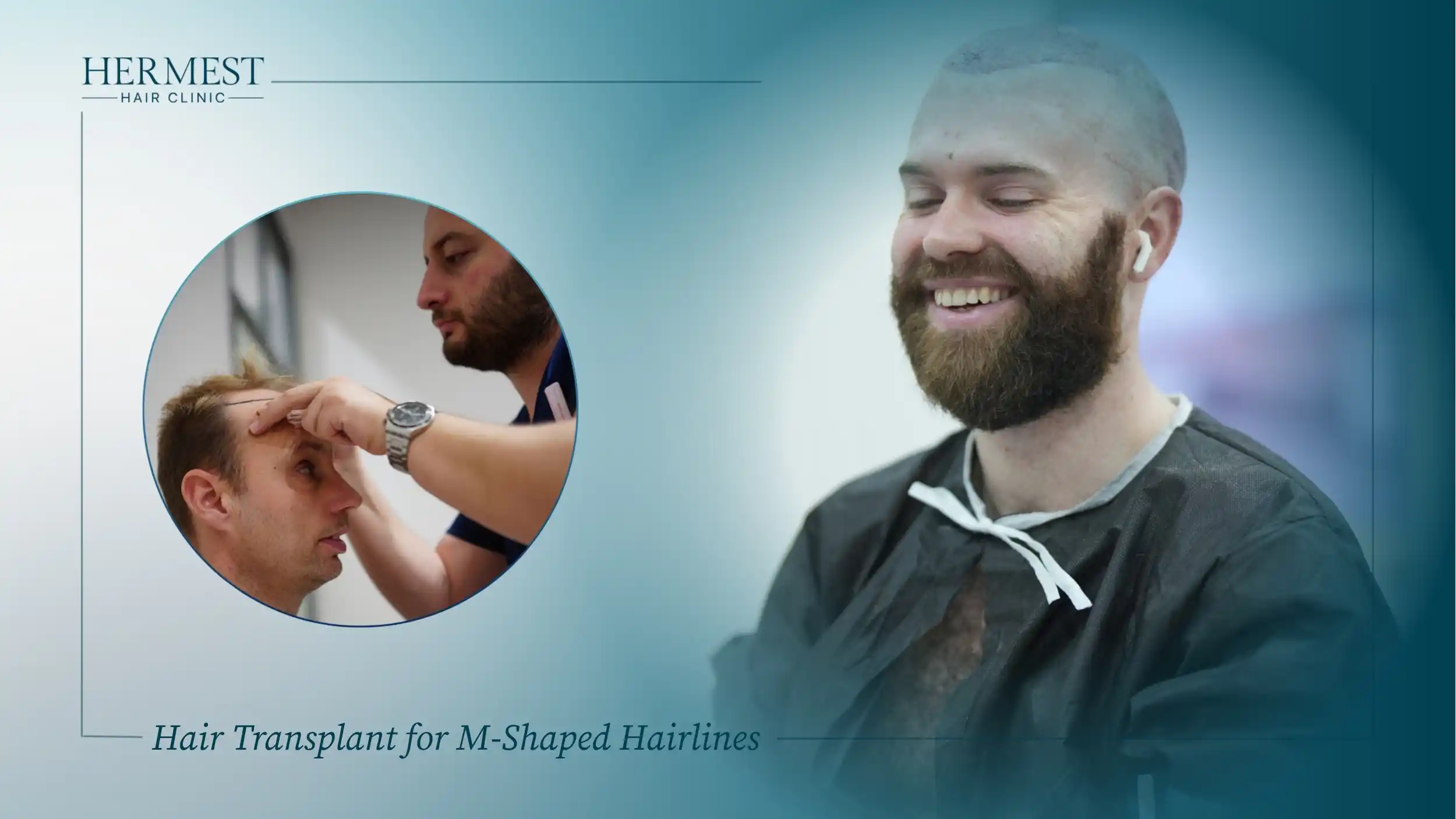
Temple restoration can create dramatic cosmetic improvement when performed carefully. Yet frontal design remains one of the most technically sensitive areas in hair transplantation.
Small mistakes become highly visible.
This is why conservative planning often produces stronger long-term results.
How does temple restoration work?
During hair transplant for M-shaped hairline procedures, follicles are typically harvested from stable donor zones and implanted strategically into recessed temple regions.
The challenge is not simply adding grafts.
Natural temple restoration requires:
- correct angle placement
- irregular density transitions
- soft frontal edges
- age-appropriate design
Straight “wall-like” hairlines usually look artificial quickly.
Why aggressive lowering becomes risky
Another major content gap competitors rarely discuss honestly.
Many younger patients request extremely low frontal designs after seeing edited social media photos. The problem is future progression.
Native hairs may continue thinning over time even after transplantation.
If the frontal design sits unnaturally low:
- donor reserves may become strained
- future blending grows harder
- results may age poorly
This is why long-term planning matters more than immediate density alone.
How Hermest approaches natural hairline design
At Hermest Hair Transplant Clinic, techniques like Unique FUE® emphasize:
- controlled extraction patterns
- donor preservation
- natural angulation
- gradual density transitions
The objective is believable aging, not obvious surgery.
Why donor management matters so much
The donor area remains finite.
Overharvesting during temple work may create visible thinning later, especially in younger patients with progressive androgenetic alopecia.
Dr. Ahmet Murat says the strongest hairline restorations often look understated rather than “perfect.” At Hermest, temple reconstruction is planned according to facial proportions, donor longevity, and likely future recession patterns rather than short-term trends.
Hair transplantation should still look natural years later. That perspective changes everything during planning.
How Hermest Designs Natural Hairlines
Natural hairlines rarely look perfectly symmetrical in real life. They contain subtle irregularities, softer transitions, and gradual density changes that most people never consciously notice.
That realism matters enormously during M-shaped hairline restoration.
Patients often arrive with screenshots of unnaturally straight celebrity-style designs. The challenge is that hyper-dense frontal walls may photograph well temporarily but age poorly over time.
At Hermest, planning focuses more on believability than perfection.
Why age-appropriate design matters
Hairlines change naturally with age.
A hairline that suits someone at 19 may appear unnatural at 45 if surrounding native hairs continue thinning gradually. This becomes especially important for younger patients with active androgenetic alopecia risk.
At Hermest, frontal placement decisions consider:
- facial structure
- forehead proportions
- donor availability
- future recession risk
- long-term density balance
This conservative philosophy often creates stronger long-term outcomes.
How Unique FUE® supports natural results
Techniques like Unique FUE® prioritize controlled graft extraction and strategic implantation patterns.
The focus stays on:
- preserving donor integrity
- minimizing visible extraction patterns
- softening temple transitions
- maintaining natural angulation
Temple angles are especially unforgiving.
Poor implantation direction immediately draws attention in frontal lighting. Competitor articles rarely discuss how technically sensitive these zones actually are.
Why density transitions matter
Another overlooked detail.
Natural hairlines do not jump abruptly from bare skin into thick dense hair. Density increases gradually across the frontal edge.
At Hermest, implantation planning avoids overly sharp borders or repetitive graft patterns that create “pluggy” appearance.
This subtlety changes realism dramatically.
Dr. Ahmet Murat says patients often think density alone creates a natural result. At Hermest, the team pays equal attention to angulation, irregularity, temporal flow, and long-term donor preservation before placing grafts.
A believable hairline usually attracts less attention than an aggressively artificial one.
When Should You See a Hair Specialist?
Not every M hairline requires treatment immediately. Some patterns remain stable for years without meaningful progression.
Still, certain changes deserve professional evaluation earlier rather than later.
Timing influences options.
What signs suggest active progression?
You should monitor more carefully if you notice:
- rapid temple recession
- thinning behind the frontal edge
- visible crown loss
- miniaturized hairs
- increased scalp visibility
- strong family history
Progression matters far more than shape alone.
A stable mature pattern behaves differently from active androgenetic alopecia evolving steadily over time.
Why early evaluation can help
Many patients wait until recession becomes cosmetically advanced before seeking assessment. By then, donor planning sometimes becomes more limited.
Early evaluation may help:
- identify progression patterns
- preserve native follicles longer
- improve long-term strategy
- reduce unnecessary panic
This does not always mean immediate surgery.
At Hermest, many consultations focus first on stabilization and monitoring rather than rushing directly into transplantation.
Can self-diagnosis become misleading?
Very easily.
Online comparisons create enormous confusion. Lighting, hair styling, wetness, and camera angles change perceived density dramatically.
Two similar-looking hairlines may behave completely differently biologically.
According to American Academy of Dermatology, androgenetic alopecia diagnosis often involves evaluating distribution patterns, progression, and follicular miniaturization rather than appearance alone.
When should younger patients seek advice?
Temple recession during the late teens or early twenties deserves thoughtful evaluation, especially with strong family history.
Not panic. Evaluation.
Dr. Ahmet Murat says patients usually regret delayed planning more often than early consultation itself. At Hermest, the goal is understanding long-term progression realistically before deciding whether treatment is necessary.
Clarity often reduces anxiety faster than endless online searching.
FAQs About M-Shaped Hairlines
Yes, sometimes. A mild M-shaped hairline may reflect normal maturation rather than active balding. The important difference is whether recession continues progressing and whether miniaturization appears behind the frontal line.
Concerned About Your M-Shaped Hairline?
A changing hairline does not always mean aggressive balding. At the same time, ongoing temple recession and thinning should not be ignored casually either.
The difficult part is knowing the difference.
At Hermest Hair Clinic, Dr. Ahmet Murat and the team evaluate:
- temple recession patterns
- follicle miniaturization
- donor density
- crown involvement
- long-term progression risk
The focus stays on realistic planning and natural outcomes rather than rushed cosmetic decisions.
Whether you are noticing early temple changes, researching treatments, or considering a hair transplant for M-shaped hairline restoration, a professional assessment can help clarify what is actually happening before progression advances further.
Dr. Ahmet Murat says the strongest hair restoration plans usually begin with understanding future progression instead of reacting emotionally to temporary appearance changes. At Hermest, donor preservation and long-term facial balance remain central during every stage of planning.
You can request a personalized hair analysis with Hermest to learn whether your pattern appears stable, maturing, or actively progressing.