


What Is a Trichologist? Hair & Scalp Specialist Explained
 ChatGPT
 Claude
 Perplexity
 Grok
Grok
 Gemini

Searching what is a trichologist usually happens after months of frustration. The hair keeps shedding. The scalp feels irritated. The density looks thinner in photos. Yet every product, supplement, or viral internet routine seems to promise something different. People want clarity. That is where trichology often enters the conversation.
A trichologist is a hair and scalp specialist trained to evaluate conditions affecting the scalp, hair shaft, and certain forms of hair thinning. Most trichologists are not medical doctors like dermatologists, though their background and certification can vary significantly depending on the country and organization involved.
Many often oversimplify trichologists either as miracle hair experts or dismiss them entirely. Reality sits somewhere between those extremes. According to research published through the International Journal of Trichology and discussions available through PMC / NIH, trichology focuses on the scientific study of hair and scalp disorders, though diagnostic authority and medical scope differ from dermatology.
At Hermest Hair Clinic, many patients arrive unsure whether they need:
- a trichologist
- dermatologist
- hair transplant consultation
- scalp analysis
- medical treatment
- cosmetic guidance
The answer depends on the underlying issue.
Dr. Ahmet Murat says many patients spend months treating the wrong problem because no proper scalp evaluation happened initially. At Hermest, follicle analysis, scalp imaging, and understanding the cause of thinning usually matter more than immediately recommending products or procedures.
This guide explains:
- what trichologists actually do
- how they differ from dermatologists
- what happens during consultations
- which conditions they may help evaluate
- when medical treatment becomes necessary
- how to choose qualified hair specialists carefully
Not every scalp problem requires surgery. Not every thinning pattern is cosmetic either.
Quick Insights
- Trichologists specialize in hair and scalp analysis.
- Most trichologists are not licensed medical doctors.
- Dermatologists handle prescriptions and medical diagnosis.
- Trichoscopy helps evaluate follicles and scalp conditions.
- Proper diagnosis matters before treatment planning.
- Breakage, shedding, and miniaturization require different approaches.
- Ethical specialists explain limitations realistically.
What Is a Trichologist?
A trichologist is a specialist who studies the hair and scalp and evaluates conditions affecting hair growth, shedding, breakage, and scalp health.
The field itself is called trichology.
Many people assume trichologists are automatically medical doctors. Usually, they are not. This becomes one of the biggest misunderstandings online.
What does trichology actually study?
Trichology focuses on:
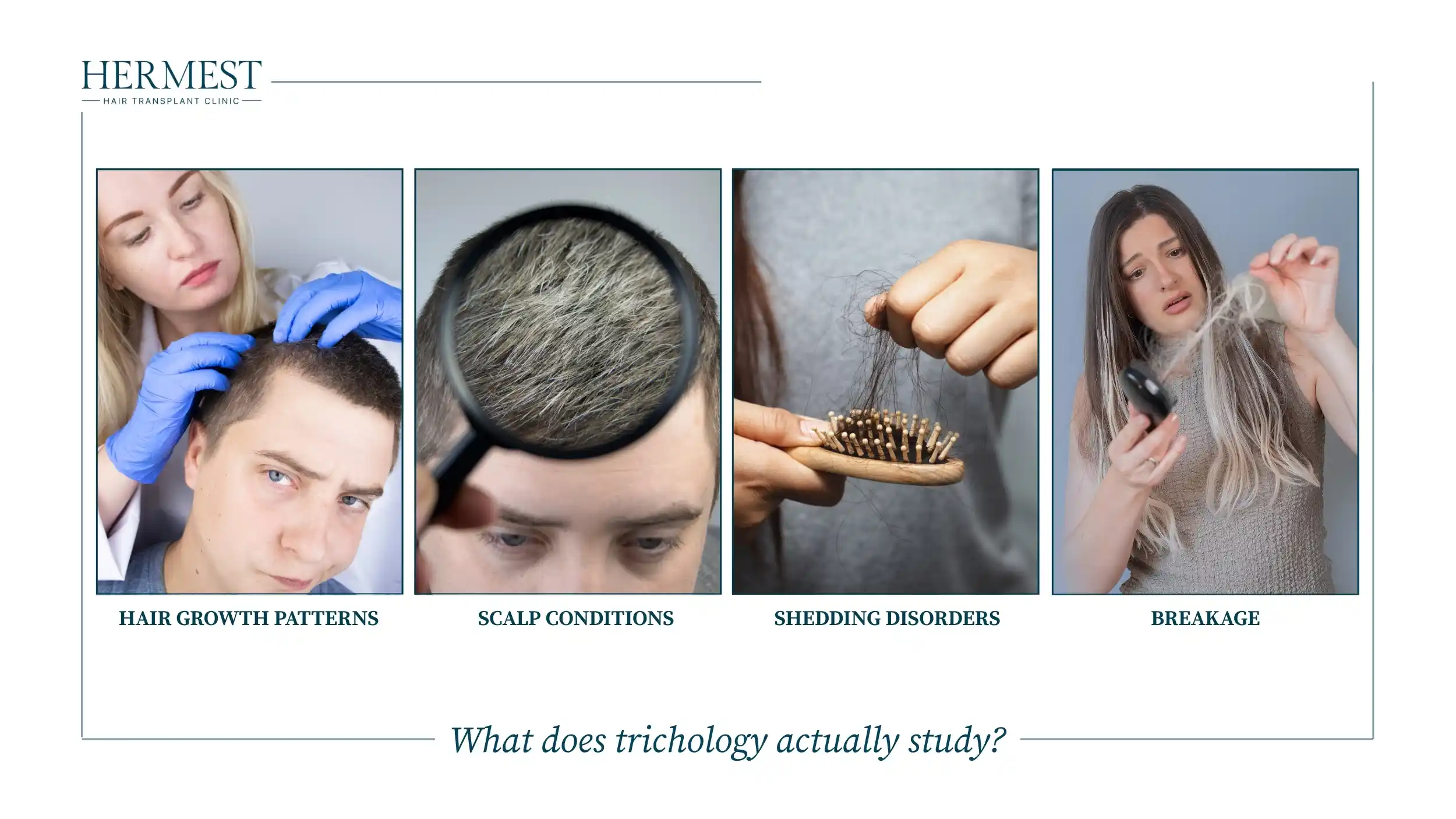
- hair growth patterns
- scalp conditions
- shedding disorders
- breakage
- hair shaft abnormalities
- thinning patterns
A hair and scalp specialist may assess both cosmetic and biological factors contributing to visible hair problems.
This often includes examining:
- scalp inflammation
- follicle miniaturization
- dandruff
- hair density
- shaft fragility
- lifestyle influences
What conditions do trichologists commonly evaluate?
Many trichologists work with patients experiencing:
- diffuse shedding
- early androgenetic alopecia
- telogen effluvium
- scalp irritation
- seborrheic dermatitis
- excessive breakage
According to the American Academy of Dermatology (AAD), hair loss may involve medical, hormonal, inflammatory, nutritional, or genetic causes depending on the individual case.
This complexity explains why proper assessment matters.
Why are qualifications confusing online?
Unlike dermatology, trichology is not regulated identically worldwide. Some trichologists complete structured education through recognized organizations. Others may have limited clinical training depending on the region.
This variation creates confusion for patients searching best trichologist for hair loss online.
At Hermest, patients are encouraged to evaluate:
- training background
- clinical experience
- diagnostic approach
- evidence-based methods
- willingness to refer medically when necessary
rather than trusting marketing language alone.
Why trichology still matters
Good trichologists may help identify patterns patients overlook entirely.
Especially early-stage changes.
Hair problems often look similar superficially while behaving very differently biologically.
Is a Trichologist a Medical Doctor?
Usually, no.
This is probably the most searched and misunderstood question surrounding trichology.
Most trichologists are not physicians and do not hold medical dermatology degrees. Their education often focuses specifically on hair and scalp science rather than full-body medicine.
Still, the situation becomes more nuanced globally.
What is the difference between a trichologist and dermatologist?
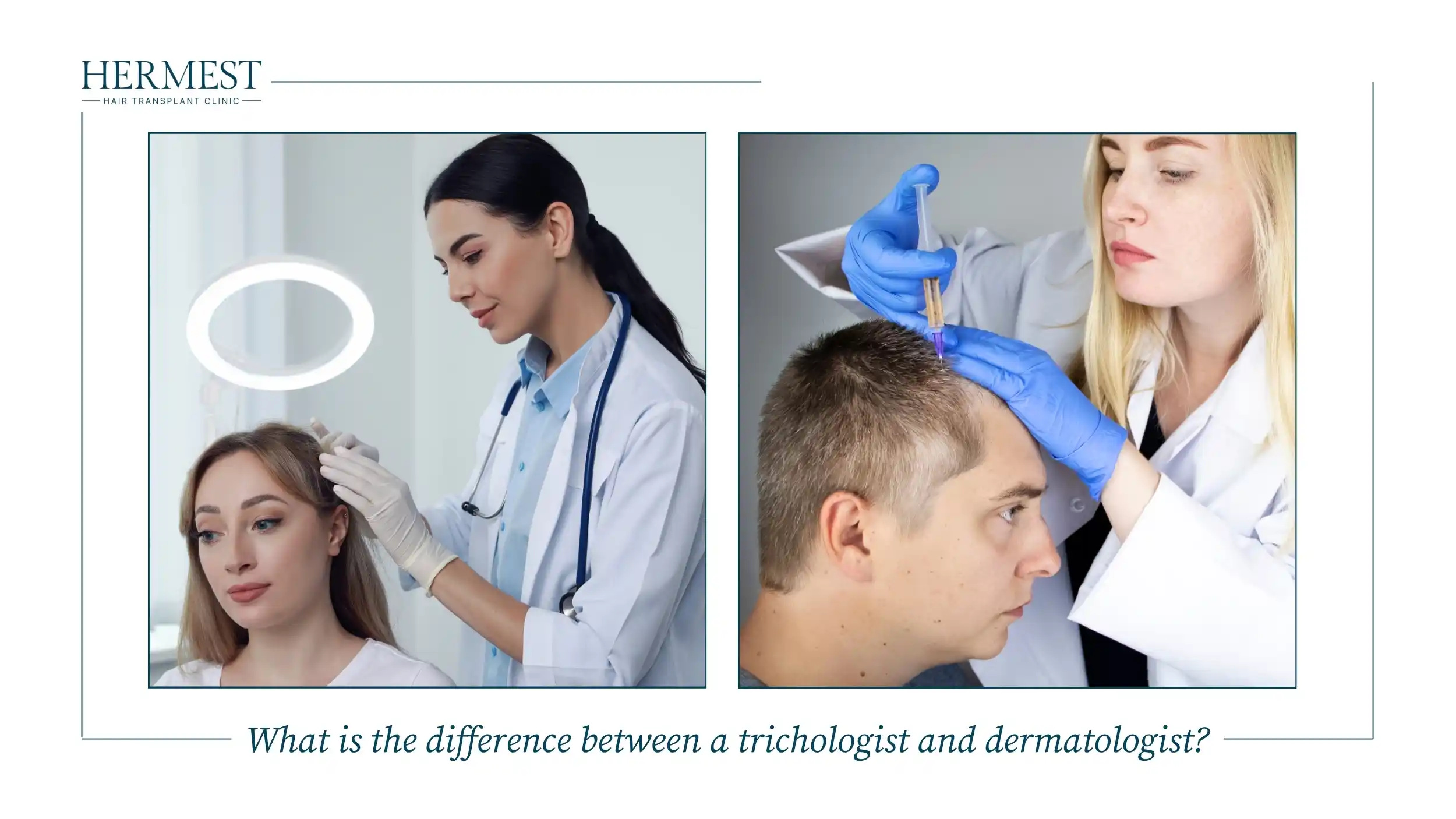
A dermatologist is a licensed medical doctor trained to diagnose and treat skin, hair, nail, and systemic medical conditions.
A certified trichologist typically focuses more narrowly on:
- scalp analysis
- hair behavior
- shedding patterns
- cosmetic hair health
- non-surgical hair concerns
Dermatologists can:
- diagnose medical diseases
- prescribe medication
- order blood tests
- perform biopsies
- treat systemic disorders
Most trichologists cannot legally perform all those functions depending on regional regulations.
Why do qualifications vary internationally?
Another major online confusion point.
Some countries maintain stronger trichology certification structures through organizations like:
- Institute of Trichologists
- World Trichology Society
Still, certification standards differ globally. Two professionals using the title “trichologist” may have very different training backgrounds.
This is why patients should investigate credentials carefully.
When should you see a dermatologist instead?
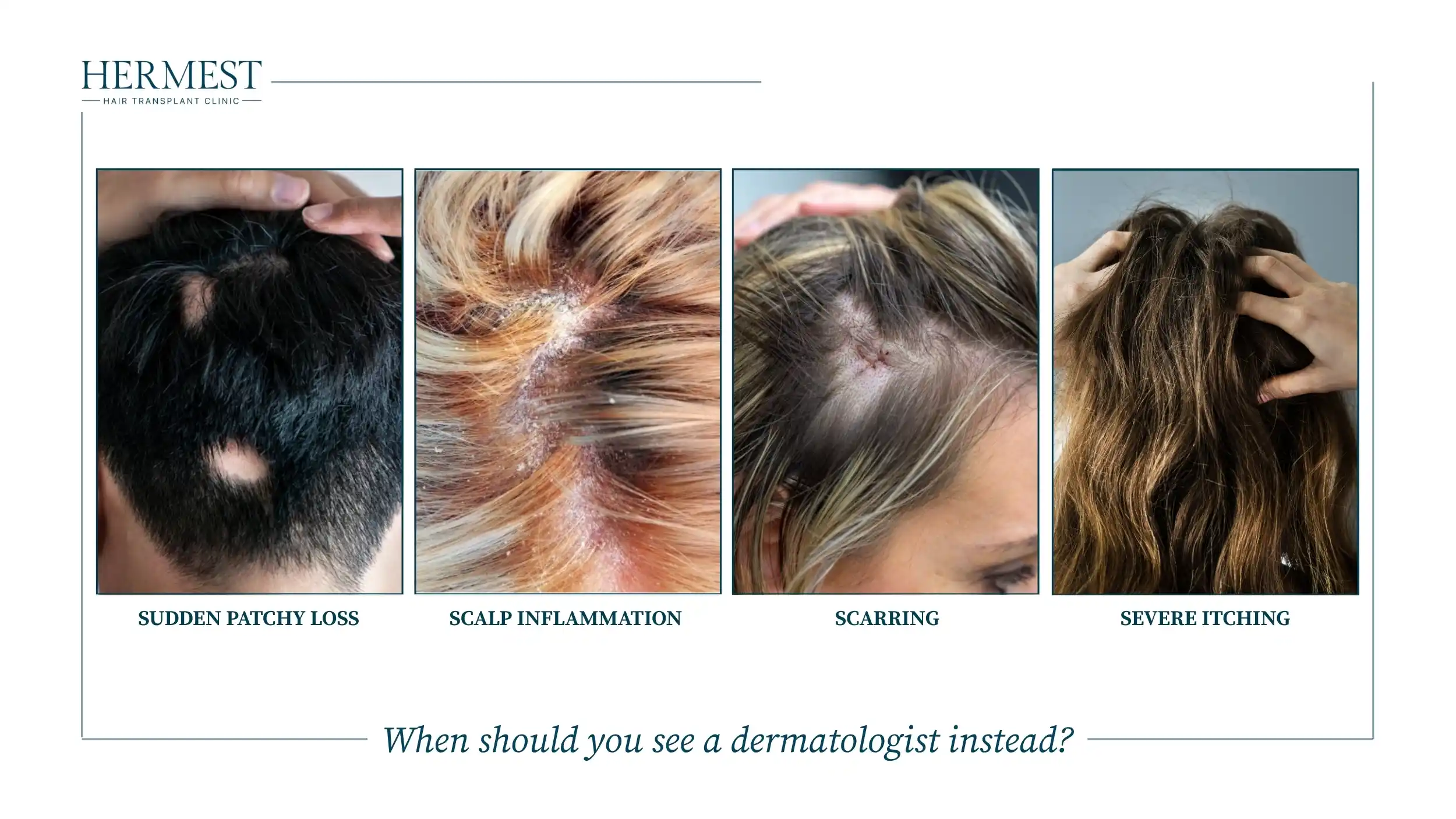
Medical evaluation becomes especially important if you experience:
- sudden patchy loss
- painful scalp inflammation
- scarring
- severe itching
- rapid shedding
- autoimmune suspicion
These situations may require bloodwork, prescription medication, or biopsy evaluation.
Can trichologists and dermatologists work together?
Yes. Often effectively.
At Hermest, scalp imaging and trichology-style evaluation may help identify patterns early before determining whether dermatologic intervention or restoration planning becomes appropriate.
Dr. Ahmet Murat says patients often waste time choosing between “medical” and “cosmetic” approaches when many scalp concerns benefit from collaborative evaluation. At Hermest, follicle analysis and medical referral pathways are integrated whenever necessary.
Good diagnosis matters more than labels alone.
What Does a Trichologist Do?
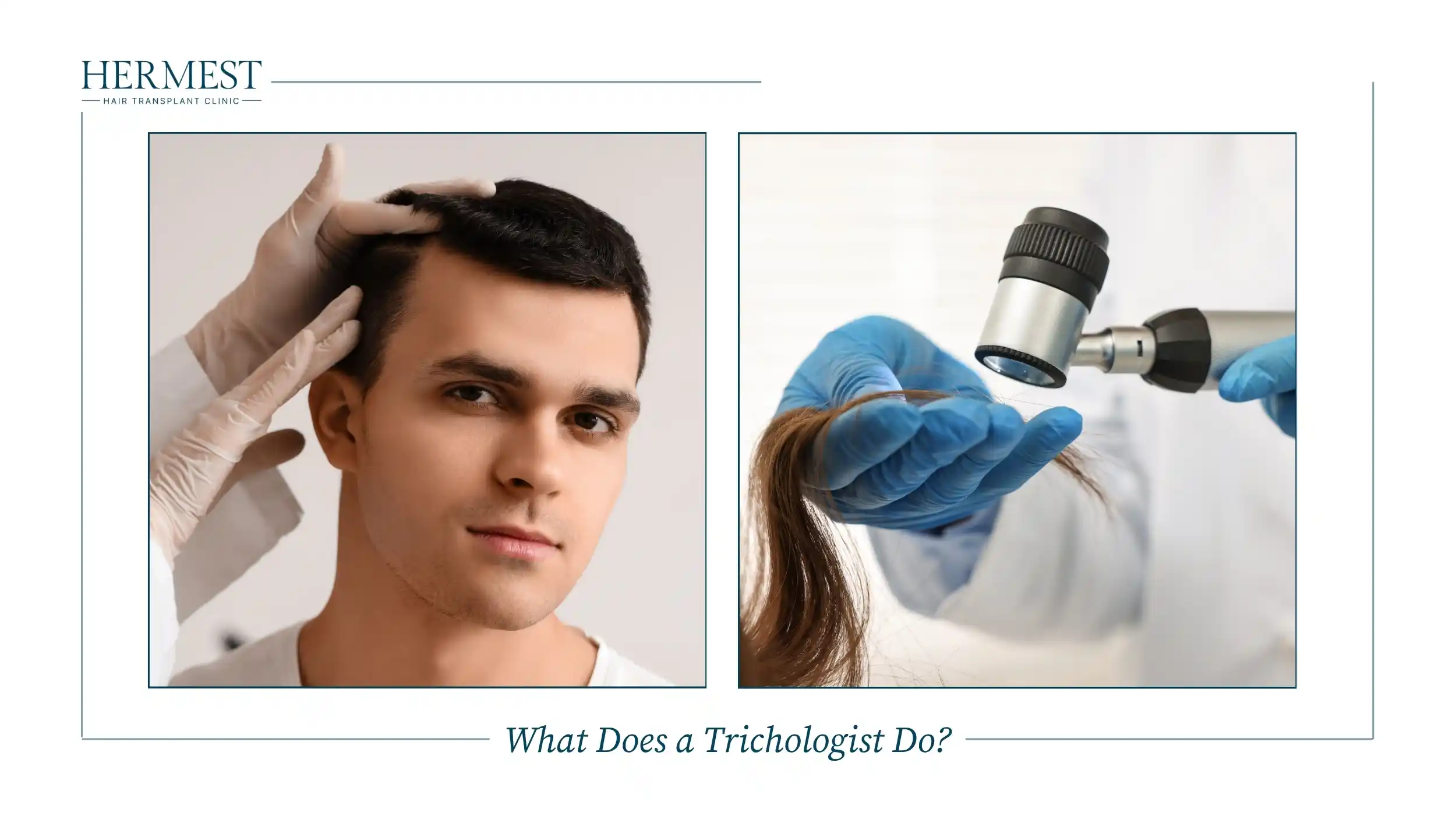
A trichologist’s work usually centers around analyzing the scalp, hair shaft, and visible thinning patterns to understand why the hair is behaving differently.
The process often becomes more investigative than people expect.
Many patients assume a consultation simply involves recommending shampoos. A proper scalp analysis should go much deeper.
How do trichologists evaluate hair loss?
A hair loss specialist may examine:
- shedding patterns
- scalp condition
- follicle density
- miniaturization
- breakage
- hair shaft texture
- inflammation signs
Many use magnified scalp imaging or trichoscopy techniques to inspect follicles and scalp surfaces more closely.
According to research discussed through PMC / NIH, trichoscopy has become an increasingly useful noninvasive method for evaluating various hair and scalp disorders.
This helps distinguish conditions that may appear visually similar initially.
What is trichoscopy?
Trichoscopy involves magnified scalp and follicle examination using specialized imaging tools.
It may help identify:
- follicle miniaturization
- inflammation
- broken hairs
- scaling
- density variation
- hair shaft abnormalities
Many patients think scalp imaging automatically “diagnoses everything”. In reality, imaging supports assessment but does not replace full medical evaluation when systemic disease is suspected.
Do trichologists evaluate lifestyle factors too?
Often yes.
Consultations may include discussion of:
- stress levels
- nutrition
- sleep patterns
- hormonal changes
- styling habits
- chemical treatments
Hair biology rarely exists independently from overall health and lifestyle patterns.
Can trichologists diagnose every hair disorder?
Not always.
Some conditions require:
- bloodwork
- scalp biopsy
- prescription medications
- autoimmune evaluation
Those areas generally fall within dermatologic medicine.
At Hermest, scalp analysis frequently helps separate:
- temporary shedding
- shaft breakage
- inflammatory scalp issues
- androgenetic alopecia progression
before treatment planning begins.
Dr. Ahmet Murat says many patients focus only on visible thinning while ignoring scalp inflammation or ongoing miniaturization underneath. At Hermest, magnified scalp evaluation often reveals progression patterns that are not obvious in normal mirror lighting.
The earlier these patterns become clear, the more options usually remain available.
What Conditions Can a Trichologist Help With?
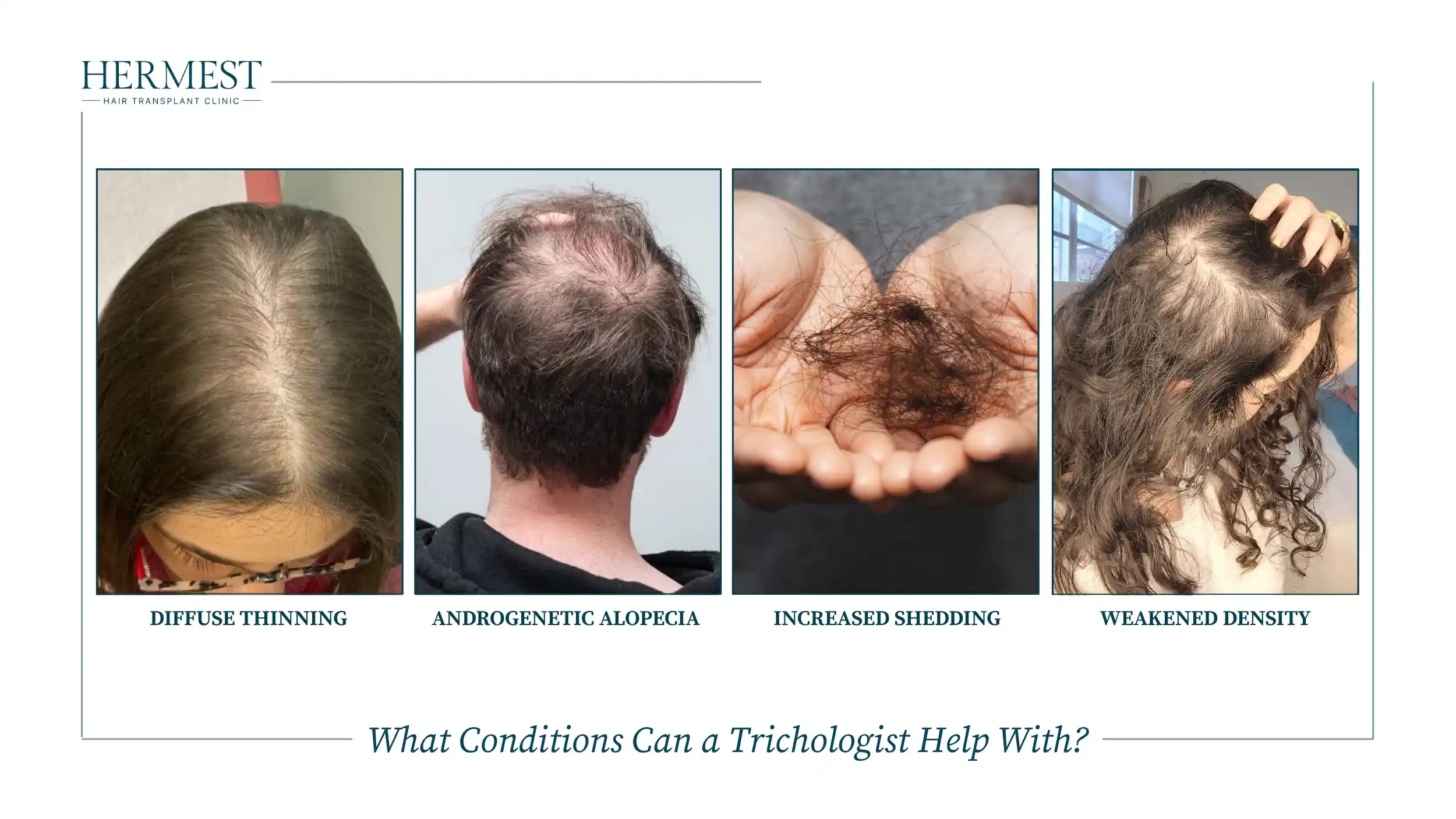
A trichologist may help evaluate many common hair and scalp concerns, especially during earlier or non-scarring stages.
Still, understanding limitations matters.
Not every condition is cosmetic. Not every shedding pattern requires surgery either.
Can trichologists help with hair thinning?
Yes, especially when evaluating:
- diffuse thinning
- early androgenetic alopecia
- increased shedding
- weakened density
- hair shaft fragility
Many patients searching trichologist for hair thinning mainly want to understand whether their loss appears temporary, progressive, or damage-related.
That distinction changes treatment planning significantly.
What is telogen effluvium?
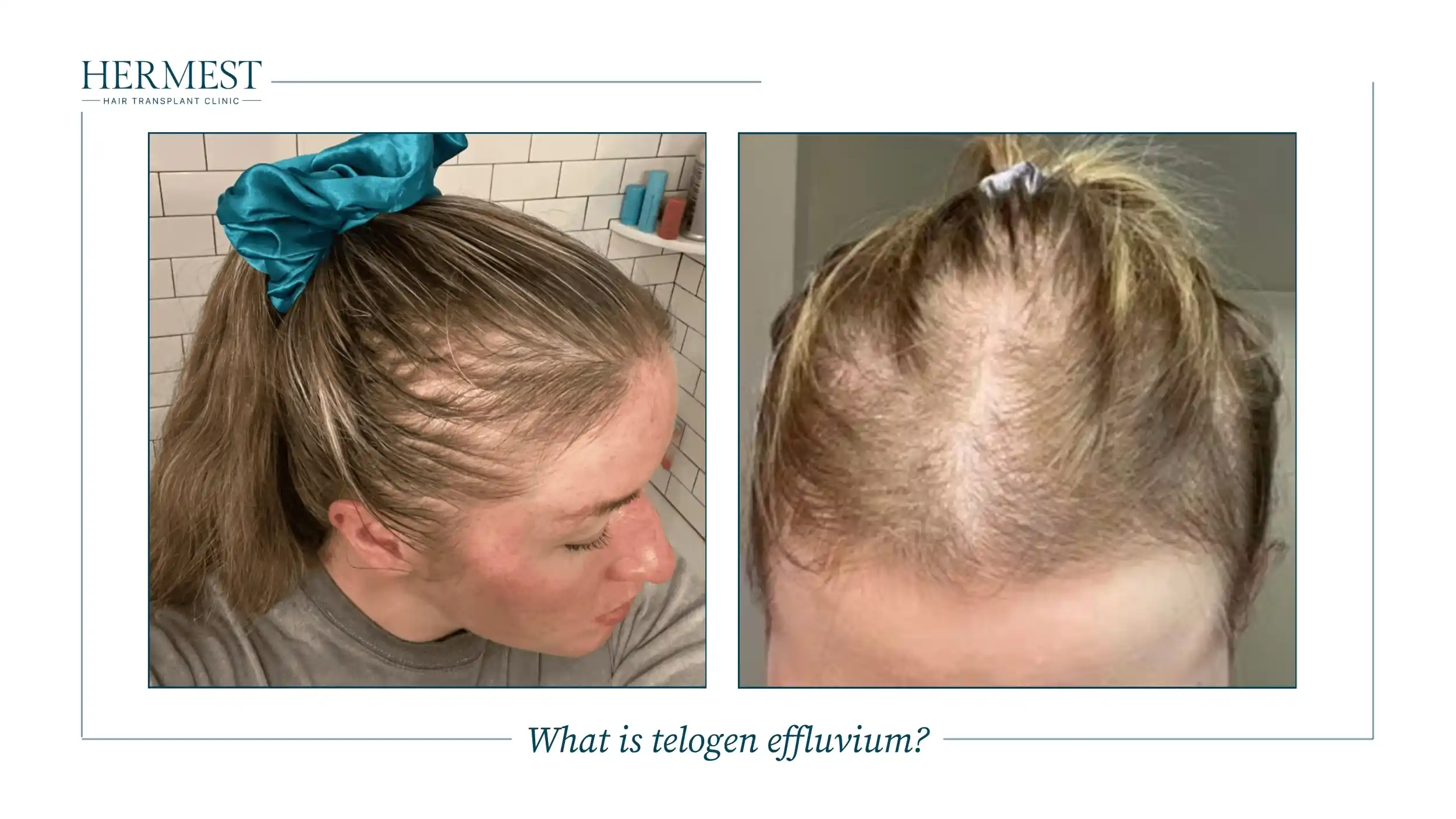
Telogen effluvium is a temporary shedding condition often triggered by:
- stress
- illness
- surgery
- hormonal shifts
- nutritional deficiencies
Patients commonly notice sudden diffuse shedding several weeks or months after the triggering event.
According to American Academy of Dermatology (AAD), telogen effluvium usually differs from androgenetic alopecia because follicles often remain capable of recovery once triggers improve.
Can trichologists evaluate dandruff and scalp irritation?
Often yes.
Scalp conditions such as:
- seborrheic dermatitis
- buildup
- irritation
- excessive oiliness
- flaking
may influence scalp comfort and hair quality significantly.
Chronic inflammation may worsen shedding or breakage indirectly even when permanent baldness is not occurring.
What about breakage and damaged hair?
Trichologists commonly assess:
- heat damage
- chemical overprocessing
- shaft fragility
- excessive breakage
- traction-related damage
At Hermest, evaluating shaft integrity separately from follicle activity helps prevent patients from mistaking cosmetic breakage for permanent hair loss.
When is medical referral necessary?
Medical referral becomes more important if symptoms involve:
- scarring
- painful inflammation
- patchy loss
- autoimmune suspicion
- severe rapid progression
Dr. Ahmet Murat says many scalp conditions overlap visually during early stages. At Hermest, identifying whether the issue involves breakage, inflammation, shedding, or follicular miniaturization usually determines whether restorative, medical, or supportive treatment becomes appropriate.
Hair problems rarely fit one single category perfectly.
What Happens During a Trichology Consultation?
Many patients arrive feeling nervous before their first consultation. They expect judgment about their hair habits or immediate pressure toward treatments.
A proper evaluation should feel much more investigative than sales-driven.
The goal is understanding why the hair or scalp changed.
What information gets reviewed first?
Most consultations begin with a detailed history covering:
- shedding timeline
- family history
- medical background
- stress exposure
- hormonal changes
- nutrition
- medications
- styling habits
This step matters more than many patients realize.
Hair loss patterns often connect to events occurring months earlier rather than immediate triggers.
How does scalp imaging work?
Many specialists use magnified imaging or trichoscopy during evaluation.
This may help identify:
- follicle miniaturization
- density variation
- inflammation
- scaling
- breakage
- shaft abnormalities
According to research discussed through the International Journal of Trichology, trichoscopy has become increasingly valuable for noninvasive hair and scalp assessment.
Still, imaging alone does not diagnose every condition completely.
What happens after scalp analysis?
The next step usually involves determining whether the pattern appears related to:
- androgenetic alopecia
- telogen effluvium
- breakage
- inflammatory scalp conditions
- traction damage
- cosmetic issues
Some patients may need:
- dermatology referral
- bloodwork
- medical therapy
- lifestyle adjustments
- transplant evaluation
- supportive scalp care
The recommendations should match the biology rather than following generic protocols.
How long does a consultation usually take?
Many consultations last between 30 and 60 minutes depending on complexity and imaging depth.
At Hermest, scalp assessment often includes evaluating:
- donor quality
- miniaturization
- scalp health
- density transitions
- progression risk
before discussing possible treatments.
Dr. Ahmet Murat says patients often expect immediate answers within minutes, but proper scalp analysis requires understanding patterns, history, and progression together. At Hermest, treatment planning begins only after identifying what the follicles are actually doing biologically.
Good evaluation often prevents unnecessary treatments later.
Trichologist vs Dermatologist: Which One Should You See?
This question creates enormous confusion online.
Some portray trichologists as replacements for dermatologists. Others dismiss trichology entirely. Neither perspective is completely accurate.
The better answer depends on the underlying scalp condition.
| Aspect | Trichologist | Dermatologist |
|---|---|---|
| Medical doctor? | Usually no | Yes (licensed physician) |
| Main focus | Hair & scalp analysis, shedding patterns, cosmetic hair health | Skin, hair, nail & systemic conditions |
| Prescribe medication | No (most countries) | Yes |
| Order blood tests | No | Yes |
| Perform biopsies | No | Yes |
| Diagnose systemic disease | No | Yes |
| Scalp imaging / trichoscopy | Yes | Yes |
| Best suited for | Early thinning, shedding, breakage, scalp irritation, dandruff, density concerns | Scarring, patchy loss, autoimmune suspicion, infection, prescription needs |
When can a trichologist help?
A scalp specialist or trichologist may help evaluate:
- early thinning
- increased shedding
- breakage
- scalp irritation
- dandruff
- hair care damage
- density concerns
For many patients, scalp imaging and structured hair analysis provide useful clarity early.
Especially when the issue appears non-scarring or cosmetic initially.
When is a dermatologist necessary?
Medical dermatology becomes more important when symptoms involve:
- painful inflammation
- scarring
- patchy bald spots
- autoimmune suspicion
- infection
- severe rapid shedding
- prescription treatment needs
Dermatologists can:
- prescribe medications
- order blood tests
- perform biopsies
- diagnose systemic diseases
Most trichologists cannot legally perform all those functions depending on regional regulations.
Can both specialists work together?
Yes. Often very effectively.
Patients think they must choose one side completely.
At Hermest, scalp analysis frequently works alongside dermatologic evaluation when:
- inflammation appears significant
- advanced miniaturization exists
- medical treatment becomes necessary
- transplantation planning requires stabilization first
Which professional is better for hair loss?
There is no universal answer.
Some patients mainly need:
- scalp care
- shedding evaluation
- breakage management
- cosmetic guidance
Others require:
- prescription therapy
- autoimmune workup
- medical diagnosis
- surgical planning
Dr. Ahmet Murat says successful hair restoration often begins with understanding whether the problem is cosmetic, inflammatory, hormonal, genetic, or medical. At Hermest, collaboration between scalp analysis and medical evaluation helps avoid treating symptoms blindly.
The right diagnosis matters more than the title alone.
Can Trichologists Prescribe Medication?
Usually, no.
This is another area where online information becomes confusing quickly. Many patients assume a certified trichologist automatically functions like a medical dermatologist.
In most countries, that is not the case.
Why can’t most trichologists prescribe medication?
Prescription authority generally belongs to licensed medical doctors.
Dermatologists and physicians can prescribe:
- finasteride
- corticosteroids
- antifungal medications
- oral treatments
- certain anti-inflammatory therapies
Most trichologists cannot legally prescribe these medications unless they also hold medical qualifications separately.
This distinction matters for patient safety.
Are there exceptions internationally?
Sometimes yes.
Qualification structures and healthcare regulations differ globally. Some practitioners combine:
- trichology education
- dermatology training
- cosmetic medicine
- hair restoration expertise
This overlap creates confusion online when patients search scalp and hair doctor or trichologist vs dermatologist for hair loss.
The title alone does not always reveal the practitioner’s medical authority clearly.
What can trichologists still recommend?
Many trichologists may still advise on:
- scalp care
- supportive products
- hair handling habits
- nutritional considerations
- lifestyle factors
- cosmetic management strategies
Some may recommend seeking dermatologic evaluation if medical treatment appears necessary.
Why medical diagnosis still matters
Certain conditions require medical intervention quickly, including:
- scarring alopecia
- autoimmune disorders
- severe inflammatory scalp disease
- sudden patchy hair loss
Delaying proper medical care may worsen outcomes in some situations.
At Hermest, scalp evaluation helps determine whether:
- supportive care
- dermatologic referral
- medical stabilization
- regenerative therapies
- transplant planning
should become the next step.
Dr. Ahmet Murat says patients should always understand who is evaluating their scalp medically versus cosmetically. At Hermest, identifying when medical treatment or dermatology involvement becomes necessary is considered part of responsible hair restoration planning.
Clear diagnosis protects patients from wasting both time and donor resources unnecessarily.
How to Choose a Good Trichologist
Not all trichologists have identical training, experience, or diagnostic quality.
This becomes one of the biggest challenges for patients researching hair loss online. Marketing language can sound convincing even when clinical understanding remains limited.
Careful evaluation matters.
Which qualifications should you look for?
A reputable trichologist should ideally demonstrate:
- structured education
- recognized certification
- clinical experience
- evidence-based methods
- transparent limitations
- willingness to refer medically
Organizations such as:
- Institute of Trichologists
- World Trichology Society
may provide educational frameworks, though standards still vary internationally.
What are major red flags?
Patients should be cautious if someone:
- guarantees regrowth
- promises instant reversal
- discourages medical evaluation entirely
- pushes expensive products aggressively
- diagnoses everything visually within minutes
- avoids discussing limitations
Many clinics blur cosmetic consultation and medical diagnosis together without clarification.
Why evidence-based evaluation matters
Good scalp analysis should involve:
- detailed history review
- progression assessment
- scalp imaging
- density evaluation
- realistic treatment planning
Hair loss rarely follows one universal pattern.
At Hermest, evaluating:
- miniaturization
- donor quality
- inflammation
- breakage
- scalp condition
helps separate cosmetic concerns from progressive follicular disorders more accurately.
Why realistic expectations matter
No ethical specialist should promise unlimited regrowth.
Some conditions improve substantially. Others mainly stabilize. Some require long-term management instead of permanent reversal.
Dr. Ahmet Murat says patients often focus on persuasive marketing instead of diagnostic quality. At Hermest, realistic explanations, proper scalp analysis, and identifying the underlying cause matter far more than exaggerated promises or trend-driven treatments.
Trust should come from clarity, not hype.
Dr. Ahmet Murat’s Perspective on Hair Loss Evaluation
Many patients begin searching for answers only after visible thinning becomes emotionally stressful. By then, they may already have tried:
- supplements
- oils
- shampoos
- internet routines
- social media trends
without understanding what is actually happening biologically.
This delays proper diagnosis frequently.
Why identifying the cause matters first
Hair loss is not one single condition.
Different patients may experience:
- androgenetic alopecia
- telogen effluvium
- breakage
- inflammatory scalp disorders
- traction-related damage
- diffuse thinning
These patterns require completely different management strategies.
At Hermest, evaluation begins with understanding:
- progression speed
- follicle behavior
- miniaturization
- scalp health
- donor stability
before discussing treatments.
Why scalp imaging helps
Magnified scalp analysis may reveal early changes patients cannot easily detect themselves.
This can include:
- follicle miniaturization
- density variation
- inflammation
- scalp scaling
- shaft fragility
Early identification often creates more treatment flexibility later.
Why breakage and miniaturization get confused
Patients commonly mistake:
- shaft breakage
- temporary shedding
- diffuse stress loss
- cosmetic thinning
for permanent baldness immediately.
At Hermest, separating follicular loss from cosmetic fiber damage becomes one of the most important parts of scalp evaluation.
Why long-term planning matters
Aggressive treatments without proper diagnosis may waste:
- money
- time
- donor resources
- emotional energy
Dr. Ahmet Murat says successful hair restoration starts with understanding whether follicles are miniaturizing, shedding temporarily, inflamed, or structurally damaged. At Hermest, treatment planning focuses on preserving long-term scalp and follicle health rather than reacting emotionally to temporary appearance changes.
Good diagnosis usually changes the entire treatment direction.
FAQs About Trichologists
A trichologist is a hair and scalp specialist trained to evaluate conditions involving hair thinning, shedding, scalp irritation, breakage, and certain scalp disorders. Most trichologists are not medical doctors.
Concerned About Hair Thinning or Scalp Problems?
Hair shedding, irritation, miniaturization, and breakage can look surprisingly similar at first. Treating the wrong condition may delay proper recovery and waste valuable time.

At Hermest Hair Clinic, Dr. Ahmet Murat and the team evaluate:
- scalp condition
- follicle miniaturization
- density patterns
- inflammation
- breakage
- donor quality
- progression risk
The goal is understanding what is actually happening biologically before recommending products, medications, regenerative therapies, or hair transplantation.
Dr. Ahmet Murat says many patients spend months chasing internet trends when the real need is proper scalp evaluation and long-term planning. At Hermest, protecting follicle health early usually creates more treatment flexibility later.
If you are experiencing thinning, excessive shedding, scalp discomfort, or visible density changes, you can request a professional scalp and hair analysis with the Hermest team.