

How to Tell If Your Hairline Is Receding: Early Signs
 ChatGPT
 Claude
 Perplexity
 Grok
 Gemini

Wondering how to tell if your hairline is receding often starts with one photograph. Your temples suddenly look higher, your forehead seems larger, or small hairs around the frontal edge appear thinner than you remember. That doesn’t automatically mean you’re going bald.
Natural hairlines vary considerably. Some people have a naturally high hairline, pronounced widow’s peak, uneven temples, or an M-shaped hairline without progressive hair loss. What matters more is whether your hairline is actually changing.
A receding hairline usually develops gradually. The temples may move backward, frontal corners can deepen, and density around the hairline may decline. Individual hairs can become progressively finer through follicular miniaturization.
According to the American Academy of Dermatology, hereditary hair loss in men commonly produces a receding hairline or thinning around the crown. It often develops slowly, potentially progressing over years.
This makes comparison more useful than inspection. Photos taken months or years apart can reveal hairline recession that isn’t obvious when checking the mirror every morning. Consistent lighting, hairstyle, camera distance, and angles make those comparisons more reliable.
Small or short hairs deserve similar caution. Baby hairs around the hairline might represent new growth, breakage, naturally fine hairs, or miniaturized follicles. Appearance alone can’t reliably separate them.
This guide will show you how to know if your hairline is receding, how to compare a mature hairline with a receding hairline, what temple miniaturization looks like, how the Norwood scale works, and when professional assessment makes sense.
Quick Insights
- Receding temples, deeper frontal corners, reduced frontal density, and increasingly fine hairs can be early signs of recession.
- The strongest clue is change over time. The American Academy of Dermatology describes a receding hairline that becomes more visible with passing years as a common sign of gradual hair loss.
- Take standardized photographs every few months using similar lighting, hairstyle, camera distance, and angles.
- Don’t rely on forehead measurements or the popular wrinkle test. There is no universal forehead-to-hairline distance that diagnoses androgenetic alopecia.
- Short baby hairs around the hairline don’t automatically mean miniaturization. They may represent new growth, naturally fine hair, breakage, or miniaturized follicles.
- Hair shedding and hairline recession aren’t the same thing. Losing approximately 50 to 100 hairs daily can fall within normal shedding.
- Trichoscopy can help identify hairline miniaturization by examining hair-shaft thickness and other follicular characteristics. DermNet describes progressive reductions in hair diameter, length, and pigmentation in androgenetic alopecia.
- Not every receding pattern represents male pattern baldness. Traction alopecia and frontal fibrosing alopecia can affect the frontal hairline too. FFA can permanently destroy follicles.
- Early diagnosis can preserve more native hair. AAD reports that hereditary hair-loss treatments tend to perform better when started soon after loss becomes noticeable.
- A hair transplant may restore areas where recession is established, but surgery doesn’t stop surrounding native hair from continuing to thin.
How to Tell If Your Hairline Is Receding

The clearest way to identify hairline recession is to look for progressive change rather than judging one mirror image. A naturally high, uneven, or M-shaped hairline isn’t enough to establish hair loss. Real recession develops over time.
The American Academy of Dermatology lists a receding hairline that becomes more noticeable each year among the gradual signs of hair loss. In men, hereditary hair loss often first appears as frontal recession or a bald spot near the crown.
What Are the First Signs of a Receding Hairline?
Early changes can be subtle. You may notice:
- your temples gradually moving farther backward
- deeper corners developing on either side
- reduced density immediately behind the frontal edge
- increasingly fine or short hairs around the temples
- an M-shaped hairline becoming more pronounced
You don’t need all these signs. Progression may begin primarily around one area. Male pattern hair loss typically develops slowly and can continue for years.
Change Over Time Matters More Than Hairline Shape
This is one of the most useful distinctions. Someone can have prominent temples or a widow’s peak from adolescence and maintain virtually the same hairline for decades. That isn’t the same as watching the frontal corners progressively retreat.
Think of hairline movement, not simply hairline position.
Dr. Ahmet Murat says:When patients ask whether their hairline is receding, I first want to know what has changed. A naturally high or M-shaped hairline isn’t enough. Progressive temple recession, declining density, and increasingly miniaturized hairs provide much stronger clues.
Another useful clue is density behind the edge. With androgenetic alopecia, inherited susceptibility causes follicles to shrink progressively.
Don’t rely on daily mirror checks. Hair length, styling, wetness, camera lenses, and overhead lighting can dramatically change how your temples appear. Standardized photographs taken months apart provide a much better comparison.
What Does a Receding Hairline Look Like?

A receding hairline usually develops gradually rather than disappearing evenly across the forehead. The first visible changes often appear around the temples and frontal corners.
In male pattern hair loss, this pattern reflects progressive follicular miniaturization. DermNet describes androgenetic alopecia as producing frontotemporal recession, with hairs gradually becoming shorter and finer.
Temple Recession
Receding temples are among the most recognizable early changes. The frontal corners may move backward, exposing more skin between the forehead and temporal hair. You might notice that hairstyles which once covered the corners no longer do so easily.
Look for progression rather than a fixed temple shape.
M-Shaped Hairline
As both temples retreat and central frontal hair remains farther forward, the hairline can develop an M-shaped appearance. An M shape alone doesn’t prove you’re balding.
Some people naturally have pronounced frontal corners or a widow’s peak. Concern increases when the M shape becomes progressively deeper and hair density around its edges declines.
Frontal Hairline Thinning
Recession doesn’t always mean a clean line moving backward. Sometimes the frontal edge becomes less defined first. Strong terminal hairs are gradually replaced by finer, shorter hairs through hairline miniaturization.
The American Academy of Dermatology explains that hereditary hair loss causes genetically susceptible follicles to shrink and eventually stop producing hair.
Can One Side Recede Faster Than the Other?
Yes. Your hairline doesn’t need to look perfectly symmetrical during every stage of recession. Slight natural asymmetry is common too. A higher right or left temple by itself isn’t enough to diagnose male pattern baldness.
One more area deserves checking: the crown. The AAD notes that male hereditary hair loss can involve the hairline, scalp top, crown, or a combination of these areas.
How to Check Your Hairline at Home
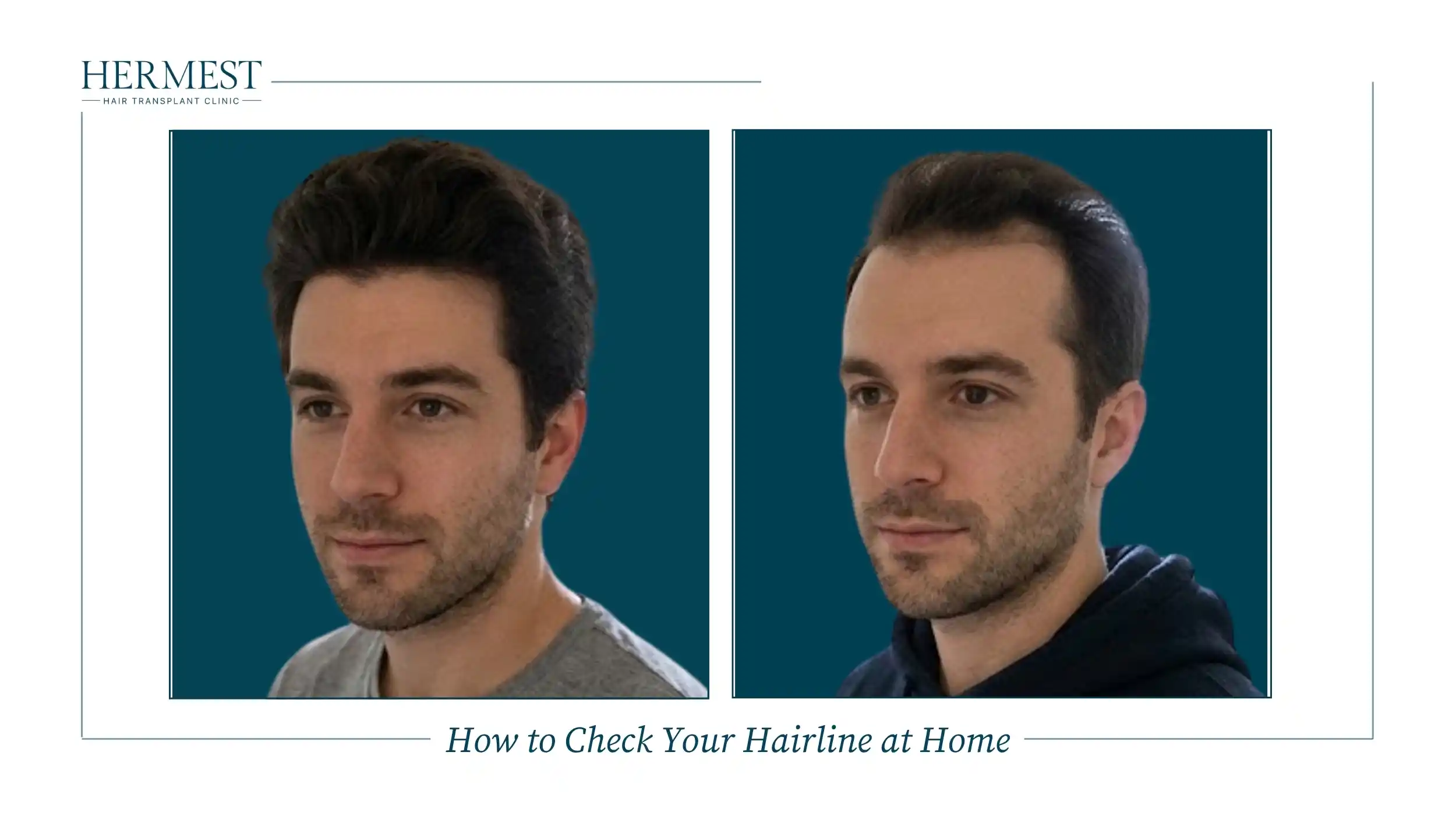
If you’re asking how to check if your hairline is receding, photographs are far more useful than repeatedly inspecting your temples in the mirror. Hairline recession develops gradually, so daily changes are usually too small to judge accurately.
Step 1: Find Older Photos
Start with photographs taken six months to several years ago.
Look for clear frontal views where your hair isn’t covering the temples. Compare the position and density of both frontal corners. Don’t focus solely on forehead size.
Step 2: Take Standardized Hairline Photos
Create a baseline using four views:
- straight-on frontal hairline
- left temple
- right temple
- frontal scalp from above
Keep your hairstyle, camera distance, lighting, and angle consistent. Dry hair works better for comparisons. Wet or oily hair separates into strands and can make normal scalp visibility resemble hairline thinning.
Step 3: Compare Months, Not Days
Repeat your photographs every two or three months. Look for gradual changes such as deeper receding temples, reduced frontal density, or increasingly fine hairs along the edge.
Dr. Ahmet Murat says:Standardized photographs can be surprisingly informative. Keep the lighting, hairstyle, camera position, and angles consistent. Comparing months rather than days makes genuine progression much easier to distinguish from styling or lighting differences.
Don’t Rely on the Forehead Wrinkle Test
You may see online advice suggesting that you raise your eyebrows, locate the highest forehead wrinkle, and measure the distance to your hairline.
That isn’t a validated diagnostic test for androgenetic alopecia. People naturally have different forehead proportions and hairline positions. A fixed measurement cannot establish whether follicles are progressively miniaturizing.
This is where professional assessment offers more information. Trichoscopy can magnify the scalp and reveal changes in hair-shaft thickness and follicular units that aren’t obvious in ordinary photographs. DermNet identifies hair-diameter diversity as an important trichoscopic feature of androgenetic alopecia.
The real home test is simpler: Has your hairline actually changed?
Mature Hairline vs Receding Hairline
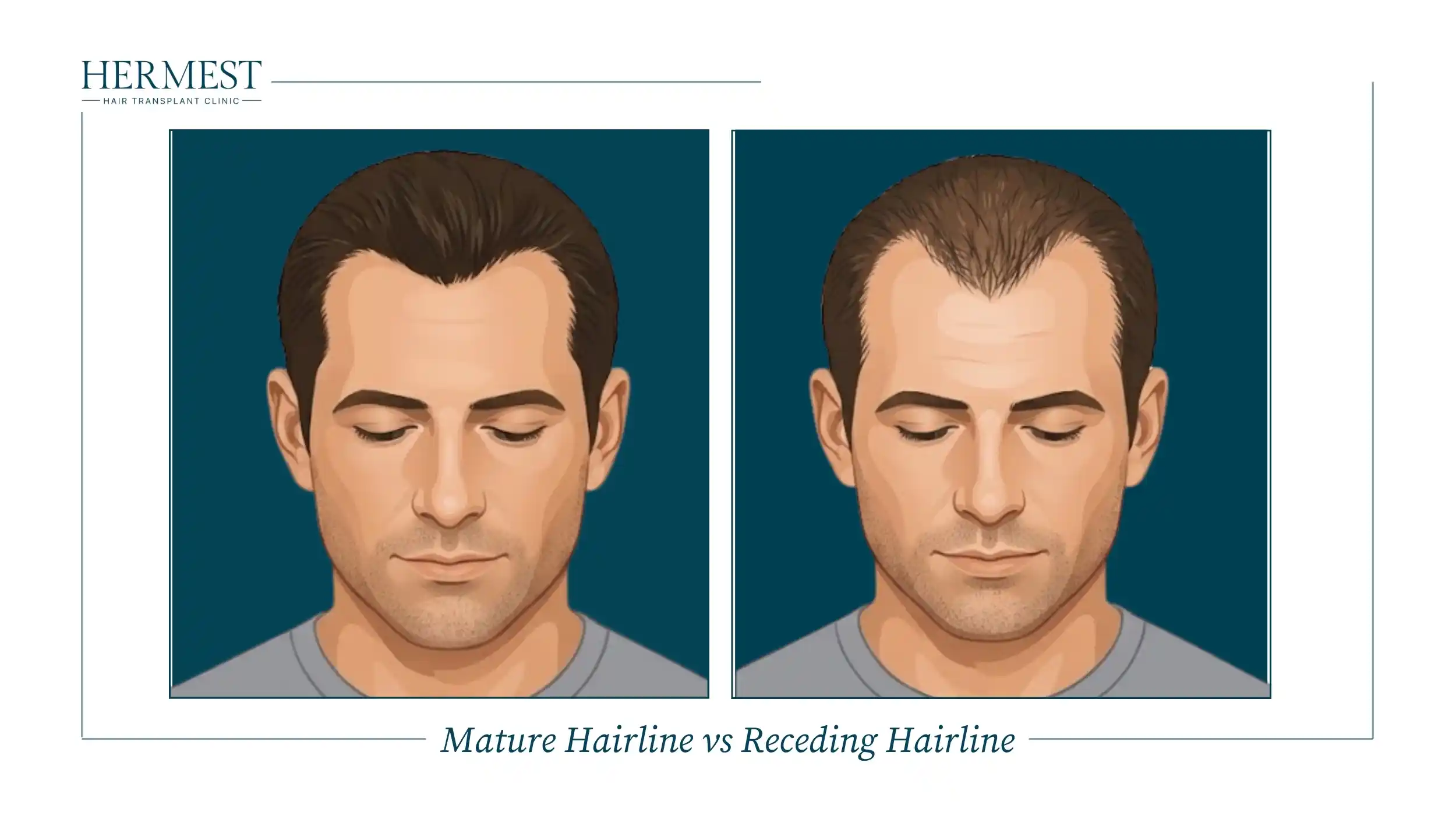
The difference between a mature hairline and a receding hairline isn’t always obvious. Both can involve higher temples or a more noticeable M-shaped appearance compared with adolescence. The strongest clue is progression.
“Mature hairline” is a common descriptive term, rather than a precise medical diagnosis or standardized stage of hair loss. For that reason, you shouldn’t assume every small change during early adulthood is harmless maturation.
What Does a Mature Hairline Look Like?
A hairline described as mature may sit slightly higher than it did during adolescence. The frontal corners can appear more defined, creating a subtle M shape.
If the position and density then remain relatively stable across years, ongoing hairline recession becomes less obvious.
A naturally high forehead or widow’s peak can create a similar appearance. Neither automatically means male pattern baldness.
What Suggests Your Hairline Is Actually Receding?
Progressive changes provide stronger evidence:
- temples continue moving backward across comparison photos
- frontal corners become progressively deeper
- density around the frontal edge decreases
- hairs in affected areas become finer and shorter
- thinning begins appearing around the crown too
Genetically susceptible follicles gradually shrink and can eventually stop producing visible hair. This follicular miniaturization matters more than forehead measurements.
Dr. Ahmet Murat says:A naturally high or M-shaped hairline can remain stable for many years. I become more suspicious of androgenetic alopecia when the temples continue moving backward and hairs around the frontal edge progressively lose thickness and density.
One photograph cannot reliably separate maturation from early recession. Compare standardized images across several months and look for movement plus miniaturization.
If you’re still uncertain, a dermatologist can examine the follicles and determine whether progressive androgenetic alopecia is present.
Normal Hairline vs Receding Hairline
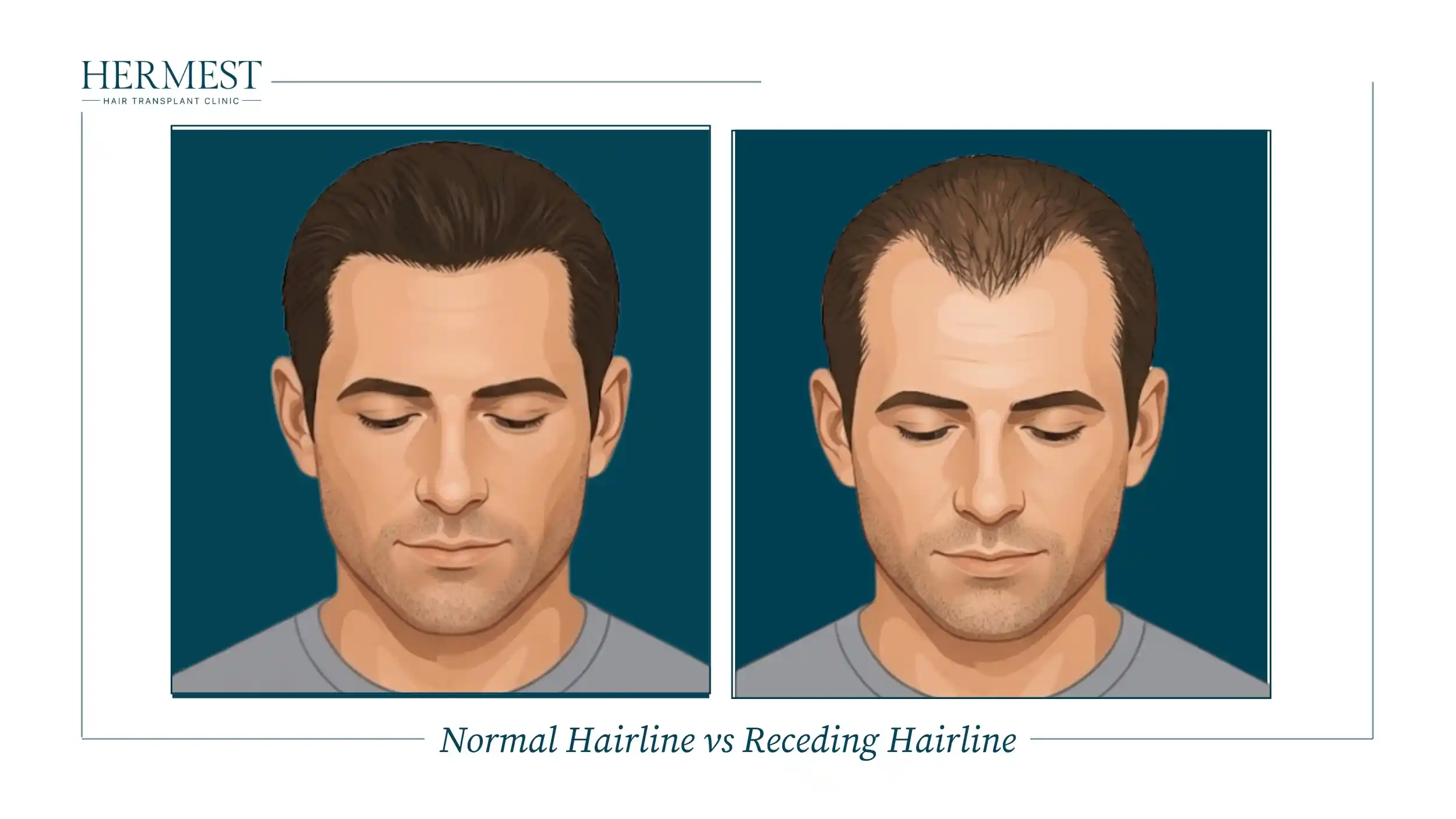
A normal hairline and a receding hairline cannot be told apart by forehead size alone. Normal hairlines come in many shapes, including straight, rounded, M-shaped, asymmetrical, high, and widow’s-peak patterns.
The better question is whether your hairline is changing.
A Naturally High Hairline Is Not Necessarily Receding
Some people naturally have more distance between their eyebrows and frontal hairline. If older photographs show approximately the same position and density, a high forehead alone doesn’t indicate hairline recession.
There is no universal measurement that defines a normal hairline height.
Does a Widow’s Peak Mean You Are Going Bald?
No. A widow’s peak describes a central V-shaped point where frontal hair extends downward. You can have a pronounced widow’s peak without androgenetic alopecia.
Concern increases when the temples surrounding that central point progressively retreat, making the V or M shape more pronounced.
Does an Uneven Hairline Mean Hair Loss?
Not necessarily. Human faces and hairlines aren’t perfectly symmetrical. One temple can naturally sit slightly higher than the other.
What matters is whether that difference becomes greater over time. That gives us a useful distinction:
Hairline position describes anatomy. Hairline movement suggests progression.
What Makes Recession More Suspicious?
A combination of temple recession, declining frontal density, and increasing numbers of fine or short hairs provides stronger evidence than hairline shape alone.
If your hairline has looked essentially identical since your late teens, its shape may simply be yours. If standardized photographs show continuing backward movement, however, early male pattern hair loss becomes more plausible.
Are Your Temples Receding?
The temples are often one of the first places men notice hairline recession. The corners may appear deeper, styling becomes harder, or more scalp becomes visible around the frontotemporal areas. Yet naturally high temples don’t automatically indicate hair loss.
Why Do the Temples Often Recede First?
In androgenetic alopecia, genetically susceptible follicles respond to androgen activity by gradually miniaturizing. DermNet describes male pattern hair loss as typically involving frontotemporal recession and thinning over the vertex. Miniaturization changes the hairs before an area becomes completely bald.
Affected hairs may gradually become:
- finer in diameter
- shorter than surrounding hairs
- less pigmented or visually prominent
- more widely spaced as density declines
This can make the frontal corners look increasingly transparent before they appear completely recessed.
How Can You Tell If Your Temples Are Actually Receding?
Compare each temple with photographs taken several months or years earlier. Look for the boundary progressively moving backward. Then examine whether density immediately behind that boundary has changed too.
A few naturally fine hairs aren’t enough. Male pattern loss involves progressive reductions in hair diameter, length, and pigmentation.
Can One Temple Recede Faster Than the Other?
Yes. Early receding temples don’t always progress with perfect symmetry. Natural asymmetry can produce the same appearance, though. This is why progression across photographs provides stronger evidence than comparing your left and right sides on one particular day.
Trichoscopy can help when visual inspection remains uncertain. It magnifies hair shafts and follicles, making changes such as diameter variation and miniaturization easier to identify.
So don’t judge your temples by shape alone. Movement plus declining density and miniaturization provides a much stronger signal.
Are Baby Hairs Around Your Hairline a Sign of Balding?
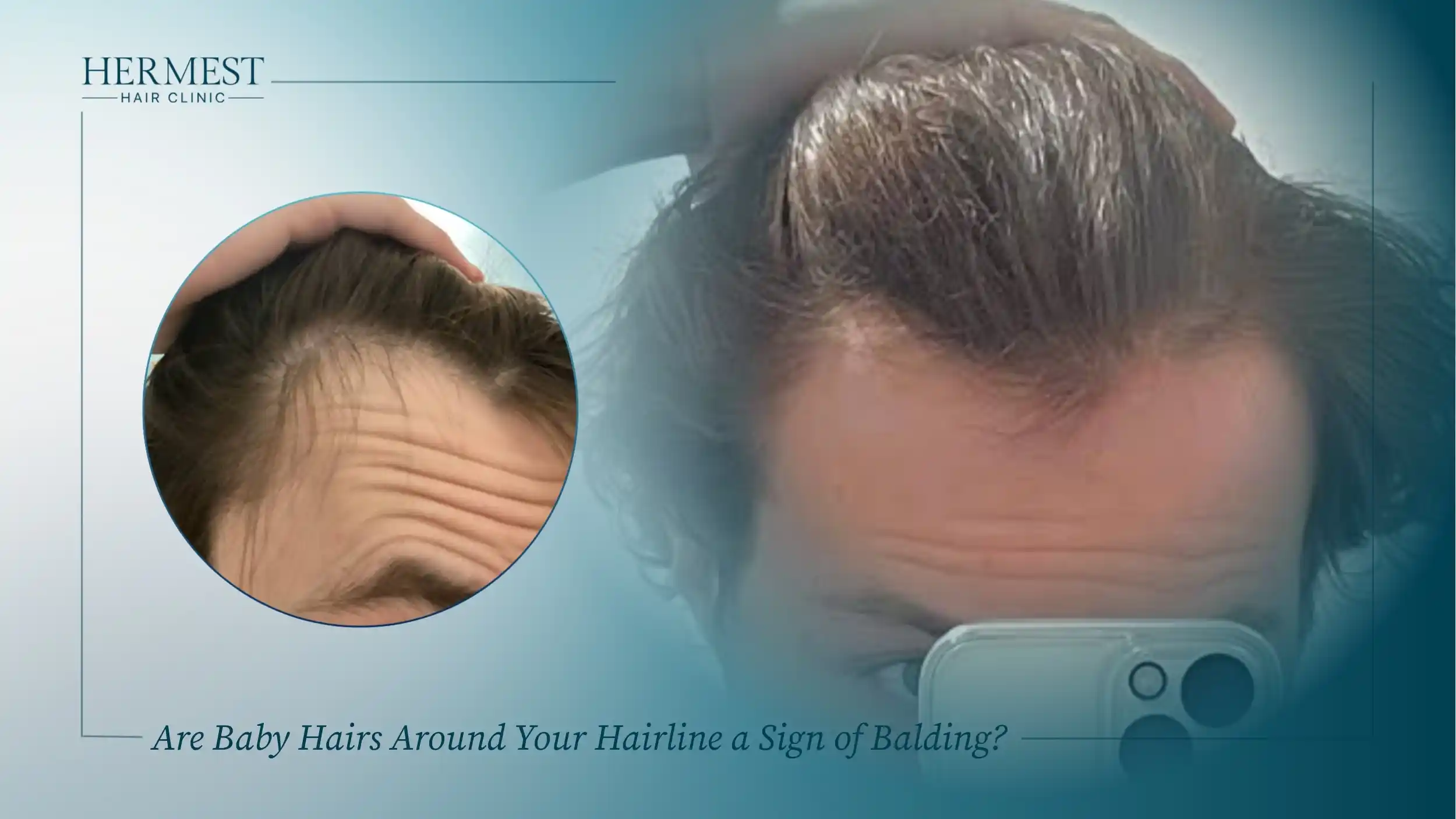
Seeing short, fine hairs around your frontal edge can make you wonder whether your hairline is thinning. These so-called baby hairs can sometimes indicate follicular miniaturization, but they don’t automatically mean your hairline is receding. The same appearance can have several explanations.
Miniaturized Hair vs New Hair Growth
With androgenetic alopecia, susceptible follicles gradually produce thinner, shorter hairs. This process is known as hair follicle miniaturization and can become visible around the temples before more obvious recession develops.
DermNet describes progressive variation in hair-shaft diameter as a characteristic trichoscopic finding in androgenetic alopecia. Affected follicles increasingly produce finer hairs compared with neighboring terminal hairs.
Short hairs around the hairline may instead represent:
- normal naturally fine hairs
- newly growing hairs
- broken hair shafts
- miniaturized hairs
This is why one close-up smartphone photograph rarely provides a reliable answer.
How Can You Tell If Short Hairs Are Miniaturizing?
Look at what happens over time. Healthy new growth should normally gain length and develop according to its natural growth cycle. With progressive miniaturization, an affected area tends to show increasing numbers of finer, shorter hairs alongside declining overall density.
The pattern matters too. Baby hairs around the hairline become more suspicious when they’re accompanied by deepening temples and continued backward movement.
Does an M-Shaped Hairline Mean You’re Going Bald?
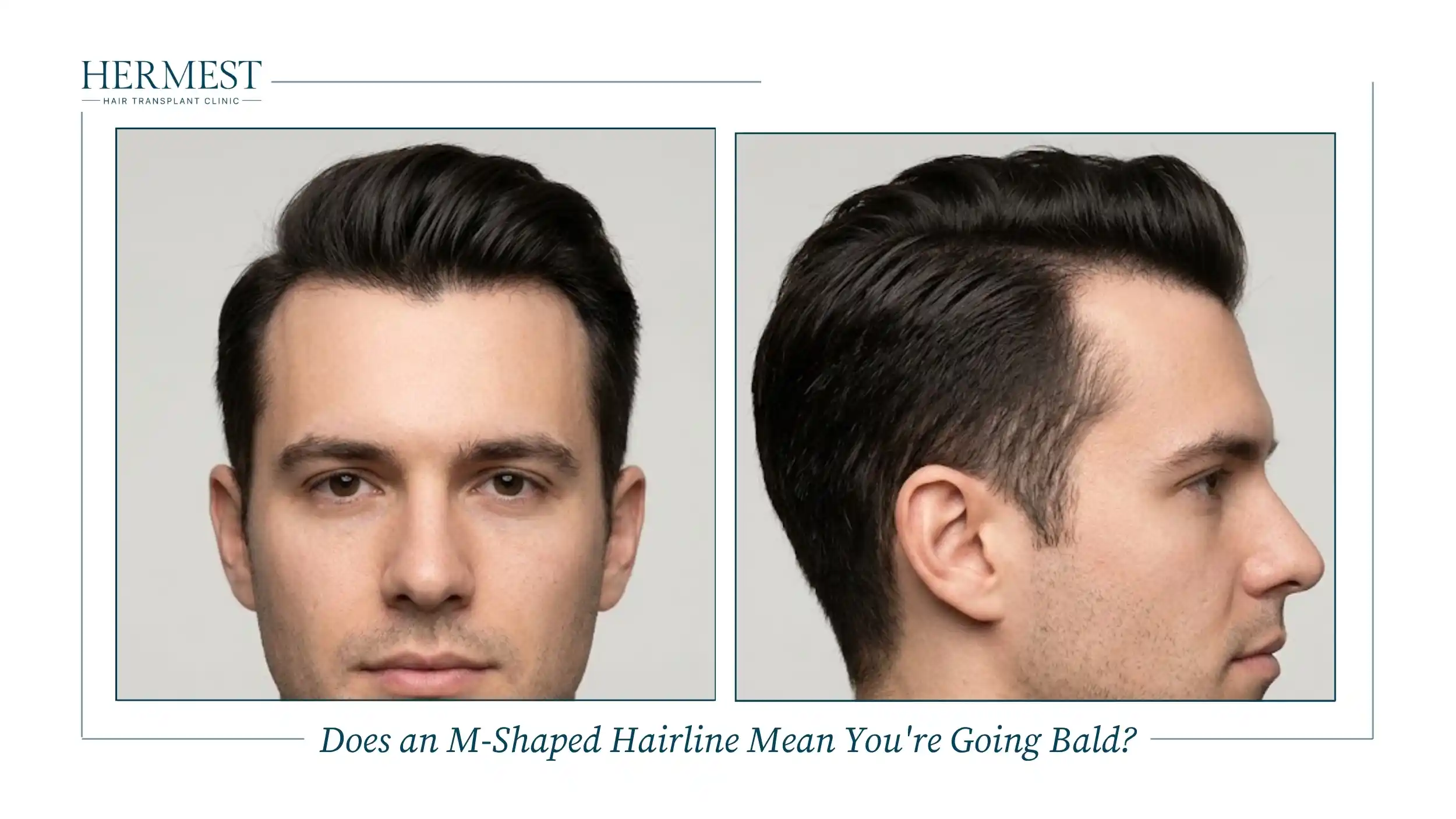
No. An M-shaped hairline doesn’t automatically mean you’re going bald. Some men naturally have deeper frontal corners or a widow’s peak, creating an M-like shape without progressive hair loss. What matters is whether that shape is becoming more pronounced.
When Is an M-Shaped Hairline a Sign of Recession?
With male pattern baldness, the temples often retreat as follicles in the frontotemporal region progressively miniaturize. The central frontal hair may remain farther forward, creating the familiar M-shaped appearance.
An M shape becomes more suggestive of hairline recession when:
- the frontal corners deepen across comparison photos
- temple density gradually decreases
- hairs around the edges become finer and shorter
- more scalp becomes visible behind the hairline
- crown thinning begins at the same time
A stable M-shaped hairline may simply represent your natural anatomy.
What About a Widow’s Peak?
A widow’s peak is a V-shaped central point extending lower on the forehead. It can make the surrounding temples appear recessed, especially under harsh lighting or with shorter hairstyles. It isn’t itself evidence of androgenetic alopecia.
The distinction becomes clearer when you compare photographs from different ages. If the central point stays similar but both corners steadily move backward, true temple recession becomes more likely.
So, don’t ask only, “Do I have an M-shaped hairline?” Ask:
Has my M shape become progressively deeper? That question tells you far more.
How Fast Does a Receding Hairline Progress?
There is no fixed timeline for hairline recession. Some men notice very gradual changes over decades, whereas others experience more noticeable progression over several years. For most people with androgenetic alopecia, the process is gradual rather than sudden.
The American Academy of Dermatology states that male pattern hair loss tends to develop slowly. It may begin with a receding hairline or thinning around the crown and continue progressing for years.
The British Association of Dermatologists similarly notes that male pattern hair loss may progress over several years to decades, with earlier onset sometimes associated with faster progression.
Why Does Hairline Recession Progress at Different Speeds?
Genetics strongly influence the pattern and timing. Androgen sensitivity within individual follicles matters too.
In male pattern hair loss, susceptible follicles undergo progressive miniaturization. Recent clinical literature describes DHT-related follicular miniaturization as a central process behind progressive thinning. This means you might notice deeper temples before dramatic shedding occurs.
Progress isn’t necessarily constant either. Looking stable for several months doesn’t prove that male pattern baldness has permanently stopped.
Can You Predict Your Final Norwood Stage?
Not reliably. Your current hairline cannot tell you exactly where your eventual pattern will finish. Family history can provide context, but it doesn’t offer a precise forecast.
Dr. Ahmet Murat says:A Norwood 2 hairline today doesn’t tell us exactly where that patient will be ten years later. We assess age, family history, miniaturization, crown density, donor characteristics, and documented progression before making long-term treatment or transplant decisions.
This is another reason not to obsess over weekly changes. Standardized photographs every few months provide a clearer picture than daily mirror checks.
So, how fast does a hairline recede? There is no universal rate. What matters clinically is whether your own hairline shows continuing movement and miniaturization over time.
What Is the Norwood Scale?
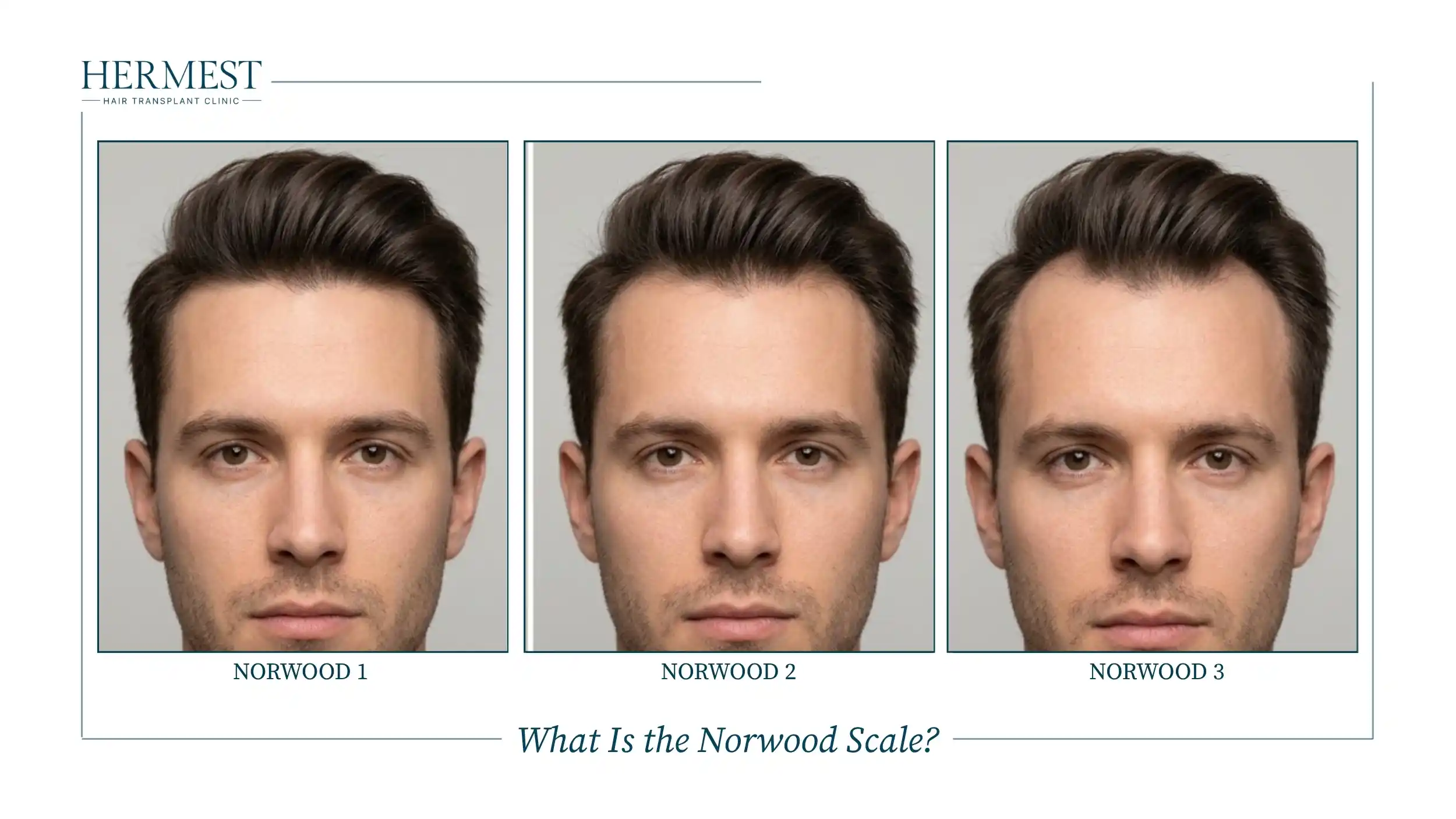
The Norwood scale, or Hamilton-Norwood scale, is widely used to classify the visible stages of male pattern baldness. It helps describe how far frontal, temporal, and crown hair loss has progressed.
The complete system contains seven major stages. For someone asking whether their hairline is beginning to recede, the first three stages are most relevant.
Norwood 1: Little or No Visible Recession
Norwood 1 represents minimal or no apparent hair loss around the frontal and temporal regions.
This doesn’t mean every Norwood 1 hairline must be perfectly straight. Natural asymmetry and different forehead shapes still occur.
Norwood 2: Mild Temple Recession
With Norwood 2, slight recession develops around both temples, often creating triangular frontal corners. This can resemble what people commonly call a mature hairline.
Norwood 2 doesn’t tell you how quickly your hair will change. Some men remain near this stage for long periods.
Norwood 3: More Established Hairline Recession
Norwood 3 involves deeper frontotemporal recession with substantially reduced coverage around the temples. The original classification considered this the first stage representing clinically significant balding.
A separate Norwood 3 Vertex pattern includes more noticeable crown loss.
What Can’t the Norwood Scale Tell You?
This is where people often give the scale too much authority.
Your Norwood stage cannot reliably determine:
- how quickly future recession will occur
- whether treatment will regrow particular follicles
- your eventual degree of baldness
- how many grafts a transplant would require
- whether an unusual hairline is definitely androgenetic alopecia
A 2026 review points out that traditional visual staging systems don’t capture microscopic changes such as follicular miniaturization and may miss subtle early progression.
So, use the Norwood scale to describe a pattern, not predict your future.
Does Increased Hair Shedding Mean Your Hairline Is Receding?
No. Increased shedding and a receding hairline are related to hair loss, but they aren’t the same process. You can shed more hair without developing temple recession, and male pattern baldness can progress without dramatic shedding. This distinction can prevent unnecessary worry.
How Much Daily Hair Shedding Is Normal?
The American Academy of Dermatology states that losing around 50 to 100 hairs per day can be normal. Old hairs naturally shed as follicles cycle through growth and resting phases.
Seeing hairs in the shower, on your pillow, or in your brush doesn’t prove your hairline is receding. The more useful question is whether frontal density and position are changing.
Shedding vs Hairline Recession
Think about the two patterns separately. Hair shedding describes hairs leaving follicles. Hairline recession describes progressive changes in frontal or temporal coverage.
Telogen effluvium provides a good example. DermNet describes it as excessive diffuse shedding that often develops several months after a trigger such as illness, major weight loss, iron deficiency, thyroid disease, medication changes, or emotional stress. It can sometimes produce bitemporal thinning too.
With androgenetic alopecia, the process centers more heavily on progressive follicular miniaturization. DermNet explains that susceptible follicles produce increasingly fewer and finer hairs as the growth phase shortens.
The two conditions can coexist. Telogen effluvium may temporarily increase shedding and make previously subtle male pattern hair loss more noticeable.
Trichoscopy can help separate early androgenetic alopecia from telogen effluvium by examining hair-shaft thickness and follicular patterns.
So don’t count every fallen hair. Watch the pattern and progression instead.
Can a Receding Hairline Grow Back?
Sometimes. Whether a receding hairline can grow back depends on its cause, how long the recession has been present, and how far the affected follicles have miniaturized. Early androgenetic alopecia doesn’t necessarily mean every follicle along the hairline has disappeared.
Miniaturized Follicles vs Lost Follicles
With male pattern hair loss, genetically susceptible follicles progressively shrink. DermNet explains that DHT shortens the growth phase and contributes to follicular miniaturization, producing increasingly fewer and finer hairs.
If follicles are still producing fine, miniaturized hairs, treatment may improve some of them. Once an area has become extensively bald, meaningful non-surgical regrowth becomes much less likely.
The American Academy of Dermatology reports that treatment can reduce further loss and produce some regrowth. Results tend to be better when treatment begins soon after hair loss becomes noticeable.
Can Minoxidil Regrow a Receding Hairline?
Topical minoxidil can stimulate growth and help maintain existing hair in people with male pattern hair loss. Full restoration shouldn’t be expected, and response varies between individuals. Results commonly require six to twelve months of continued treatment.
What About Finasteride?
For suitable men, prescription finasteride can slow further androgenetic hair loss and may produce some regrowth. AAD reports that roughly 80% to 90% of men taking it experience slowing of further loss. Potential adverse effects need discussion with a dermatologist before treatment.
This is why identifying early signs of a receding hairline matters. Waiting until the temples are completely bare reduces the opportunity for medical treatment to preserve native density.
Treatment must match the diagnosis. Minoxidil alone, for example, isn’t considered sufficient treatment for active frontal fibrosing alopecia.
When Is a Hair Transplant an Option for a Receding Hairline?

A hair transplant for a receding hairline can restore frontal coverage when follicles have miniaturized beyond meaningful medical recovery. Yet having visible temple recession doesn’t automatically make someone a good surgical candidate. Long-term planning matters more than filling today’s gaps.
Clinical consensus recommends transplantation for androgenetic alopecia when hair loss is sufficiently stable and the patient has adequate donor follicles. Surgery is discouraged in younger patients whose alopecia remains clinically progressive without prior treatment.
What Makes Someone a Good Hair Transplant Candidate?
Assessment should consider your current Norwood scale pattern alongside:
- age and rate of progression
- donor density and hair caliber
- miniaturization within the donor region
- family history of advanced baldness
- frontal, mid-scalp, and crown density
- realistic expectations for lifetime coverage
Hair transplant practice guidelines recommend examining donor density at multiple points and assessing hair caliber, safe donor boundaries, and possible retrograde thinning before harvesting grafts.
Why Future Hair Loss Changes Today’s Hairline Design
A transplant relocates follicles. It doesn’t stop untreated androgenetic alopecia in surrounding native hair. This creates a major planning issue.
If a very low, dense hairline consumes too many grafts today, continued recession behind those transplanted hairs could produce an unnatural appearance later. Published surgical guidance warns against aggressively lowering hairlines, particularly in younger patients with early progressive loss.
At Hermest, surgeon-led hairline planning considers both current recession and potential future loss before determining graft placement. FUE or DHI may then be selected according to the patient’s individual restoration plan.
The donor supply is finite. Guidelines estimate that safe lifetime scalp harvesting can vary substantially between individuals, which makes donor preservation part of every long-term strategy.
Frequently Asked Questions About a Receding Hairline
Look for progressive change over time, rather than judging your hairline from one photograph. Deepening temples, declining frontal density, backward movement, and increasingly fine hairs around the edge can suggest hairline recession. Male pattern hair loss commonly produces frontotemporal recession through progressive follicular miniaturization.