
Hairstyles for Balding Women: 35 Best Haircuts for Thinning Hair
 ChatGPT
 Claude
 Perplexity
 Grok
Grok
 Gemini

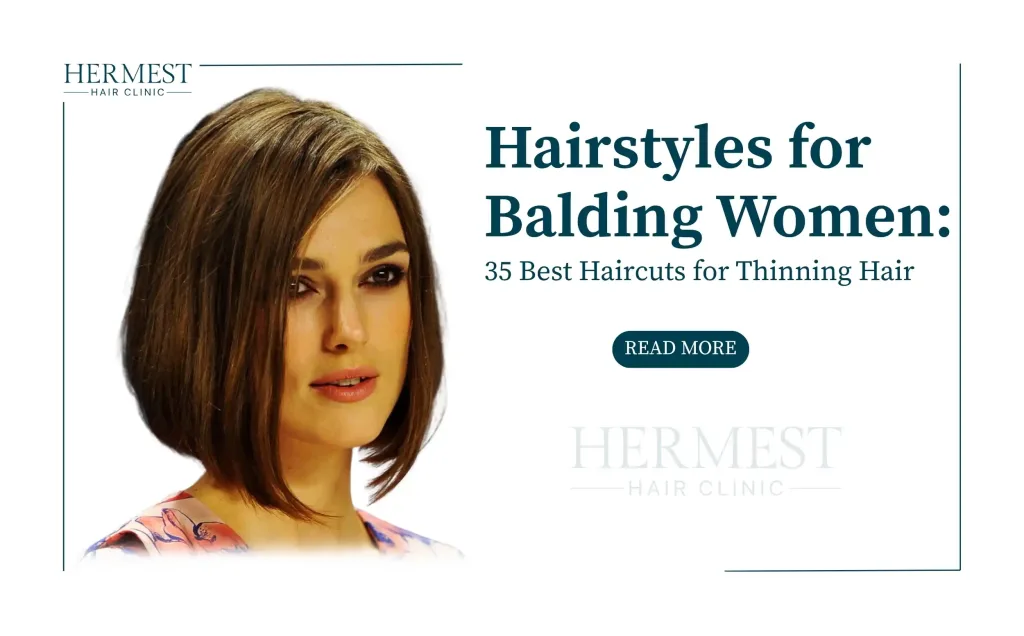
Choosing the right hairstyles for balding women can make a remarkable difference in both appearance and confidence. While no haircut can stop hair loss, the right style can create the illusion of fuller hair, soften visible thinning, and help you feel more comfortable with your look as you explore medical treatment options.
If you’ve recently noticed a widening part, thinning around the crown, or reduced hair volume, you’re not alone. Female hair loss affects millions of women worldwide and can occur at any age due to genetics, hormonal changes, menopause, stress, medical conditions, or certain medications. According to the American Academy of Dermatology (AAD), identifying the underlying cause of hair loss is just as important as finding the right styling solution.
This guide goes beyond simply showing attractive haircuts. You’ll discover the best hairstyles for balding women, learn which cuts work best for different thinning patterns, understand which hairstyles should be avoided, and explore styling techniques that create natural-looking volume without placing additional stress on fragile hair.
You’ll also learn when a new haircut may be enough, when medical treatment should be considered, and whether options such as PRP therapy or a hair transplant may be appropriate for some women.
Dr. Nesim Tugen says:
“A flattering hairstyle can improve confidence almost immediately, but it’s equally important to understand why the hair is thinning. At Hermest, we evaluate the scalp, hair density, and the underlying cause of hair loss before recommending treatment. Styling can enhance appearance, but healthy hair always begins with a healthy scalp.”
Whether you’re experiencing female pattern hair loss, diffuse thinning, menopausal hair changes, or temporary shedding, this comprehensive guide will help you choose styles that complement your hair’s current condition while protecting its long-term health. By combining practical hairstyling advice with evidence-based medical guidance, you’ll be better equipped to make informed decisions and achieve fuller-looking, healthier hair.
Quick Insights
- The most flattering hairstyle depends on your hair density, face shape, curl pattern, and where thinning occurs.
- Short hairstyles such as pixie cuts and layered bobs often create the strongest illusion of volume because they reduce excess weight.
- Medium-length hairstyles like lobs, butterfly cuts, and soft shags provide an excellent balance between fullness and styling flexibility.
- Long hairstyles can still look beautiful if enough density remains and the cut includes soft layers instead of heavy, one-length ends.
- Hairstyles should complement your natural hair rather than simply trying to hide thinning.
- Tight ponytails, sleek buns, heavy extensions, and tight braids may contribute to traction alopecia if worn regularly.
- Lightweight styling products, root-lifting techniques, and changing your hair part can significantly improve the appearance of thin hair.
- Hair toppers, hair fibers, and gentle accessories provide immediate cosmetic improvement without placing unnecessary stress on fragile strands.
- If thinning continues despite changing your hairstyle, seek professional evaluation as early diagnosis offers the best opportunity to preserve existing hair.
- Treatments such as topical minoxidil, PRP therapy, low-level laser therapy (LLLT), or a carefully planned hair transplant may be appropriate for selected women depending on the cause of hair loss.
Understanding Female Hair Loss Before Choosing a Hairstyle
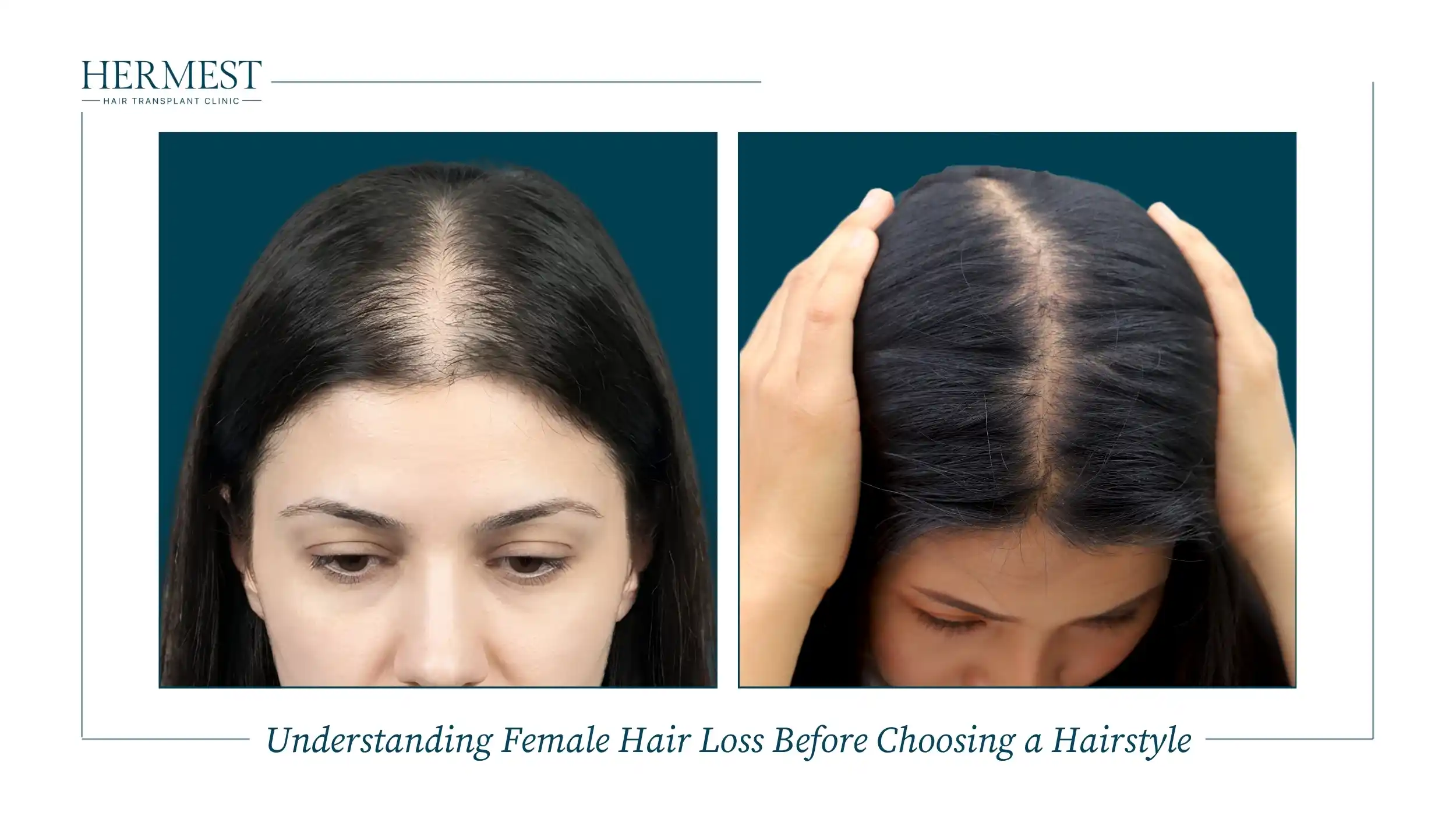
Before selecting one of the best hairstyles for balding women, it’s important to understand why your hair is thinning. A haircut can improve the appearance of fullness, but it won’t address the underlying condition causing hair loss. Choosing the right style starts with identifying the pattern and cause of thinning.
According to the American Academy of Dermatology (AAD), female hair loss isn’t a single condition. Several disorders can produce similar symptoms, yet each may require a different treatment approach.
Common Causes of Hair Thinning in Women
The most common causes include:
- Female pattern hair loss (androgenetic alopecia).
- Hormonal changes during menopause.
- Telogen effluvium after illness, childbirth, or stress.
- Traction alopecia caused by tight hairstyles.
- Nutritional deficiencies or certain medical conditions.
Some women notice gradual thinning across the crown, while others develop a widening part or reduced density throughout the scalp. Understanding where the thinning occurs helps determine which hairstyles for women with thinning hair will provide the most natural-looking coverage.
Hair Loss Patterns Matter
Not every hairstyle works for every type of thinning.
For example:
- Crown thinning often benefits from layered cuts that add lift and volume at the top.
- A widening part can appear less noticeable with a deep side part or textured layers.
- Temple recession may be softened with curtain bangs or side-swept fringe.
- Diffuse thinning usually responds best to hairstyles that create movement without exposing the scalp.
This personalized approach is one of the biggest factors missing from many hairstyle galleries online.
Dr. Nesim Tugen says:
“We never recommend hairstyles based solely on fashion trends. The most flattering haircut depends on the pattern of thinning, hair density, and scalp condition. Understanding these factors allows us to suggest styles that improve volume while protecting the remaining hair.”
Why Diagnosis Comes Before Styling
Many women spend years changing hairstyles without realizing their hair loss is progressing.
Early evaluation allows your dermatologist or hair restoration specialist to determine whether the thinning is temporary, medically treatable, or part of female pattern baldness. In many cases, combining the right haircut with appropriate medical treatment produces the best cosmetic and long-term results.
The hairstyles throughout this guide are organized with these different thinning patterns in mind, helping you choose a look that complements your hair today while supporting healthier hair for the future.
What Makes a Hairstyle Look Fuller?
The most flattering hairstyles for women with thinning hair don’t rely on tricks or excessive styling. Instead, they use shape, movement, and strategic cutting techniques to create the appearance of greater volume.
Understanding what makes hair look fuller will help you choose a haircut that works with your natural hair rather than trying to hide it.
It’s About Shape, Not Just Length
Many women assume cutting their hair short is the only solution for thinning. While shorter styles often create more lift, length alone doesn’t determine how full your hair appears.
Professional hairstylists create the illusion of density by balancing several elements, including:
- Layers that add movement without removing too much weight.
- Texture that prevents hair from lying flat.
- Strategic part placement.
- Face-framing pieces that soften visible thinning.
- Volume concentrated where hair appears sparse.
A well-designed haircut can make medium or even long hair appear significantly fuller than a poorly cut short style.
Volume Starts at the Roots
Flat roots often make thinning look more noticeable.
Creating lift near the scalp draws attention away from widening parts and visible scalp while giving the hair a healthier, more voluminous appearance.
Simple styling techniques can help, such as:
- Blow-drying with a round brush.
- Using volumizing mousse before drying.
- Lifting the roots with Velcro rollers.
- Changing your part occasionally.
- Applying dry shampoo for texture rather than only oil control.
These methods create optical density without placing unnecessary stress on fragile strands.
Dr. Nesim Tugen says:
“Many women focus on covering thinning areas, but creating natural volume often produces a much more youthful result. The right haircut should enhance your existing hair rather than forcing it into a style it can’t comfortably support.”
Less Weight Often Creates More Fullness
One surprising principle is that removing weight can actually make thin hair appear thicker.
Heavy, one-length hairstyles frequently pull the hair downward, causing it to separate and reveal more scalp. Carefully placed layers, textured ends, and soft movement allow the hair to expand naturally, creating the impression of greater density.
This is why many of the best hairstyles for balding women include layered bobs, textured lobs, feathered cuts, and soft shags rather than long, blunt styles.
As you explore the hairstyle gallery in the following sections, you’ll notice that each recommendation isn’t simply fashionable. Every cut is chosen because it addresses a specific pattern of female hair loss, helping you find a style that looks fuller while remaining easy to maintain and gentle on thinning hair.
35 Best Hairstyles for Balding Women
Finding the right haircut can make a noticeable difference when you’re dealing with thinning hair. The best hairstyles for balding women don’t simply hide sparse areas. They create natural volume, improve balance, and make the hair appear denser without putting additional stress on fragile strands.
There’s no universal haircut that works for everyone. The ideal style depends on your hair density, curl pattern, face shape, and, most importantly, where the thinning occurs. A woman with crown thinning needs a different approach than someone with a widening part or recession around the temples.
The hairstyles below are grouped by hair length to help you compare your options more easily. Each recommendation explains why it works, who it’s best suited for, when it may not be the right choice, and simple styling tips that maximize fullness.
Short Hairstyles for Balding Women
Short haircuts remain some of the most effective hairstyles for women with thinning hair because they reduce excess weight while creating lift at the roots. They also require less styling time and often make fine hair appear significantly thicker than long, flat styles.
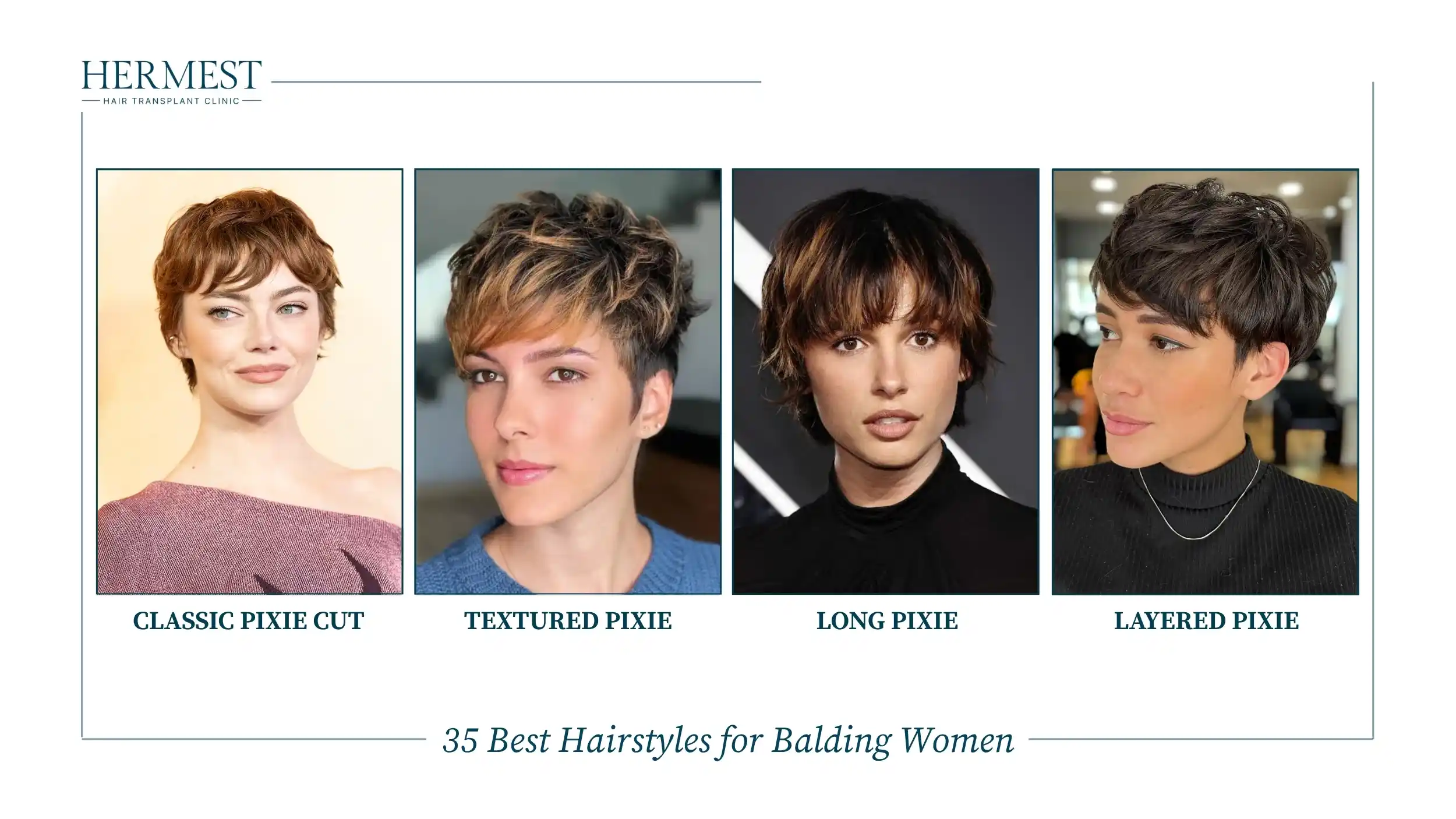
1. Classic Pixie Cut
Why It Works
The classic pixie removes heavy length that can pull fine hair downward. With more volume concentrated at the crown, hair naturally appears fuller and healthier.
Best For
Women with mild to moderate female pattern hair loss, diffuse thinning, fine hair, or early crown thinning.
Avoid If
Your scalp is visible across large areas or your hairline has advanced recession that may become more noticeable with an ultra-short cut.
Styling Tip
Apply volumizing mousse before blow-drying and finish with a light texture paste for soft definition instead of stiff hold.
2. Textured Pixie
Why It Works
Adding texture creates separation between strands, producing movement and the illusion of greater density. The intentionally tousled finish distracts attention from sparse areas.
Best For
Women with fine, straight hair, thinning at the crown, or those wanting a youthful, modern appearance.
Avoid If
Your hair is extremely coarse or naturally very curly, as excessive texture can sometimes become difficult to control.
Styling Tip
Use a matte texturizing powder at the roots instead of heavy waxes that flatten thin hair.
3. Long Pixie
Why It Works
A longer pixie combines the fullness of short hair with extra coverage around the temples and forehead. Longer side sections soften visible thinning while maintaining volume on top.
Best For
Women with temple recession, a widening part, or early signs of female pattern baldness.
Avoid If
You have advanced diffuse thinning throughout the scalp, where longer sections may expose additional scalp.
Styling Tip
Sweep the longer fringe diagonally across the forehead instead of wearing it straight down.
4. Layered Pixie
Why It Works
Soft layers increase movement while preventing the haircut from appearing flat. Carefully placed layers also help disguise uneven density throughout the scalp.
Best For
Women with fine or medium-density hair who want fuller-looking volume without daily styling.
Avoid If
Your hair is extremely thin and lacks enough density to support multiple layers.
Styling Tip
Lift the crown gently while drying, then separate the layers with your fingertips rather than a brush.
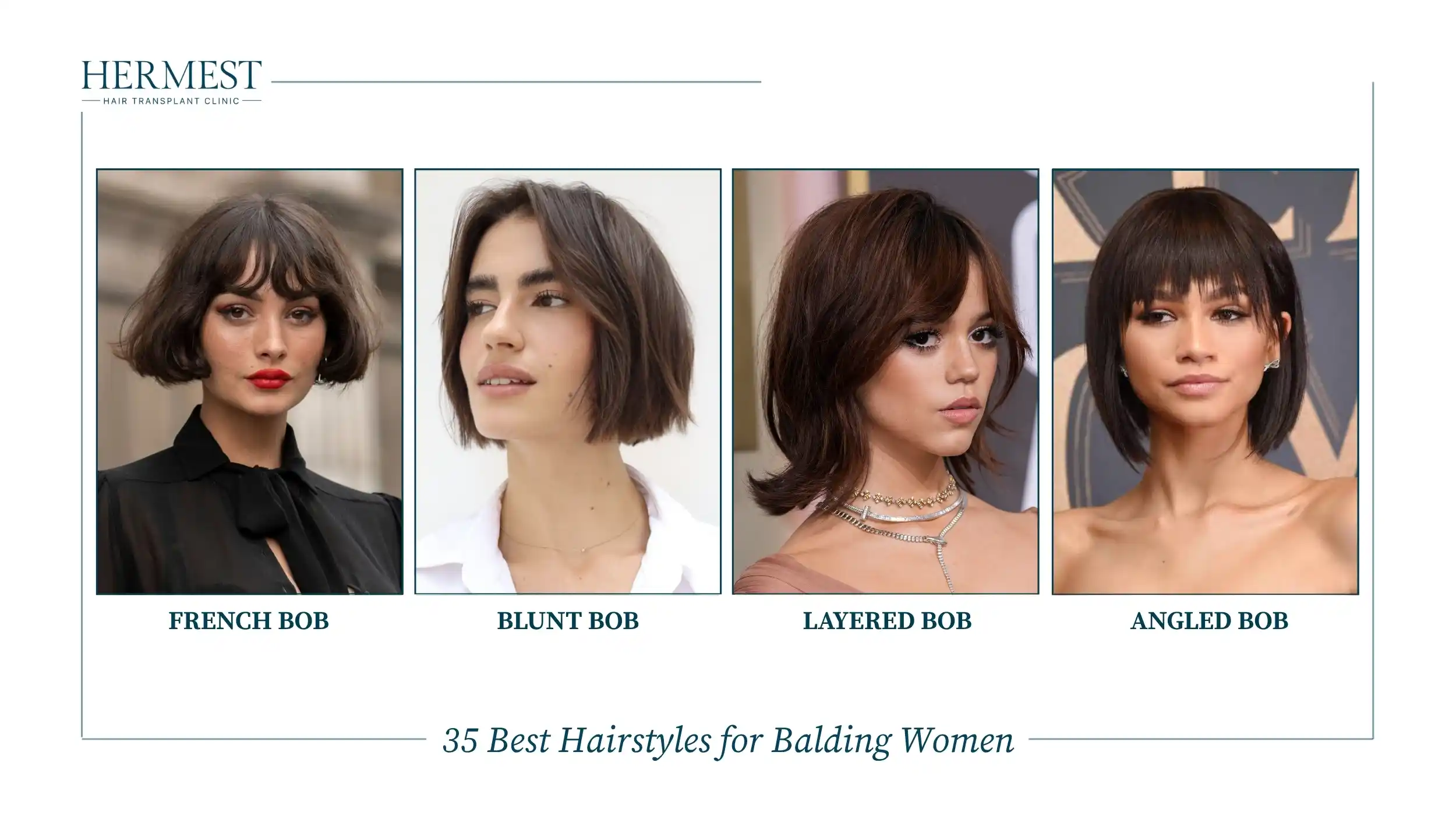
5. French Bob
Why It Works
Ending around the jawline, the French bob naturally adds width to the face while making hair appear thicker. Its blunt outline creates an impression of stronger density.
Best For
Women with fine hair, widening parts, oval faces, and mild crown thinning.
Avoid If
Your hair becomes very frizzy in humid weather without regular styling.
Styling Tip
Pair it with wispy bangs or a side part to soften visible scalp around the front.
6. Blunt Bob
Why It Works
Unlike heavily layered cuts, the blunt bob keeps all the ends at the same length, creating a thicker, fuller outline. This clean edge makes every strand contribute to the overall appearance of volume.
Best For
Women with fine, straight hair and early hair loss in women.
Avoid If
Your hair naturally lacks movement or becomes triangular at the bottom.
Styling Tip
Finish with a root-lifting spray rather than applying heavy products through the ends.
7. Layered Bob
Why It Works
A layered bob combines the fullness of a bob with soft internal movement, making it one of the most versatile haircuts for thinning hair.
Best For
Diffuse thinning, mild crown hair loss, and women wanting a youthful style.
Avoid If
The layers become too short or over-texturized, as this may reduce overall density.
Styling Tip
Ask your stylist for long, blended layers instead of choppy ones.
8. Angled Bob
Why It Works
Longer front sections naturally frame the face while the shorter back creates lift around the crown. This combination produces a fuller silhouette from every angle.
Best For
Women with thinning at the back of the scalp or a widening part.
Avoid If
Your neck is very short or your hair is extremely curly without regular blow-drying.
Styling Tip
Blow-dry the crown upward while keeping the front smooth and polished.
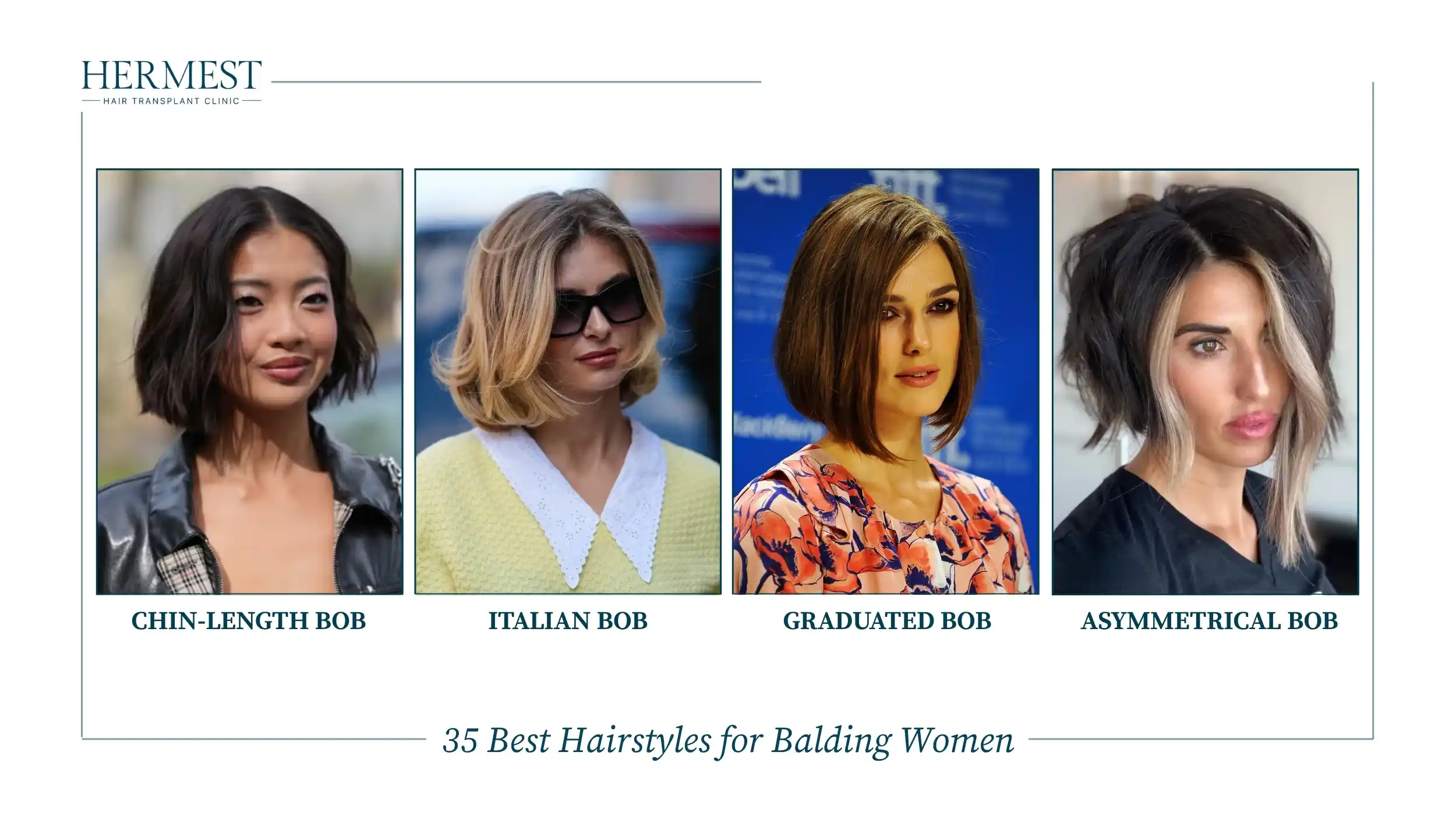
9. Chin-Length Bob
Why It Works
Stopping exactly at the chin gives the hairstyle a wider appearance while preventing the hair from becoming weighed down by extra length.
Best For
Women with fine hair, narrow faces, or early menopausal thinning.
Avoid If
Your hair loses significant volume below the ears.
Styling Tip
A slightly off-center part often creates more fullness than a perfectly centered one.
10. Italian Bob
Why It Works
The Italian bob features soft volume, natural body, and subtle fullness around the jawline. It looks elegant while maintaining a healthy appearance for thin hair.
Best For
Women who prefer sophisticated, polished hairstyles with minimal maintenance.
Avoid If
Your hair is extremely flat and struggles to hold shape without styling.
Styling Tip
Create loose bends with a large curling iron rather than tight curls.
11. Graduated Bob
Why It Works
Short stacked layers at the back naturally lift the crown, creating the appearance of thicker hair without sacrificing softness.
Best For
Women experiencing crown thinning or reduced volume around the back of the head.
Avoid If
You prefer wash-and-go hairstyles without any styling.
Styling Tip
Use a round brush to emphasize the stacked shape while drying.
12. Asymmetrical Bob
Why It Works
Uneven lengths draw the eye toward the haircut itself instead of sparse areas. The asymmetry also creates movement that disguises lower density.
Best For
Women with one-sided thinning or a widening frontal part.
Avoid If
You prefer classic, symmetrical hairstyles.
Styling Tip
Wear the longer side over the area with less density for additional coverage.
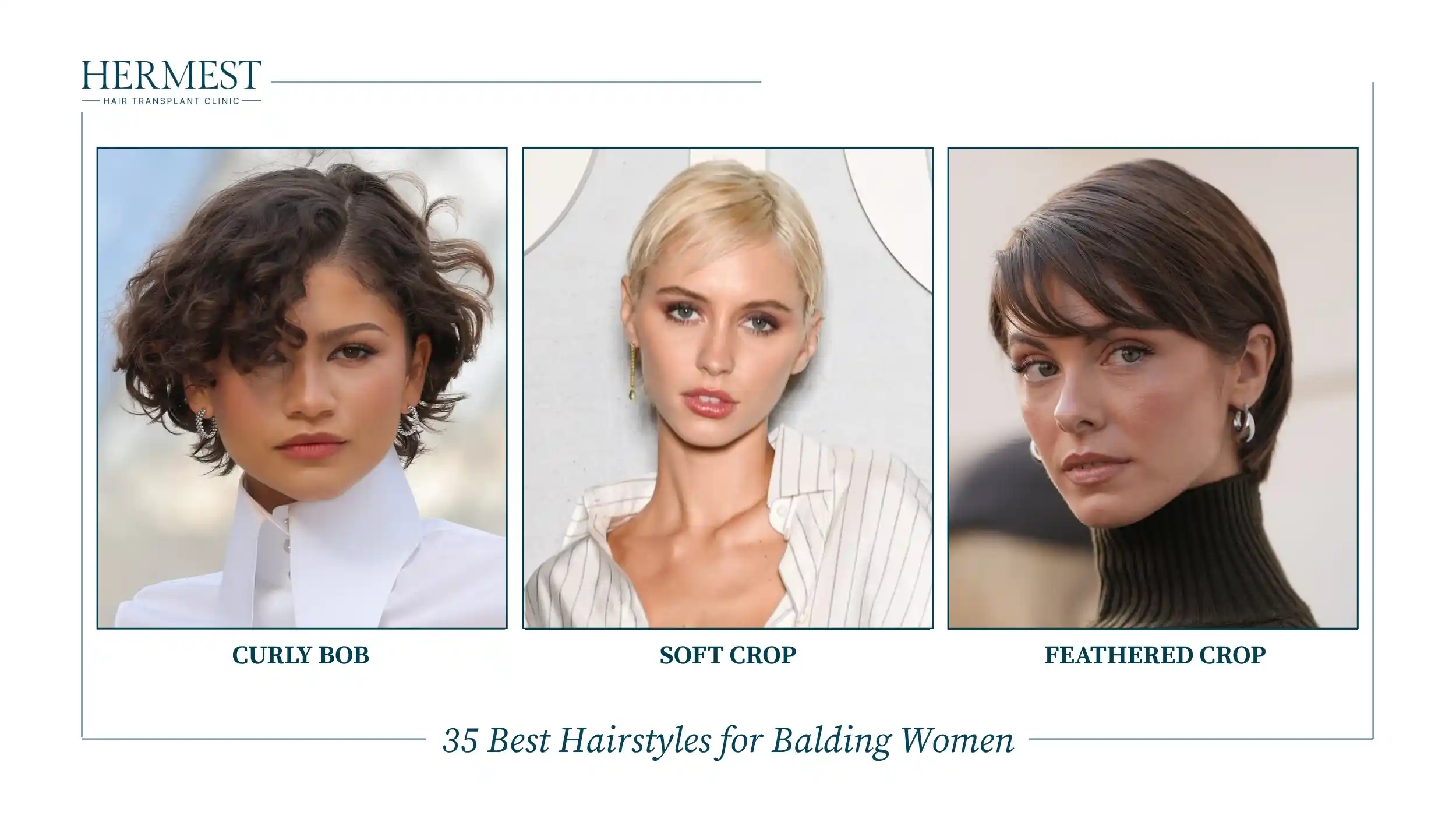
13. Curly Bob
Why It Works
Natural curls create built-in volume, making thinning less noticeable than in straight hair. The rounded shape also reduces scalp visibility.
Best For
Women with naturally curly or wavy hair experiencing diffuse thinning.
Avoid If
Your curls are severely damaged or over-processed.
Styling Tip
Diffuse dry your curls upside down to maximize root lift.
14. Soft Crop
Why It Works
The soft crop features feathered edges instead of sharp lines, creating a light, airy appearance that helps thin hair appear naturally fuller.
Best For
Older women with fine hair and gradual thinning.
Avoid If
You enjoy dramatic, highly structured hairstyles.
Styling Tip
Use lightweight styling cream sparingly to maintain soft movement.
15. Feathered Crop
Why It Works
Feathered layers add texture without removing excessive weight, making the haircut appear fuller from every angle. The soft finish also blends naturally with areas of uneven density.
Best For
Women with fine hair, menopausal thinning, or mild female pattern hair loss who want a low-maintenance style.
Avoid If
Your hair is extremely coarse or prone to significant frizz.
Styling Tip
A light mist of volumizing spray at the roots and gentle finger styling are usually enough to maintain shape throughout the day without weighing the hair down.
The short hairstyles above demonstrate that reducing length doesn’t mean sacrificing femininity or style. In many cases, a carefully designed short cut provides more lift, movement, and optical density than longer hairstyles ever could. The next section explores medium-length hairstyles that offer even greater versatility while continuing to camouflage thinning hair naturally.
Medium Hairstyles for Women with Thinning Hair
Medium-length cuts offer the perfect balance between coverage and volume. Unlike very short hairstyles, they provide more styling versatility, while avoiding the heaviness that often makes long, fine hair appear flatter. For many women experiencing female pattern hair loss, a widening part, or menopausal thinning, shoulder-length hairstyles create the ideal combination of fullness and movement.
The secret lies in preserving enough length to frame the face while incorporating layers and texture that prevent the hair from separating and exposing the scalp. Many of these styles also work well alongside volumizing products, hair fibers, or medical treatments such as topical minoxidil or PRP therapy.
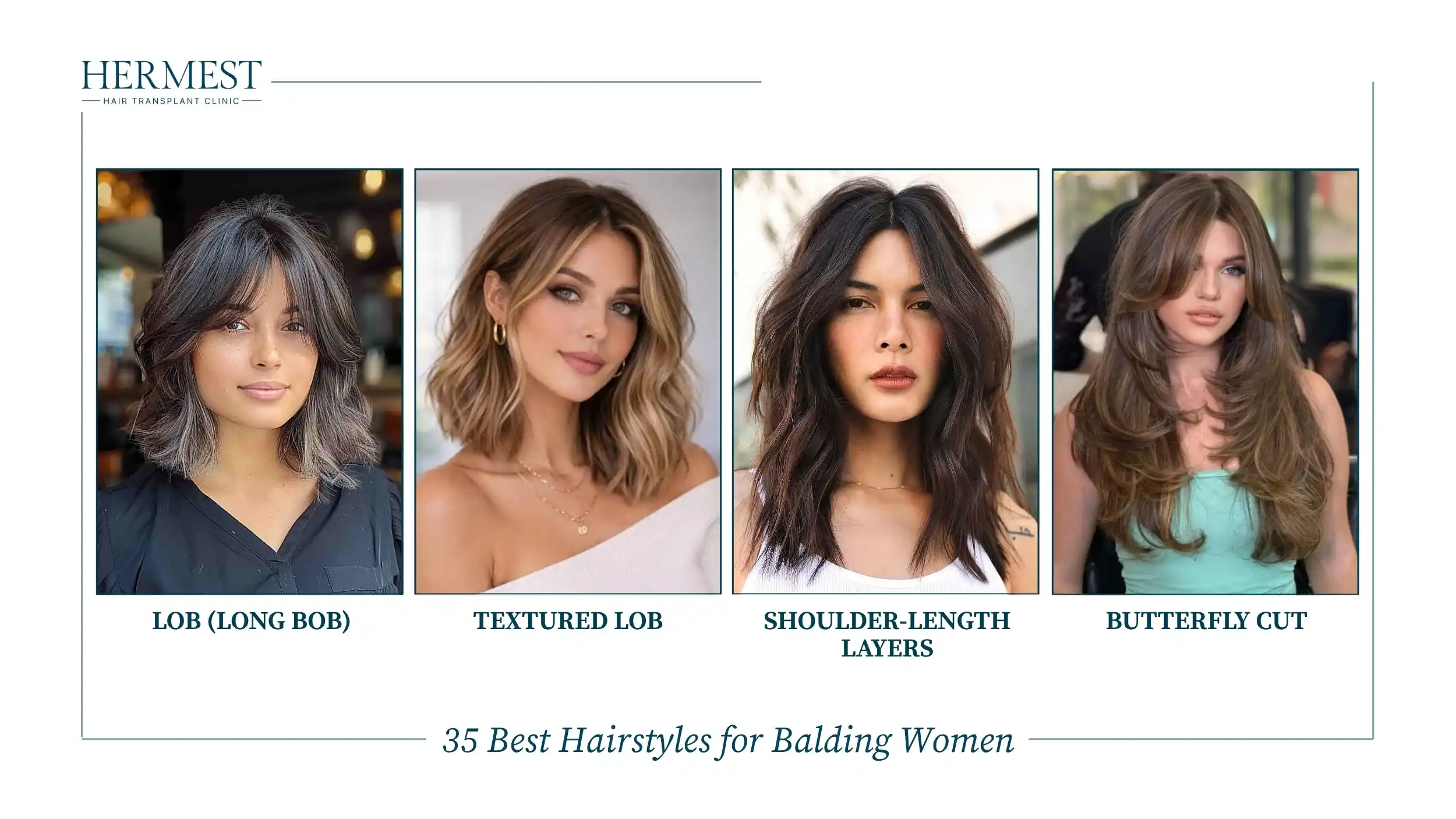
16. Lob (Long Bob)
Why It Works
The lob sits between the chin and shoulders, offering enough length for styling while remaining light enough to maintain natural body. It’s one of the most versatile hairstyles for women with hair loss because it flatters almost every face shape.
Best For
Women with diffuse thinning, fine hair, or mild crown thinning who want a professional, easy-to-maintain look.
Avoid If
Your hair becomes noticeably thinner toward the ends, making the lower half appear stringy.
Styling Tip
Add soft bends with a large curling iron to create width and movement without making the hairstyle look overly styled.
17. Textured Lob
Why It Works
Adding subtle texture gives the lob extra movement and creates the illusion of thicker hair. The uneven finish prevents fine strands from lying flat against the scalp.
Best For
Women with straight or slightly wavy hair and early female pattern baldness.
Avoid If
Your hair is already extremely dry or damaged, as too much texturizing may emphasize fragile ends.
Styling Tip
Use a sea salt spray only on the mid-lengths and ends, avoiding the roots to prevent dryness.
18. Shoulder-Length Layers
Why It Works
Long, blended layers distribute volume evenly throughout the hair while maintaining a full perimeter. This creates natural lift without making the hairstyle appear overly choppy.
Best For
Women with medium-density hair, widening parts, or menopausal thinning.
Avoid If
Your hair is extremely fine and lacks enough density to support multiple layers.
Styling Tip
Ask your stylist for soft, invisible layers rather than heavily razored ends.
19. Butterfly Cut
Why It Works
The butterfly cut combines shorter face-framing layers with longer lengths underneath, creating volume around the crown while preserving overall length. It has become one of the most popular haircuts for thinning hair in recent years.
Best For
Women who want to keep long-looking hair while adding noticeable fullness around the face.
Avoid If
Your density is very low throughout the scalp, as dramatic layers may expose additional thinning.
Styling Tip
Blow-dry the shorter layers away from the face using a round brush for maximum lift.
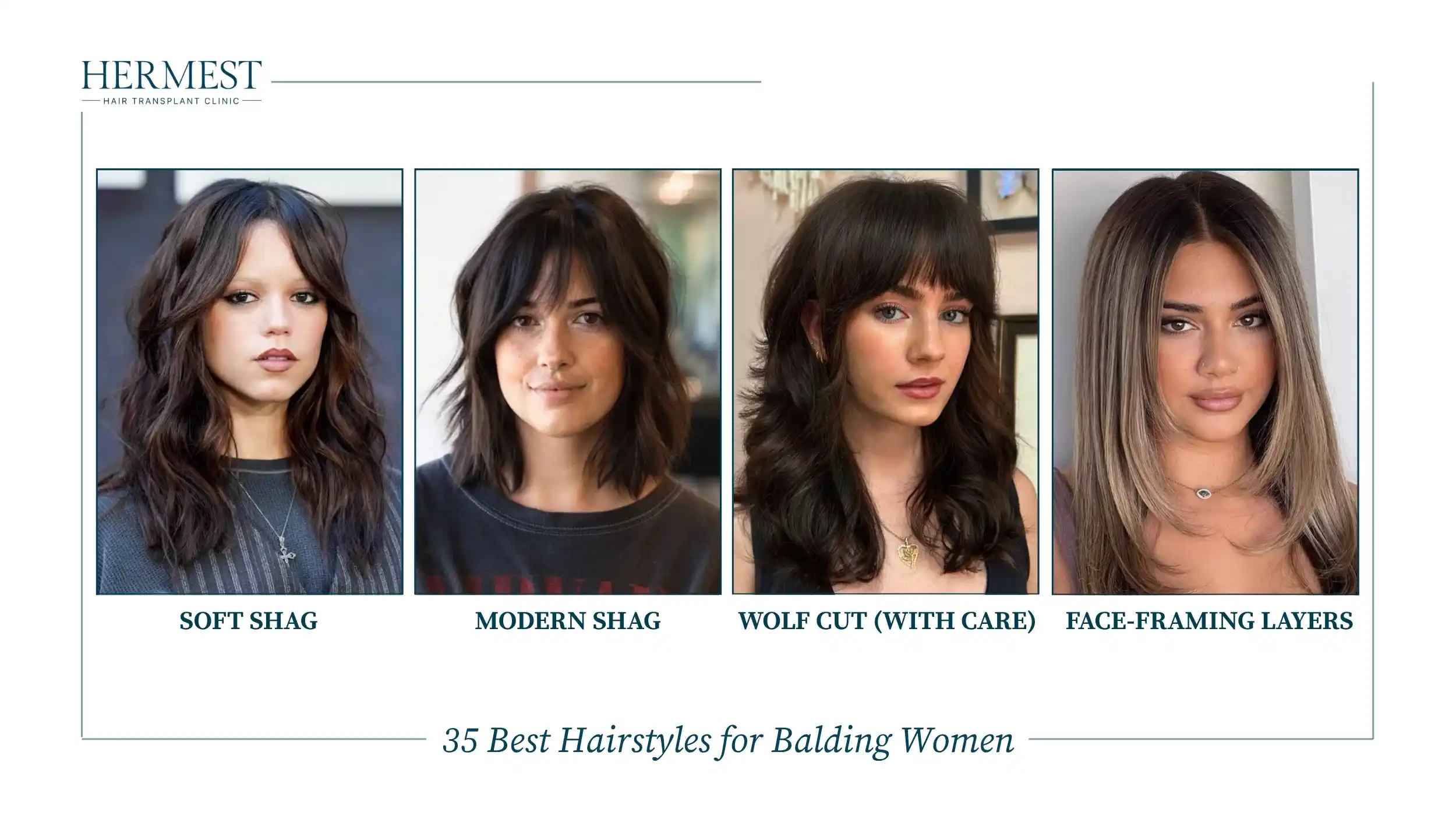
20. Soft Shag
Why It Works
Unlike the heavily layered shags of previous decades, the modern soft shag uses gentle layers that create movement without sacrificing density. It naturally disguises uneven hair thickness.
Best For
Women with wavy hair, fine hair, or thinning around the crown.
Avoid If
Your hair is extremely straight and struggles to hold texture.
Styling Tip
Scrunch in a lightweight mousse while the hair is damp to enhance natural movement.
21. Modern Shag
Why It Works
The modern shag uses soft layering around the crown and face to produce fullness while maintaining an effortless appearance. The texture naturally distracts from visible scalp.
Best For
Women with fine to medium hair who enjoy a relaxed, contemporary style.
Avoid If
You prefer sleek, polished hairstyles with perfectly smooth finishes.
Styling Tip
Apply volumizing mousse before diffusing to encourage natural lift.
22. Wolf Cut (With Care)
Why It Works
The wolf cut combines elements of the shag and mullet, creating significant volume around the crown. When customized correctly, it can help disguise thinning at the top of the scalp.
Best For
Younger women with moderate hair density and naturally wavy hair.
Avoid If
You have advanced female pattern hair loss or very sparse hair, as aggressive layers can reduce the appearance of density.
Styling Tip
Ask for a softer version with longer layers instead of an extreme wolf cut.
23. Face-Framing Layers
Why It Works
Strategically placed layers around the face soften thinning temples and create visual width without dramatically changing the overall haircut.
Best For
Women with temple recession, a high forehead, or mild frontal thinning.
Avoid If
The front hairline has significant hair loss that requires greater coverage.
Styling Tip
Curl the front sections slightly away from the face to increase fullness.
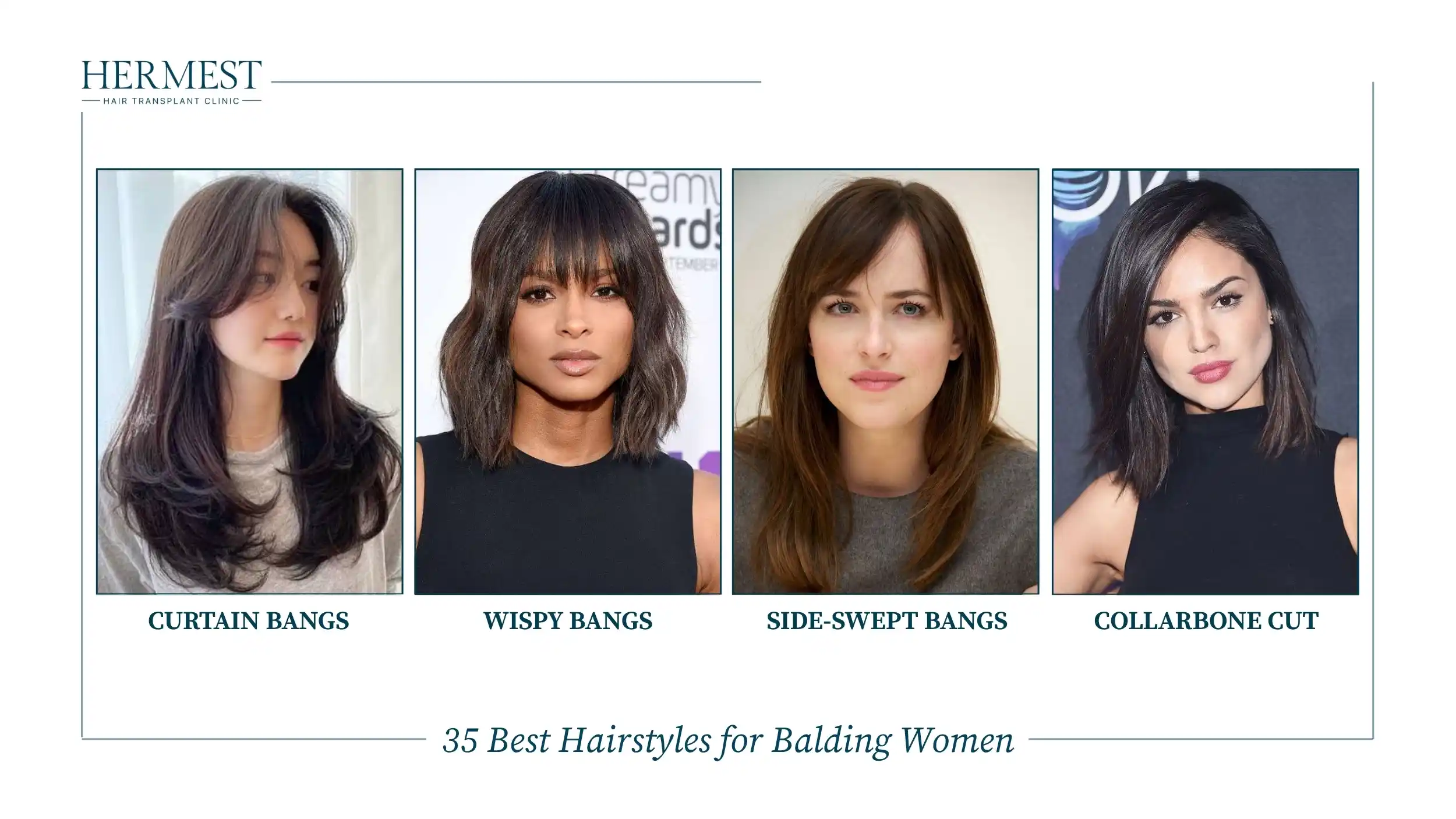
24. Curtain Bangs
Why It Works
Curtain bangs gently frame the forehead while blending naturally into the rest of the hairstyle. They help disguise recession around the temples and soften a widening part.
Best For
Women with early frontal thinning or mild hairline recession.
Avoid If
Your bangs become oily very quickly or your forehead hair density is extremely low.
Styling Tip
Use a medium round brush to create soft outward curves rather than heavy inward curls.
25. Wispy Bangs
Why It Works
Unlike thick blunt bangs, wispy bangs require less hair while still providing subtle coverage across the forehead. They create softness without reducing density elsewhere.
Best For
Women with fine hair who want light facial framing.
Avoid If
Your hairline has very sparse density across the entire front.
Styling Tip
Keep the bangs light and airy instead of cutting them too thick.
26. Side-Swept Bangs
Why It Works
A diagonal fringe naturally covers one side of the hairline and creates the illusion of greater fullness across the front of the scalp.
Best For
Women with a widening part, temple thinning, or asymmetrical hair loss.
Avoid If
Your hair grows strongly forward and resists side styling.
Styling Tip
Blow-dry the bangs across the forehead while still damp for a natural sweep.
27. Collarbone Cut
Why It Works
Ending just above the shoulders, this haircut maintains fullness while remaining light enough to preserve movement and volume.
Best For
Women who want a versatile style that works for both straight and wavy hair.
Avoid If
The ends appear noticeably thinner than the rest of the hair.
Styling Tip
Trim every 8–10 weeks to keep the perimeter looking full.
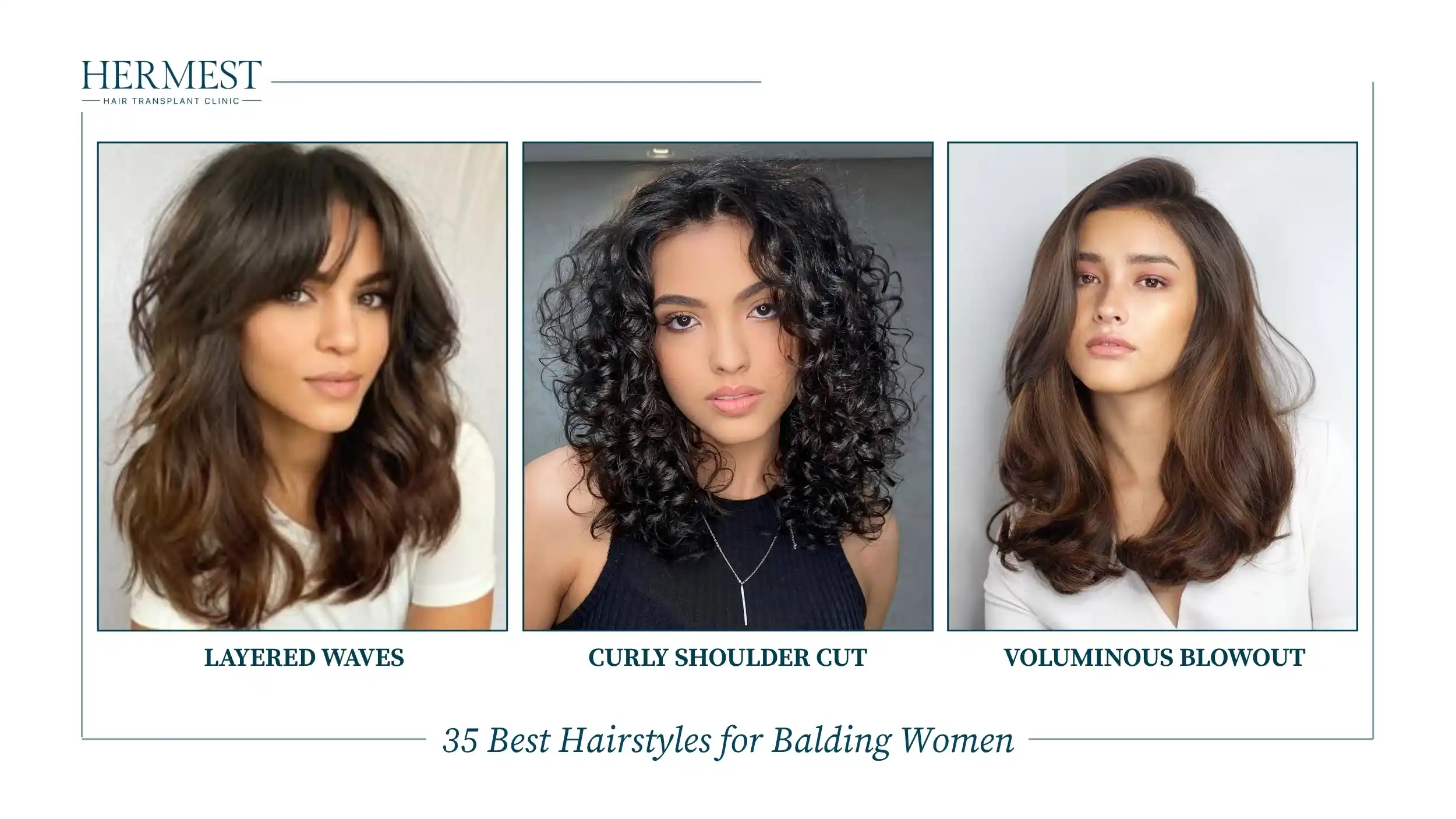
28. Layered Waves
Why It Works
Soft waves increase the distance between individual strands, making the hair appear naturally thicker. Combined with long layers, they help camouflage visible scalp.
Best For
Women with naturally wavy or easily styled hair.
Avoid If
Your hair is extremely fragile from repeated heat styling.
Styling Tip
Use a large-barrel curling iron and gently brush out the curls for soft movement.
29. Curly Shoulder Cut
Why It Works
Natural curls provide built-in volume that effectively conceals thinning. Keeping the length around the shoulders prevents excessive weight from stretching the curls.
Best For
Women with curly hair experiencing diffuse thinning or crown hair loss.
Avoid If
Your curls are severely damaged by heat or chemical treatments.
Styling Tip
Use a diffuser and curl-enhancing cream to maximize root volume without creating stiffness.
30. Voluminous Blowout
Why It Works
Although technically a styling technique rather than a haircut, a professional blowout can dramatically improve the appearance of fine hair by creating lift, body, and movement from the roots.
Best For
Special occasions, professional settings, or women wanting temporary fullness between haircuts.
Avoid If
You frequently use very high heat, which may increase hair breakage over time.
Styling Tip
Always apply a heat protectant before blow-drying and finish with a lightweight volumizing spray instead of heavy hairspray.
Medium-length hairstyles remain one of the most forgiving choices for women with thinning hair because they combine flexibility, elegance, and natural-looking volume. When paired with the right cut and gentle styling techniques, they can significantly reduce the visibility of sparse areas while preserving the health of existing hair. In the next section, we’ll explore long hairstyles that allow women to maintain their length without sacrificing fullness or movement.
Long Hairstyles for Balding Women
Many women believe they must cut their hair short as soon as thinning begins. While shorter styles often create more lift, long hair can still look beautiful when enough density remains and the haircut is designed to maximize movement instead of weight. The key is avoiding one-length styles that pull the hair downward and reveal more of the scalp.
The following hairstyles for balding women are ideal for those who want to keep their length while making fine or thinning hair appear fuller. Most rely on soft layers, strategic parting, and gentle styling rather than dramatic cutting techniques.
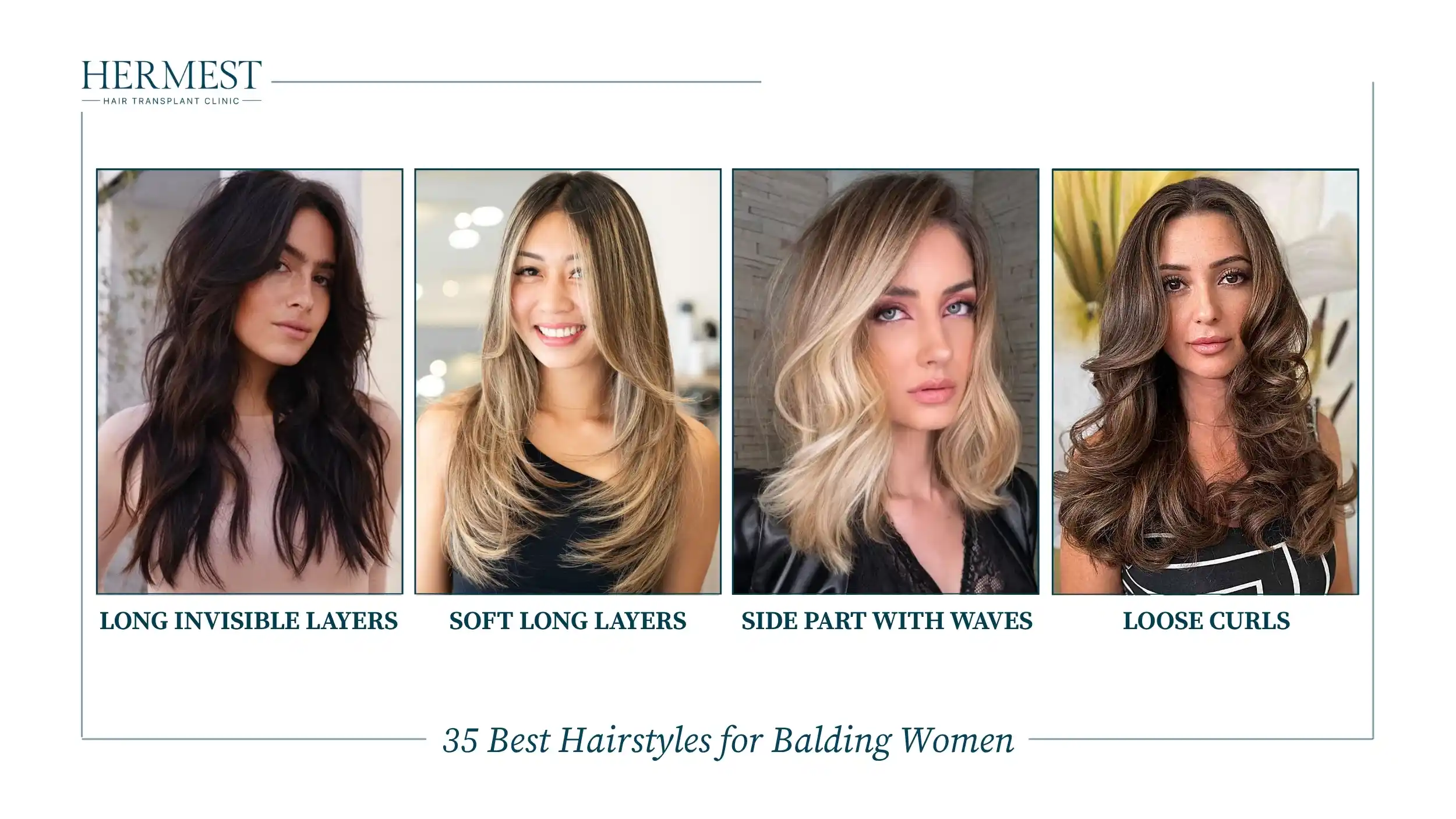
31. Long Invisible Layers
Why It Works
Invisible layers remove internal weight without noticeably changing the overall length. This allows the hair to move more freely while maintaining a fuller-looking perimeter.
Best For
Women with mild female pattern hair loss, fine hair, or early diffuse thinning who prefer longer hairstyles.
Avoid If
Your ends are significantly thinner than the rest of your hair, as additional layering may make them appear even finer.
Styling Tip
Keep the layers subtle and ask your stylist to preserve thickness around the bottom edge of the haircut.
32. Soft Long Layers
Why It Works
Soft layers create movement throughout the hair while preventing long strands from appearing flat or lifeless. They also reduce the visual contrast between thicker and thinner areas.
Best For
Women with medium-density hair who want natural volume without sacrificing length.
Avoid If
Your hair is extremely fine or fragile and cannot support multiple layers.
Styling Tip
Style with loose waves rather than leaving the hair perfectly straight to enhance dimension.
33. Side Part with Waves
Why It Works
Changing the part immediately creates lift at the roots while soft waves increase width throughout the hairstyle. Together, they effectively camouflage widening parts and visible scalp.
Best For
Women with crown thinning, early frontal hair loss, or naturally straight hair.
Avoid If
Your hairline has advanced recession on one side that cannot be comfortably covered.
Styling Tip
Switch your part occasionally to prevent the hair from becoming permanently flat in one direction.
34. Loose Curls
Why It Works
Loose curls separate individual strands, making the hair appear denser without looking overly styled. They also reduce the visibility of scalp compared with pin-straight hair.
Best For
Women with fine to medium-density hair who enjoy wearing their hair down.
Avoid If
Your hair has become very dry from repeated heat styling.
Styling Tip
Choose large-barrel curls instead of tight ringlets for a softer, fuller appearance.
35. Long Hair with Curtain Bangs
Why It Works
Curtain bangs frame the face while helping disguise thinning around the temples and hairline. Combined with soft layers, they create balance and make long hair appear more voluminous.
Best For
Women with a widening part, temple recession, or early menopausal thinning.
Avoid If
The front hairline has very limited density, making it difficult to create natural-looking bangs.
Styling Tip
Blow-dry the bangs away from the face with a round brush to maintain soft volume throughout the day.
Hairstyles to Avoid If You Have Thinning Hair
Not every trendy hairstyle is suitable for thinning hair. While the right haircut can create the illusion of greater density, the wrong styling habits may make hair loss more noticeable or even contribute to further shedding over time.
According to the American Academy of Dermatology (AAD), hairstyles that place continuous tension on the scalp can lead to traction alopecia, a preventable form of hair loss caused by repeated pulling on the hair follicles. If detected early, traction alopecia is often reversible. However, long-term tension may permanently damage the follicles, making hair regrowth much more difficult.
The goal isn’t to avoid these styles forever. Instead, wear them occasionally, keep them loose, and give your hair regular breaks.
Tight Ponytails
Why to Avoid Them
A tightly secured ponytail pulls constantly on the hairline and temples, where the hair is naturally finer and more vulnerable. Over time, repeated tension may worsen thinning around the front of the scalp.
Better Alternative
Choose a low, loose ponytail secured with a soft fabric scrunchie instead of a tight elastic band.
High, Tight Buns
Why to Avoid Them
Sleek ballerina buns create concentrated tension in the same area every day. Women who regularly wear this hairstyle often develop thinning around the temples or frontal hairline.
Better Alternative
Wear a loose low bun and vary its position throughout the week to reduce repeated stress on the same follicles.
Tight Braids and Cornrows
Why to Avoid Them
Braids themselves aren’t harmful, but excessive tightness is. Styles that pull firmly on the scalp can contribute to traction alopecia, particularly when worn continuously for weeks.
Better Alternative
Ask your stylist to braid loosely enough that your scalp doesn’t feel sore afterward.
Heavy Hair Extensions
Why to Avoid Them
Extensions add extra weight that your natural hair must support. For women already experiencing female pattern hair loss or diffuse thinning, this additional tension may accelerate breakage and hair shedding.
Better Alternative
If you choose extensions, opt for lightweight clip-ins worn only occasionally instead of permanent methods that constantly pull on the roots.
Extremely Long One-Length Hair
Why to Avoid It
Very long hair isn’t harmful by itself, but when it’s cut to a single length, its weight often pulls the roots flat. As the hair separates naturally throughout the day, the scalp becomes more visible, especially around a widening part or crown.
Better Alternative
Maintain your length while incorporating soft, blended layers that create movement without sacrificing fullness.
Flat Middle Parts
Why to Avoid Them
A perfectly straight center part can emphasize scalp visibility, particularly in women with crown thinning or a widening part caused by female pattern baldness.
Better Alternative
Try a slightly off-center or side part. Even a subtle shift can immediately create more lift at the roots and reduce the appearance of sparse areas.
Aggressive Backcombing
Why to Avoid It
Teasing the hair may provide temporary volume, but repeated backcombing weakens the cuticle and increases breakage. Since thinning hair already has reduced density, preserving every healthy strand is important.
Better Alternative
Create volume with root-lifting mousse, a round brush, or Velcro rollers instead of excessive teasing.
Daily High-Heat Styling
Why to Avoid It
Frequent use of straighteners, curling irons, and very hot blow dryers doesn’t usually cause permanent hair loss from the follicle, but it can weaken the hair shaft, leading to breakage that makes thinning appear worse.
Better Alternative
Use heat protectant every time you style your hair and lower the temperature whenever possible. Giving your hair regular heat-free days also helps maintain stronger, healthier strands.
The best hairstyles for women with thinning hair should never rely on tight pulling, excessive weight, or damaging styling habits. Instead, they should support the health of your remaining hair while creating natural volume and movement. By protecting your follicles today, you also improve the likelihood of maintaining healthier, fuller-looking hair in the future.
Styling Tips That Make Thin Hair Look Thicker
The right haircut is only part of the equation. Daily styling techniques can dramatically improve how full your hair appears without hiding it under heavy products or damaging it with excessive heat. In fact, small adjustments to your routine often make a bigger visual difference than changing your haircut alone.
Women with female pattern hair loss, diffuse thinning, or menopausal hair changes should focus on creating natural lift and movement rather than trying to force extra volume. The goal is healthy-looking fullness, not stiff or overstyled hair.
Lift the Roots Instead of the Ends
Many women apply volumizing products throughout the entire length of their hair. Unfortunately, this can weigh the hair down instead of lifting it.
For better results:
- Apply volumizing mousse or root-lifting spray only near the scalp.
- Blow-dry the roots upward using a round brush.
- Finish with cool air to help maintain lift.
Creating volume where the hair naturally lies flat makes thinning much less noticeable.
Change Your Hair Part Regularly
Hair naturally settles into the same position over time. If you’ve worn the same center or side part for years, the roots may begin to flatten, making scalp visibility more obvious.
Changing your part every few days immediately creates extra height while reducing attention on widening parts or sparse areas.
A slightly off-center part is often one of the easiest ways to make hairstyles for women with thinning hair appear fuller.
Choose Lightweight Styling Products
Heavy creams, oils, and waxes often make fine hair look greasy and separated.
Instead, choose products specifically formulated for volume, such as:
- Volumizing mousse.
- Texture spray.
- Root-lifting spray.
- Lightweight thickening foam.
- Dry shampoo for added grip and body.
Using less product usually creates better results than using more.
Dry Shampoo Isn’t Just for Oily Hair
Many people think dry shampoo is only useful between washes. In reality, it also adds texture and grip, making fine hair appear noticeably thicker.
Applying a small amount at the roots before styling creates lift that often lasts throughout the day.
For women with early female pattern baldness, this simple trick can noticeably reduce scalp visibility.
Try Hair Fibers for Instant Coverage
Hair fibers attach to existing strands using static electricity, helping camouflage widening parts and crown thinning within seconds.
They work best when:
- Some natural hair remains.
- Hair color closely matches the fibers.
- A setting spray is used afterward.
Although hair fibers don’t treat hair loss, they can provide an immediate cosmetic improvement while waiting for medical treatments to produce results.
Blow-Dry Upside Down
Drying your hair upside down lifts the roots away from the scalp and naturally increases body.
Once the hair is nearly dry, flip it back and finish styling with a round brush for a softer, more polished finish.
This technique works particularly well with haircuts for thinning hair such as layered bobs, lobs, and butterfly cuts.
Use Velcro Rollers Instead of Excessive Heat
Large Velcro rollers remain one of the safest ways to create long-lasting volume.
After blow-drying:
- Roll the top sections away from the face.
- Allow them to cool completely.
- Remove gently using your fingers rather than a brush.
The result is natural lift without repeatedly exposing fragile hair to high temperatures.
Sleep Smarter
Nighttime habits can also influence hair health.
Consider:
- Sleeping on a silk or satin pillowcase to reduce friction.
- Wearing a loose braid instead of a tight ponytail.
- Avoiding sleeping with wet hair whenever possible.
These small adjustments help minimize breakage, preserving the density you already have.
Remember: Styling Doesn’t Replace Treatment
The techniques above can dramatically improve the appearance of thinning hair, but they don’t stop progressive hair loss.
If you’re noticing increasing scalp visibility, ongoing shedding, or a widening part that continues to enlarge, it’s worth consulting a dermatologist or hair restoration specialist. According to the American Academy of Dermatology, early diagnosis and treatment of female pattern hair loss offer the best opportunity to slow progression and preserve existing hair.
By combining smart styling techniques with evidence-based treatments when appropriate, many women achieve fuller-looking hair while protecting their long-term scalp health.
Hair Accessories That Help Hide Thinning Hair
A flattering haircut and good styling routine can make thin hair look noticeably fuller, but the right accessories can provide an additional confidence boost. Modern hair accessories are no longer just fashion items. Many are specifically designed to create volume, camouflage sparse areas, and reduce stress on fragile hair.
The key is choosing accessories that work with your natural hair instead of pulling on it. Heavy clips, tight elastics, and poorly fitted extensions may worsen breakage or contribute to traction alopecia, while lightweight, well-designed accessories can improve both comfort and appearance.
Hair Toppers
Hair toppers have become one of the most popular cosmetic solutions for women experiencing female pattern hair loss or crown thinning.
Unlike a full wig, a topper blends with your natural hair and covers only the thinning area.
Best For
- Crown thinning.
- Widening parts.
- Diffuse thinning with enough surrounding hair for attachment.
Advantages
- Natural appearance.
- Lightweight and breathable.
- Easy to style alongside your own hair.
- Available in synthetic and human hair options.
A professionally fitted topper often looks virtually undetectable while instantly increasing the appearance of hair density.
Halo Hair Extensions
Unlike traditional extensions that attach directly to the hair, halo extensions rest on an invisible wire around the head.
Because they don’t pull on individual strands, they are generally gentler than bonded or taped extensions.
Best For
Women whose thinning is mainly around the crown while maintaining good density around the sides and back.
Avoid If
Your hair is very thin throughout the entire scalp, making the halo difficult to conceal.
Soft Headbands
Soft fabric or padded headbands can redirect attention away from thinning near the front of the scalp while adding style to everyday hairstyles.
Choose flexible materials that don’t squeeze tightly against the temples.
They pair especially well with:
- Lobs.
- Shoulder-length layers.
- Loose waves.
- Curtain bangs.
Decorative Scarves
Silk or lightweight cotton scarves provide stylish coverage on days when your hair feels flatter than usual.
They are also an excellent option during periods of increased shedding caused by:
- Illness.
- Stress.
- Postpartum recovery.
- Medical treatments.
Scarves allow the scalp to breathe while avoiding the friction sometimes caused by heavier hats.
Hair Fibers
Hair fibers aren’t technically an accessory, but they deserve special mention because of how effectively they camouflage thinning.
These tiny keratin-based fibers cling to existing hairs, making them appear significantly thicker.
They work particularly well for:
- Crown thinning.
- Widening parts.
- Mild hair loss in women.
- Early female pattern baldness.
Hair fibers provide immediate cosmetic improvement and wash out easily with shampoo.
Volume Clips
Small volumizing clips placed beneath the top layer of hair can lift the roots without teasing or backcombing.
Unlike traditional teasing methods, they don’t repeatedly damage the hair shaft.
They’re especially useful for women whose hair becomes flat throughout the day despite using volumizing products.
Silk Scrunchies
Sometimes the simplest accessory is also one of the healthiest.
Silk or satin scrunchies reduce friction and minimize breakage compared with standard elastic bands.
They’re particularly beneficial for women who frequently wear ponytails or buns but want to reduce unnecessary tension on fragile hair.
Choosing Accessories That Protect Your Hair
When selecting any accessory, prioritize comfort over appearance.
If an accessory:
- Pulls painfully on the scalp,
- Leaves your head sore after removal,
- Causes hair to snap during removal, or
- Feels unusually heavy,
it’s likely doing more harm than good.
According to the American Academy of Dermatology (AAD), reducing chronic tension is one of the simplest ways to help prevent traction alopecia, especially in women who regularly wear tight hairstyles.
The best accessories don’t simply hide thinning. They support healthier styling habits while helping you feel more confident every day. When combined with the right haircut, gentle hair care routine, and appropriate medical treatment if needed, they become valuable tools for managing thinning hair without sacrificing comfort or style.
When a Hairstyle Isn’t Enough
The right haircut can create the appearance of fuller hair, improve facial balance, and boost confidence. However, if your hair continues to become thinner over time, changing your hairstyle alone won’t stop the underlying process.
Many women spend months or even years trying different cuts, styling products, and cosmetic solutions before seeking professional advice. While these approaches may temporarily disguise thinning, progressive hair loss often requires medical evaluation and targeted treatment.
According to the American Academy of Dermatology (AAD), early diagnosis offers the best opportunity to slow or stabilize many forms of female hair loss before significant follicle damage occurs.
Signs It’s Time to Seek Professional Advice
Occasional shedding is completely normal. Most people lose between 50 and 100 hairs each day as part of the natural growth cycle.
You should consider seeing a dermatologist or hair restoration specialist if you notice:
- A widening part that gradually becomes more visible.
- Increasing scalp visibility around the crown.
- Hair that feels noticeably thinner than it did a year ago.
- Persistent shedding lasting longer than three months.
- Thinning concentrated around the temples or frontal hairline.
- A family history of female pattern hair loss.
The earlier the underlying cause is identified, the more treatment options are typically available.
Medical Treatments That May Help
Treatment depends on the cause of hair loss rather than the hairstyle itself.
Your specialist may recommend one or more of the following:
Topical Minoxidil
Minoxidil remains one of the first-line treatments for female pattern baldness. It helps extend the hair growth phase and may improve hair density in many women when used consistently.
Platelet-Rich Plasma (PRP)
PRP therapy uses concentrated platelets from your own blood to support healthier follicles.
Some women experience improvements in hair thickness and reduced shedding, particularly during the early stages of thinning.
Low-Level Laser Therapy (LLLT)
Laser devices approved for home or clinical use may stimulate hair follicles and improve hair density in selected patients.
Results usually develop gradually over several months.
Hormonal Treatment
Women whose hair loss is related to hormonal changes, including menopause or androgen sensitivity, may benefit from prescription medications recommended by their physician.
Treatment should always be individualized after appropriate medical evaluation.
Dr. Nesim Tugen says:
“One of the biggest misconceptions is waiting until large areas of hair have disappeared before seeking help. In reality, preserving existing follicles is often easier than replacing lost hair. Early intervention usually provides the best long-term outcomes.”
Can Women Have a Hair Transplant?
Yes. A hair transplant can be an excellent option for carefully selected women, but not everyone is a suitable candidate.

Unlike men, many women experience diffuse thinning, where hair becomes thinner across the entire scalp, including the donor area. Since successful transplantation depends on healthy donor follicles, this pattern requires careful evaluation.
Women who often achieve the best results include those with:
- Stable female pattern hair loss.
- Localized thinning rather than diffuse loss.
- Hairline recession.
- Scarring alopecia that has become inactive.
- Hair loss following cosmetic surgery or trauma.
At Hermest, every female patient undergoes a detailed scalp and donor area assessment before surgery is considered. Factors such as donor density, hair shaft thickness, scalp elasticity, and long-term hair loss progression are evaluated to determine whether transplantation is the most appropriate solution.
Lifestyle Habits That Support Healthier Hair
Medical treatments work best when combined with healthy daily habits.
Simple changes can help protect existing hair, including:
- Eating a balanced diet rich in protein and iron.
- Managing chronic stress.
- Avoiding smoking whenever possible.
- Limiting excessive heat styling.
- Choosing loose hairstyles that reduce tension.
- Following a consistent hair care routine.
These habits won’t cure hair loss in women, but they help create a healthier environment for existing follicles.
Dr. Nesim Tugen says:
“Our philosophy is always to combine medical science with realistic expectations. A beautiful hairstyle can improve confidence today, but understanding the cause of hair loss allows us to protect your hair for the future. Every treatment plan at Hermest is personalized because every woman’s hair loss journey is different.”
A new hairstyle can be a wonderful first step, but it shouldn’t be the only solution if your hair continues to thin. If you’ve noticed progressive shedding, increasing scalp visibility, or reduced hair density despite changing your haircut, consulting an experienced specialist can help you understand the cause and choose the most appropriate treatment. Acting early often makes the greatest difference in preserving healthy, natural-looking hair for years to come.
Frequently Asked Questions
There isn’t a single hairstyle that’s best for every woman experiencing hair loss. The ideal choice depends on where the thinning occurs, your hair density, and your natural texture. In general, layered pixie cuts, textured bobs, lobs, and shoulder-length layered hairstyles create the appearance of greater volume while reducing scalp visibility. Women with crown thinning often benefit from styles that add height at the roots, while curtain bangs or side-swept bangs can help soften a widening part or thinning temples.