

How Often Should You Wash Your Hair? A Clinical Guide
 ChatGPT
 Claude
 Perplexity
 Grok
Grok
 Gemini


Shampoo is one of the few products almost everyone worldwide uses, yet almost nobody is told how often to use it. Some people lather up every morning without a second thought, others stretch a single wash across a whole week, and each group is often convinced the other is doing it wrong. In reality, both can be right, because the ideal washing schedule depends on your scalp and hair rather than on one universal rule.
The answer dermatologists give most often is that most adults do well washing every one to three days. Fine, straight hair or an oily scalp may need daily washing. Thick, curly, or coily hair usually needs one or two washes a week, and tightly coiled 4c hair often goes one to two weeks. Whatever your type, your scalp sets the real schedule; you should wash when it turns oily, itchy, flaky, or smelly, and wash less if your lengths feel dry and brittle.
Dr. Nesim Tugen says:
“The scalp is skin, so I treat washing like skin care rather than a calendar rule. If the scalp feels oily, itchy, or flaky, it needs cleansing. If the hair feels dry and breaks easily, protect the lengths and wash a little less. Most people find their rhythm within two or three weeks of paying attention to those signals.”
Quick Insights
- Most adults do well washing every 1–3 days; fine or oily hair may need daily washing.
- Curly hair usually suits 1–2 washes a week; coily and 4c hair, once a week to once every two weeks.
- Washing less does not “train” the scalp to make less oil; hormones and genetics control sebum.
- Dandruff usually needs more frequent washing plus a medicated shampoo.
- Washing does not cause hair loss; shedding 50–100 hairs a day is normal.
- No wash schedule speeds up hair growth, but a calm scalp and less breakage help length retention.
- After a hair transplant, washing follows a medical protocol starting around day 3.
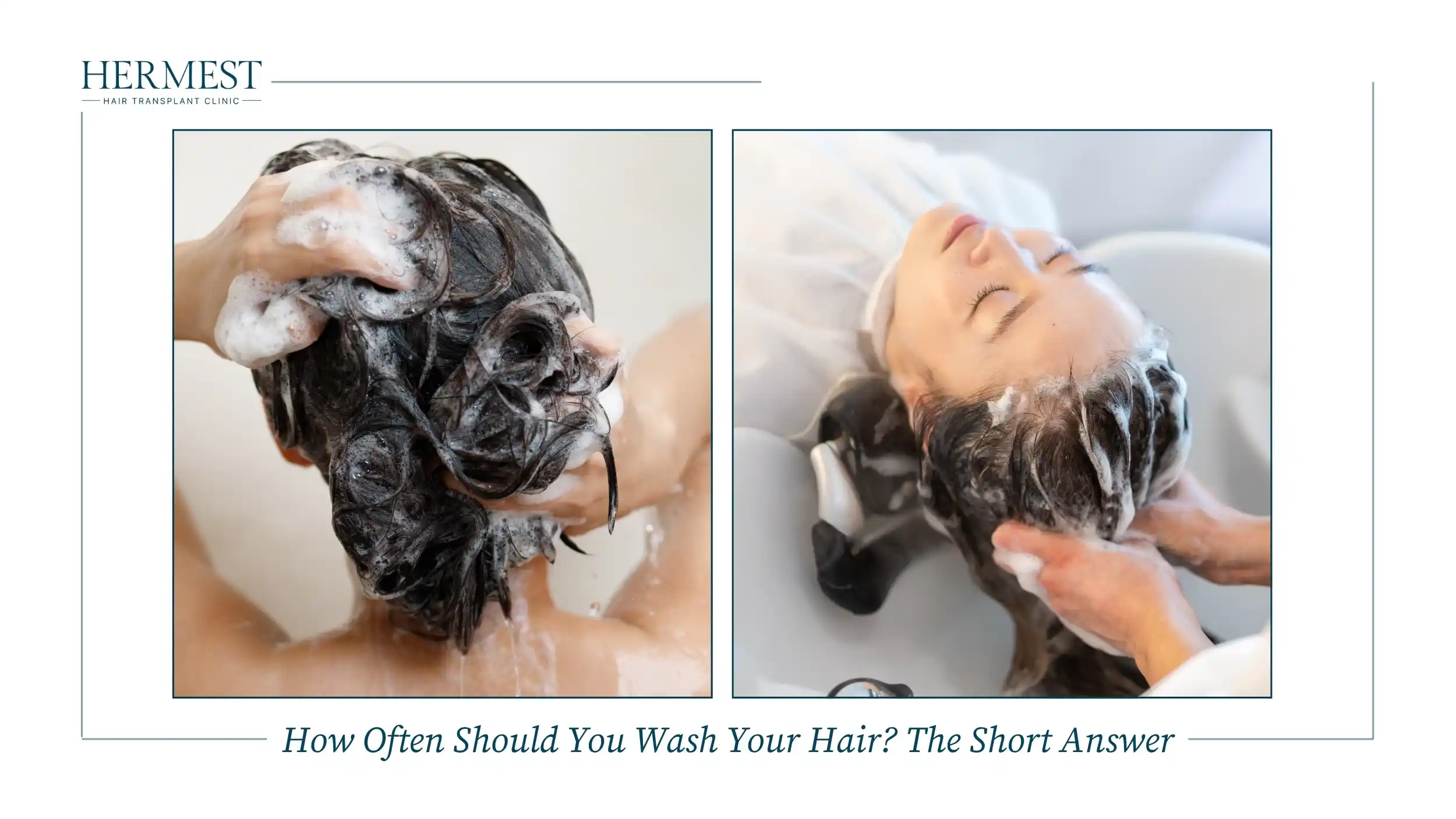
How Often Should You Wash Your Hair? The Short Answer
Wash your hair as often as your scalp needs cleansing, which for most adults means every one to three days. The American Academy of Dermatology put it simply that you should wash based on how often your hair gets dirty or oily, and with straight hair and an oily scalp, daily shampooing may suit you. Hair type changes the number because sebum slides easily down straight strands but travels slowly along curls and coils.
What Leading Dermatology Sources Agree On
| Source | Hair/scalp focus | Finding |
|---|---|---|
| Skin Appendage Disorders, 2021 | 1,500 Asian adults | 5–6 washes/week had the best overall scores; daily washing beat weekly. |
| Journal of Cosmetic Dermatology, 2016 | Scalp conditions | Daily washing improved scaling and itch in people with seborrheic dermatitis or psoriasis. |
| Journal of Dermatology, 2024 | Afro-textured hair | Weekly washing reduced dandruff and scalp itch; benefits did not last beyond a week. |
| Dermatology Research and Practice, 2026 | 4,796 Saudi participants | Higher shampoo frequency was associated with better hair and scalp condition. |
The sources agree on four points: oily and fine hair can be washed daily, most people sit between daily and every three days, coily hair is washed weekly or fortnightly, and an itchy, flaky scalp is a reason to wash more.
Is It Bad to Wash Your Hair Every Day?
Not for most people with straight, fine or oily hair, provided the shampoo is gentle and goes on the scalp. In the controlled phase of the 2021 study by Punyani and colleagues, daily washing outperformed weekly washing on every measure with no objective hair damage. Daily shampoo is more likely to dry out long, curly, coily, bleached or chemically treated hair, which does better with fewer shampoos and more conditioning.
What Builds Up on Your Scalp Between Washes?
Shampoo cleans the scalp first and the hair second. Its surfactants lift oil, sweat, dead skin, and product residue so water can rinse them away. Each follicle’s sebaceous gland releases sebum, which in small amounts protects and softens hair. The problem is accumulation.
Some oil is useful. Sebum helps the scalp keep its moisture, reduces friction along the hair shaft, and gives hair its natural shine, which is why stripping it completely with harsh, frequent washing can leave hair dull and brittle. The goal of washing is not a squeaky-clean scalp, but one where oil, sweat and flakes never sit long enough to cause itch, odour or flaking.
When washes are stretched beyond what your scalp tolerates, roots go flat and shiny, surface oils oxidise and can irritate skin, and the scalp yeast Malassezia gets more lipids to feed on. Mayo Clinic dermatologist Dr. Dawn Davis notes that without regular shampooing, dead skin and oil residue build up and can lead to dermatitis or dandruff. Odour and, in some people, inflamed follicles (folliculitis) can follow.
Why You See More Hair on Wash Day
Shedding 50-100 hairs a day is normal. Loose hairs stay tangled until washing releases them, so washing every four days shows you about four days of normal shedding at once.
Can You Train Your Scalp to Make Less Oil?
No convincing evidence supports “scalp training.” Sebaceous glands respond mainly to androgen hormones and genetics, which is why oil peaks after puberty and falls with age. Washing removes surface oil without resetting the glands; what changes during “training” is usually tolerance for oilier hair. The related claim that over-washing makes the scalp “rebound” with extra oil is debated and lacks controlled evidence. Harsh shampoos can, however, irritate the scalp and dry the ends, making oily roots look worse.
Dr. Nesim Tugen says:
“You cannot wash your way to less oil, and you cannot skip your way there either. Oil production is hormonal. What you can control is how clean and calm the scalp stays, through regular, gentle cleansing matched to how quickly your own scalp gets oily.”
Which Factors Change How Often You Need to Wash?
| Factor | Wash more often | Wash less often |
|---|---|---|
| Scalp oil | Oily scalp or skin | Dry or sensitive scalp |
| Hair texture | Fine, straight strands | Thick, coarse, curly or coily strands |
| Hair length | Short hair (roots show oil fast) | Long hair (older, drier ends) |
| Age and hormones | Puberty, young adulthood | Older age, post-menopause |
| Scalp conditions | Dandruff, seborrheic dermatitis | Very dry, easily irritated scalp |
| Sweat and headwear | Daily training, outdoor work, helmets, hats | Low-sweat routines |
| Styling products | Gels, waxes, sprays, dry shampoo | Minimal product |
| Chemical treatment | — | Bleach, colour, relaxers, perms |
| Environment | Humid heat, pollution, dust, pollen | Cold, dry climates |
How Each Factor Changes Your Wash Schedule
- Oil, age, and hormones. Sebaceous glands respond to androgens, so oil rises at puberty and declines with age; many women notice a drop after menopause. Pregnancy, hormonal contraception and some medications can shift it either way.
- Texture, density, and length. Fine strands show oil fast; dense, coarse hair hides it longer. Curl bends slow sebum, so a curly scalp can be oily while the ends stay dry. Long ends can be years old and need protection even when the scalp needs frequent cleansing.
- Sweat and exercise. Dermatologists differ here. Houston Methodist’s Dr. Jennifer Maender lists heavy sweating and hats or helmets as reasons to wash more often, while Cleveland Clinic’s Dr. Shilpi Khetarpal advises keeping a steady schedule regardless of exercise. Both agree sweat shouldn’t sit long enough to cause itch or odour: a water rinse after training often suffices, with a shampoo when the scalp still itches or smells.
- Products. Styling products leave residue regular shampoo may not fully remove. Dr. Khetarpal suggests a clarifying shampoo once or twice a month for heavy product users; a chelating version also removes hard-water minerals.
- Climate. Hot, humid summers often call for an extra wash or two a week; dry winters and indoor heating can dry the scalp.
- Hair structure and ancestry. Tightly coiled hair, common in people of African descent, is more fragile and prone to dryness, so many recommend washing it less often. Fine, straight hair, common in many East Asian populations, shows oil quickly; the 2021 study found daily washing beneficial in Asian adults. Individual hair matters more than ancestry, so treat these as starting points.
Wash Schedule by Hair Texture and Oil Speed
Two people with identical curls can have very different scalps, so the matrix combines both. Find your texture row, then the column matching how quickly your roots turn oily after a wash.
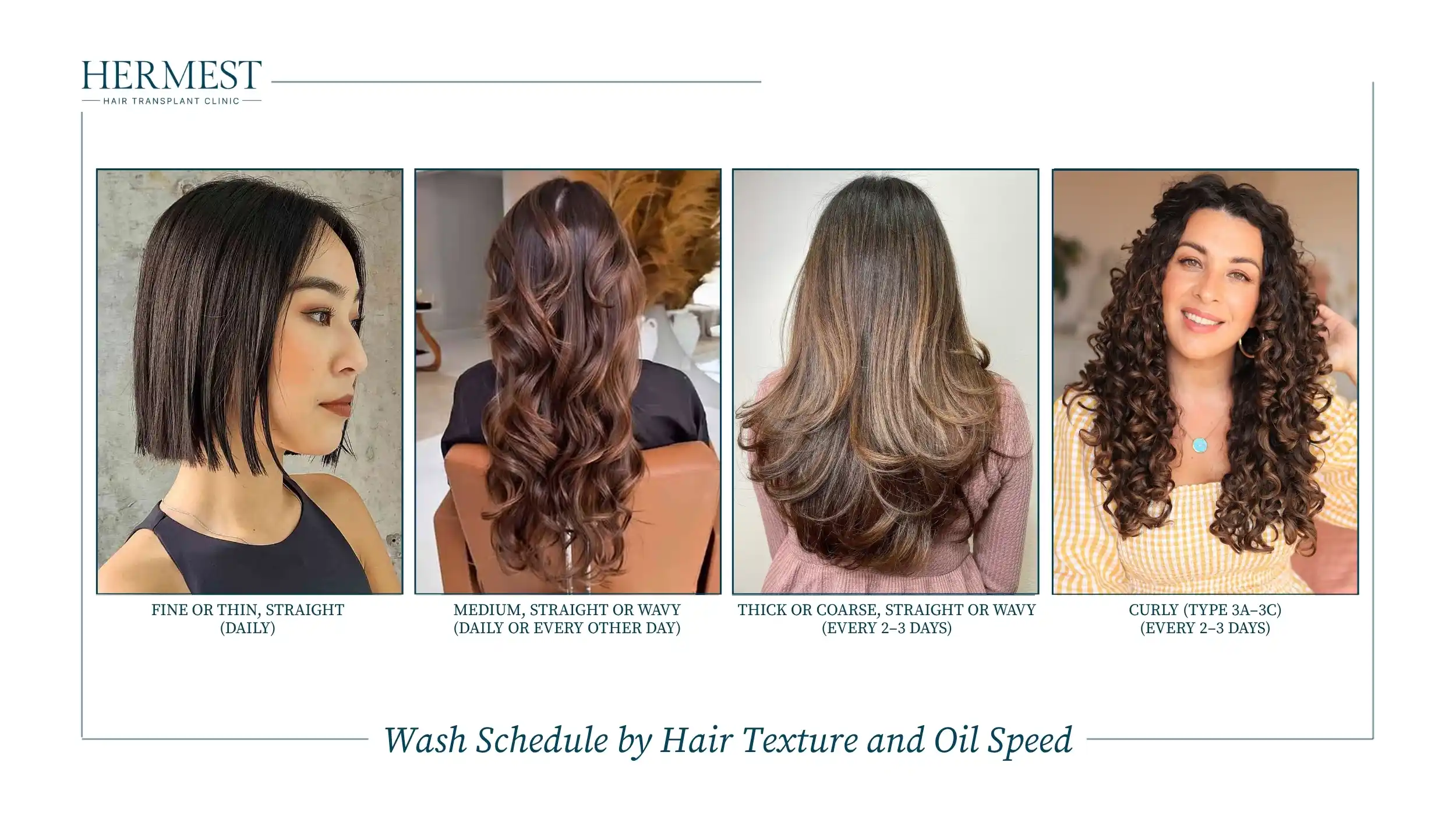
| Hair texture | Oily by day 1–2 | Oily by day 3–4 | Comfortable 5+ days |
|---|---|---|---|
| Fine or thin, straight | Daily | Every 1–2 days | Every 2–3 days |
| Medium, straight or wavy (type 1–2) | Daily or every other day | Every 2–3 days | Every 3–4 days |
| Thick or coarse, straight or wavy | Every 2–3 days | Every 3–4 days | Every 4–6 days |
| Curly (type 3A–3C) | Every 2–3 days, scalp-focused | Twice a week | Once a week, rinse or co-wash between |
| Coily or kinky (type 4A–4C) | Once or twice a week, scalp-focused | Once a week | Every 1–2 weeks |
Two rules override the matrix. If your scalp itches, flakes or smells before wash day, wash and if your lengths feel dry or tangle easily after a week, move one column right and add conditioning.
Fine, straight and wavy hair show oil fastest. Use a light, “daily use” or volumising shampoo on the scalp and condition only the ends, for fine or straight hair. Waves often have oily roots and drier mid-lengths, so most people with waves land on every two to three days.
Curly Hair (Type 3)
If you have curly hair and wonder how often you should wash it, one or two shampoos a week suits most people. Curls lose moisture quickly, so frequent shampooing increases frizz and breakage. A mid-week water rinse or co-wash refreshes the pattern, and conditioning dry or curly hair along its entire length. See our guide to types of curly hair explains how 3A, 3B and 3C curls differ.
Coily and 4C Hair (Type 4)
How often should you wash 4C hair? Once a week to once every two weeks. This range to prevent product build-up, with conditioner at every wash, coating the fragile ends. Sebum barely travels along tight coils, and each bend is a potential breakage point. Even when 4c hair doesn’t look oily, the scalp still needs cleansing; most guidance suggests not exceeding two to three weeks.
- Pre-poo with oil or conditioner and detangle in sections before washing.
- Shampoo the scalp section by section with a moisturising, sulfate-free formula.
- Deep condition on wash day or do a hot oil treatment twice a month.
- For braids, twists or locs, apply diluted shampoo to the parts with a nozzle bottle and dry completely.
Dr. Nesim Tugen says:
“With coily and 4c hair, the aim is to clean the scalp without stripping the lengths. Washing once a week or every other week usually achieves that. Going much longer can leave build-up and itch, so the scalp, not the curl pattern, decides when it’s time.”
Coloured, bleached, relaxed, or permed hair needs fewer, gentler washes than its natural texture would, with a colour-safe or sulfate-free shampoo, conditioner every time, and lukewarm water to slow fading.
How to Find Your Own Wash Schedule in Three Weeks
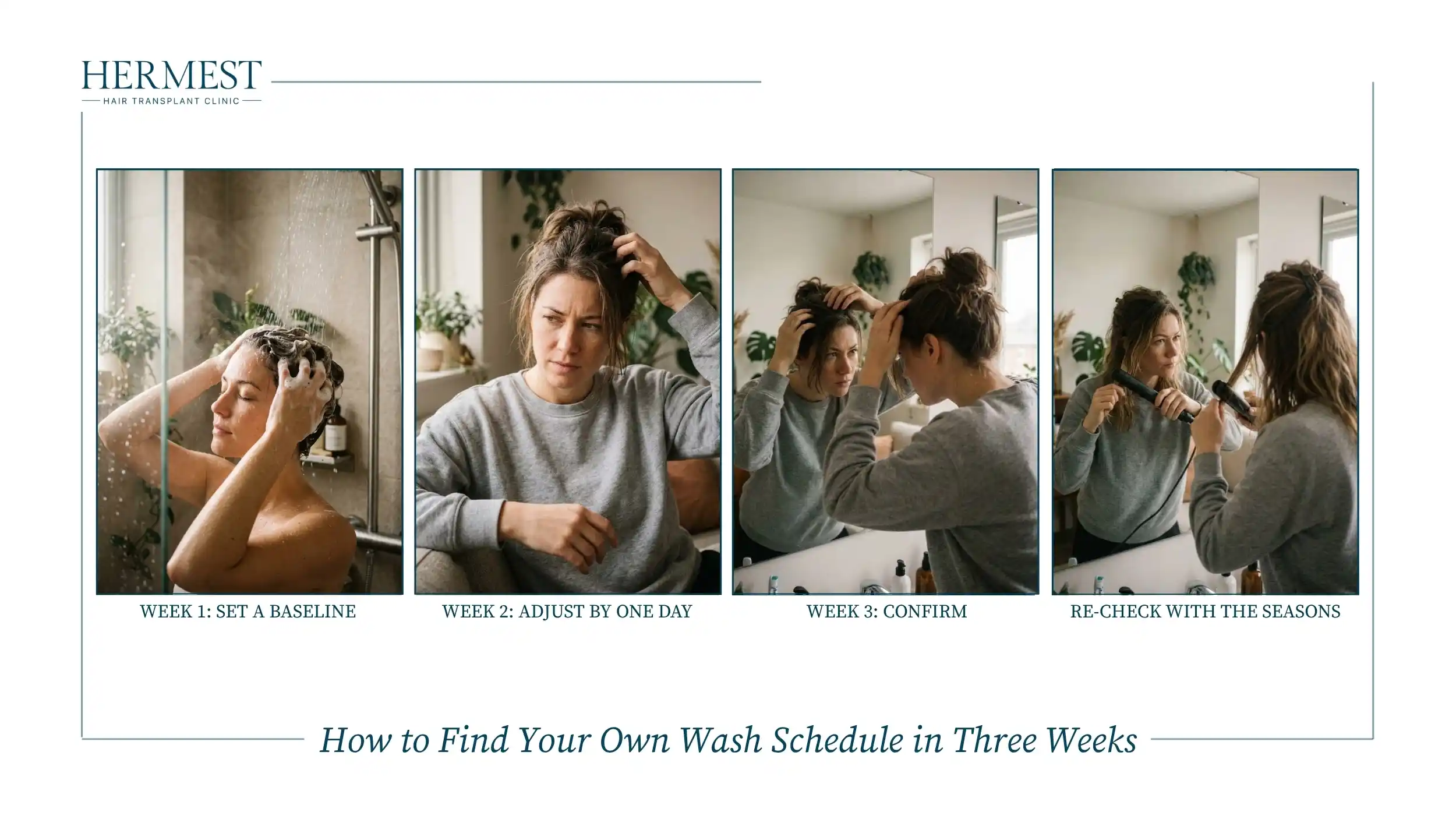
The matrix gives you a starting point, but your own scalp gives the final answer. A simple three-week test replaces guesswork with evidence from your own hair, and it works for every texture.
- Week 1: Set a baseline. Wash on the schedule your matrix row suggests, using a gentle shampoo on the scalp and conditioner on the lengths. Each evening, note three things: how your roots look (fresh, slightly flat or greasy), how your scalp feels (comfortable, itchy or tight) and how your ends feel (soft or dry). A phone note or calendar is enough.
- Week 2: Adjust by one day. If your scalp felt oily or itchy before most wash days, move one day closer together. If your scalp stayed comfortable but your ends felt dry, move one day further apart. Change only one thing at a time, so you know what made the difference.
- Week 3: Confirm. Keep the adjusted schedule and compare your notes. The right rhythm is the one where your scalp stays comfortable until wash day and your lengths stay soft the day after washing.
- Re-check with the seasons. Many people need one extra wash a week in hot, humid months and one fewer in cold, dry ones. A new medication, pregnancy, a change in training, or a new styling product can also shift your needs.
If your scalp never feels comfortable at any frequency, or flakes and itch persist whatever you change, the schedule is not the problem. That pattern usually points to dandruff, seborrheic dermatitis, or a product irritant, covered next.
Washing With Dandruff, Seborrheic Dermatitis or a Dry Scalp
If you’re asking how often you should wash your hair if you have dandruff, the answer is usually more often than now. Clinical studies advise people with fine or straight hair or an oily scalp to shampoo daily or every other day, using a dandruff shampoo twice a week. People with coarse, curly or coily hair should wash when needed and use a dandruff shampoo about once a week, on the scalp only, because the actives can dry the lengths. Dandruff isn’t caused by poor hygiene, though letting oil and flakes accumulate feeds Malassezia.
| Active ingredient | How it works | Practical note |
|---|---|---|
| Ketoconazole | Antifungal | Common first choice for seborrheic dermatitis |
| Zinc pyrithione | Antifungal, antibacterial | Gentle enough for frequent use |
| Selenium sulfide | Slows cell turnover; antifungal | Can discolour light or treated hair |
| Salicylic acid | Lifts scale | Can dry the scalp if overused |
| Coal tar | Slows cell turnover | Increases sun sensitivity; may stain light hair |
| Sulfur | Loosens scale | Often combined with salicylic acid |
Apply medicated shampoo to the scalp, lather, and leave it on for the time on the label; some need 5–10 minutes. Rinse well, condition the lengths if your hair is dry or curly, and give a new shampoo several weeks. If one stops working, alternate with a different active ingredient.
Dandruff, Seborrheic Dermatitis or Dry Scalp?
| Feature | Dandruff | Seborrheic dermatitis | Dry scalp |
|---|---|---|---|
| Flakes | White or yellowish, oily | Yellowish, greasy scale | Small, white, powdery |
| Redness | Little or none | Red, inflamed patches | Usually none |
| Other areas | Scalp only | Eyebrows, nose folds, ears, beard | Dry skin elsewhere, worse in winter |
| Wash frequency | More often + medicated | More often + medicated; may need prescription | Gentler shampoo, sometimes fewer washes |
Burning or persistent itch can have other causes; see our guides to burning scalp hair loss and whether an itchy scalp means hair growth.
Dr. Nesim Tugen says:
“When a patient with flaking tells me they’ve stopped washing to let the scalp rest, the flakes are almost always worse. For most dandruff, regular washing and the right active ingredient do the work. If flaking persists, spreads to the face, or comes with thinning, it needs a proper scalp examination.”
See a dermatologist if shampoos haven’t helped after several weeks, if the scalp is red, painful, or weeping, or if thick, silvery scales stay stuck, which can point to psoriasis.
Does Sex or Age Change the Answer?
Sex and age change the answer through hormones, hair length, and styling habits rather than different scalp biology.
Men
How often should you wash your hair as a man? With short hair, daily or every other day usually works. Androgens make men’s sebaceous glands more active on average, and short hair shows oil quickly but dries fast, so frequent washing rarely causes dryness.
- Thinning hair: Oily roots clump strands and expose scalp, so washing more often with a light volumising shampoo makes thinning hair look fuller.
- Beards: Seborrheic dermatitis often affects the beard and eyebrows too; the same medicated shampoo can usually be used there.
- Longer, curly or coily hair: Follow the texture matrix, not the short-hair rule.
Shampoo doesn’t speed up male pattern baldness, which is driven by genetics and the action of DHT on susceptible follicles. Check our guide to the causes of hair loss, which explains what does.
Women
For a woman wondering how often to wash her hair, two to three times a week is a common starting point, but texture and length matter more than sex. Fine, straight, oily hair may need daily washing; long, thick, curly or coloured hair may manage once or twice a week.
- Long lengths, colour and heat: Shampoo the scalp, condition the lengths, use colour-safe formulas and heat protectant.
- Hormonal shifts: Oiliness varies with the menstrual cycle, pregnancy and menopause, when many women find the scalp drier. Hermest’s guide to the best shampoo for menopausal hair loss covers that stage.
- Postpartum shedding: Common a few months after birth and usually temporary; washing only collects hairs already loose.
- Tight styles between washes: Tight buns or ponytails used to hide oil can cause traction alopecia; looser styles are safer.
Teenagers, Children and Older Adults
Teenagers often need daily or near-daily washing because puberty sharply increases sebum. Younger children produce little scalp oil and usually need shampoo less often than adults, though Mayo Clinic notes older, more active children generally need it more often. In older adults, the scalp makes less oil, so washes can often be spaced further apart, with a moisturising shampoo for drier or grey hair.
Does Washing Frequency Affect Hair Growth or Hair Loss?
Washing frequency doesn’t change how fast hair grows, and it neither causes nor cures hereditary hair loss. Growth, roughly a centimetre a month for most adults, is set by genetics, age, hormones and health. So if you’re looking for how often to wash hair for growth, the answer is whatever schedule keeps your scalp clean and calm while limiting breakage.
“Dirty hair grows faster” is a myth rooted in length retention. People who wash less often may also brush and heat-style less, so fewer strands snap; the hair isn’t growing faster. At the other extreme, an itchy, inflamed scalp invites scratching, and seborrheic dermatitis can be associated with increased shedding.
Why the Hair Growth Cycle Ignores Your Shampoo Schedule
Each scalp hair follows its own cycle, independent of its neighbours. In the growth phase (anagen), which lasts roughly two to seven years, the follicle produces hair continuously; at any moment, most scalp hairs are in this phase. A short transition phase (catagen) of a few weeks follows, then a resting phase (telogen) of about three months, after which the hair is released, and a new one starts growing beneath it.
Shampoo acts on the surface of the scalp and the hair shaft, not on the follicle’s timing, so it cannot lengthen anagen or speed up growth. What it can do is keep the skin around the follicle free of heavy build-up and inflammation. This is also why sudden heavy shedding usually reflects an event two to three months earlier, such as illness, a high fever, childbirth, crash dieting or major stress, rather than a change in how often you wash.
Does Washing Cause Hair Loss?
No. Shampoo doesn’t pull growing hairs from the follicle. Normal hair shedding can rise temporarily after illness, childbirth, or stress. True hair loss where something stops growth, such as hereditary hair loss, some medicines, tight hairstyles, or autoimmune conditions. Breakage is different again: shed hairs are full-length with a small white bulb, while broken hairs are short pieces caused by rough towelling, brushing wet hair, heat or harsh chemicals.
See a doctor if you notice shedding clearly heavier than normal for more than a few months, a widening part, a receding hairline or crown thinning, or patches, scalp pain or scarring.
Dr. Nesim Tugen says:
“No wash schedule causes genetic hair loss, and none will stop it. A clean, calm scalp is the foundation for healthy hair, but if density is changing, we need to look at the follicles and the pattern of loss. That is where the real treatment decisions are made.”
For thinning hair, a gentle volumising shampoo and light conditioner on the ends make hair look fuller. Ingredients such as ketoconazole have been studied as add-ons in hair-loss care, but no shampoo replaces evidence-based treatment.
Not sure whether it’s shedding or hair loss? If you’ve noticed a widening part, a receding hairline, or thinning at the crown, Hermest’s team can review photos of your scalp through a free hair analysis and explain what may be driving it and which options could fit.
Sample Weekly Wash Plans
So how often should you wash your hair in a week? Most people land between once and seven times. Adjust these plans by one day at a time.
| Profile | Mon | Tue | Wed | Thu | Fri | Sat | Sun | Shampoos per week |
|---|---|---|---|---|---|---|---|---|
| Oily scalp, fine straight hair | Shampoo | Shampoo | Shampoo | Shampoo | Shampoo | Shampoo | Optional | 6–7 |
| Normal scalp, wavy hair | Shampoo | — | Shampoo | — | — | Shampoo | — | 3 |
| Curly hair (type 3) | Shampoo + condition | — | Rinse or co-wash | — | — | Shampoo + condition | — | 2 |
| 4c hair | — | — | — | — | — | Pre-poo, shampoo, deep condition | — | 1 (or every 2 weeks) |
| Dandruff, straight hair | Medicated | Regular | Regular | Medicated | Regular | Regular | Rest | 6, incl. 2 medicated |
| Daily gym, short hair | Wash | Wash | Wash | Rest day | Wash | Wash | Rest | 5 |
Care Between Washes
- Dry shampoo absorbs oil for a day or two but doesn’t remove sweat or flakes and adds residue. Needing it daily means you need a real wash.
- Water rinses clear much of the sweat after exercise and refreshes curls, but removes only part of the oil.
- Co-washing suits many curly and coily heads. Claims that it rebalances oil production lack research, and conditioner can’t clear heavy build-up, so alternate it with shampoo.
- Brushing dry, straight hair gently spreads sebum toward the ends; use a wide-tooth comb on wet hair.
- Leave-in conditioner or light oil helps dry lengths; keep heavy oils off an oily or flaky scalp.
- A satin pillowcase, bonnet or scarf reduces friction and helps curly and long hair last between washes.
- Apple cider vinegar rinses are popular online, but there is little research behind claimed benefits. Undiluted vinegar can irritate the scalp, and it doesn’t replace shampoo.
Signs You’re Washing Too Much or Too Little
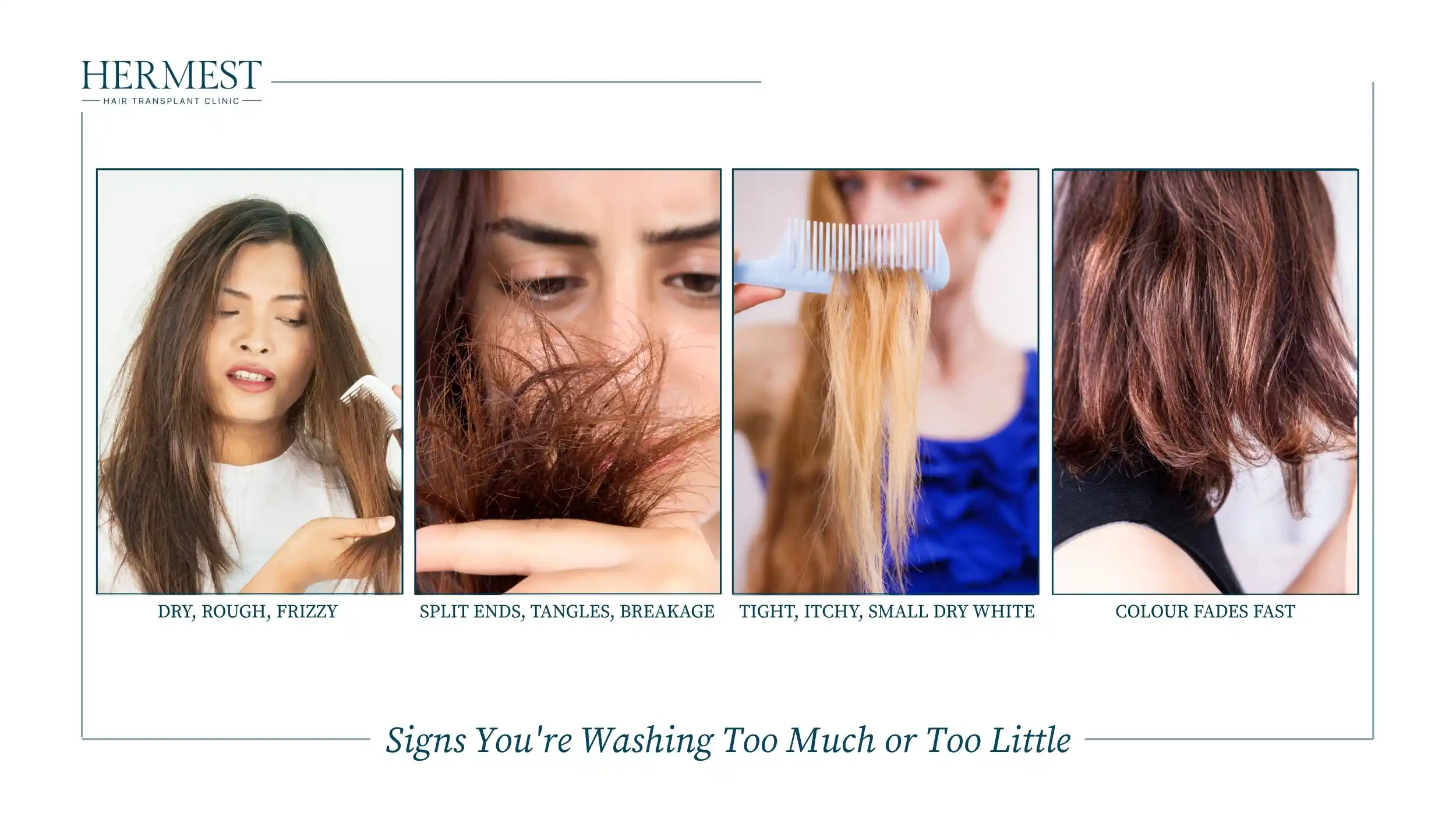
Dry lengths point to too much washing or too harsh a shampoo; an itchy, flaky, oily scalp points to too little. Cleveland Clinic’s Dr. Khetarpal describes itching, redness, and flaking as signs scalp yeast may be overgrowing.
| Sign | Likely over-washing | Likely under-washing |
|---|---|---|
| Hair feel | Dry, rough, frizzy | Flat, limp, greasy within hours |
| Ends | Split ends, tangles, breakage | Usually unaffected |
| Scalp | Tight, itchy, small dry white flakes | Itchy, oily, yellowish flakes worsening through the week |
| Other | Colour fades fast | Odour, products stop working, daily dry shampoo, tender bumps |
If you’re over-washing: add one day between washes, switch to a gentle sulfate-free shampoo on the scalp only, condition every time, add a weekly hydrating mask, blot with a microfibre towel, limit heat styling and trim split ends. Give the scalp two to three weeks to settle.
If you’re under-washing: add a wash day before changing products. If itch and flakes persist after two weeks, bring in a medicated dandruff shampoo, and clarify once if styling residue has built up. A red, sore, or weeping scalp needs a dermatologist.
How to Wash Your Hair Properly
A gentle, scalp-focused technique lets most people wash as often as their scalp needs without drying their hair.
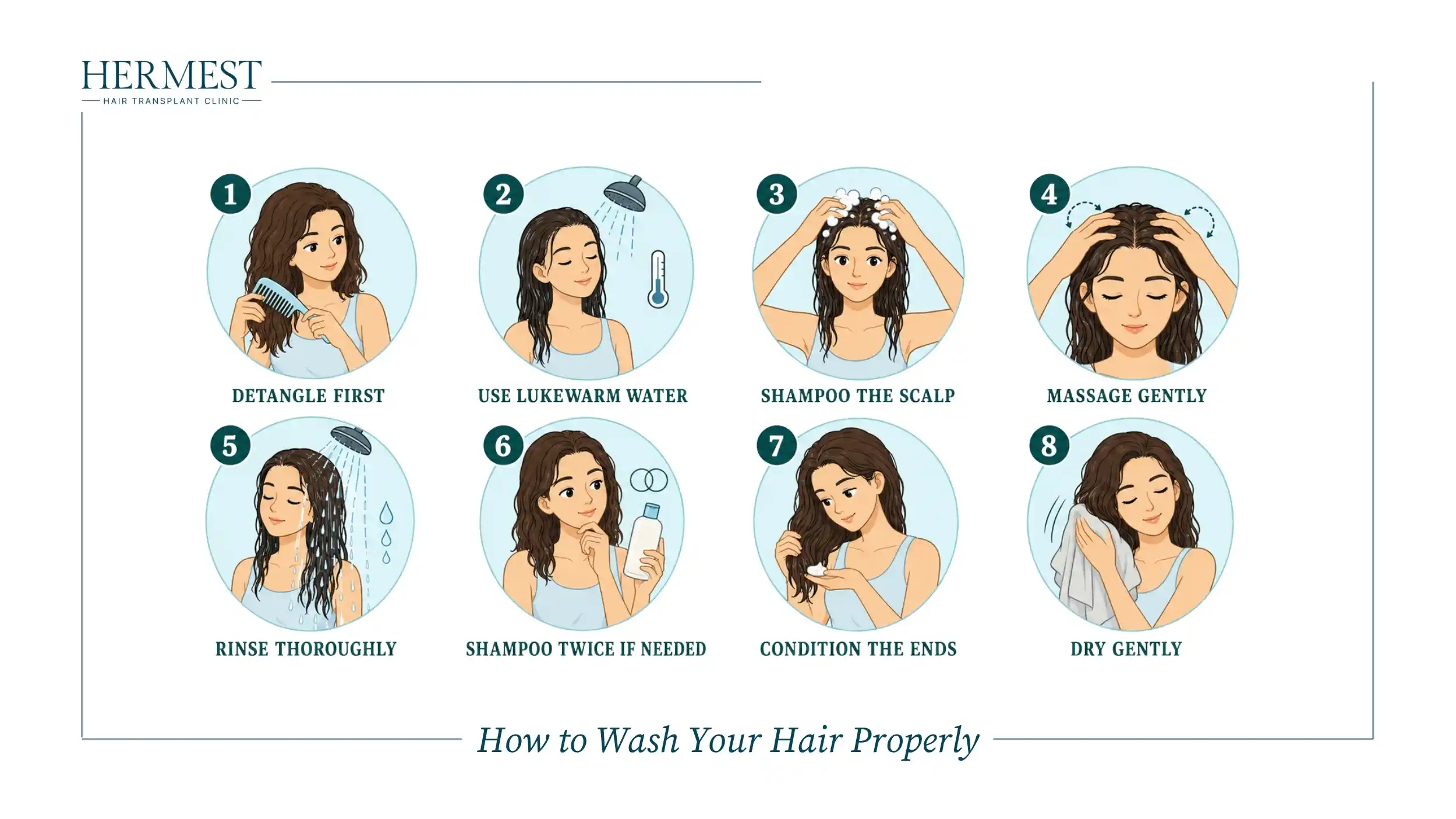
- Detangle first if hair is curly, coily, or long; wet hair breaks more easily.
- Wet thoroughly with lukewarm water. Hot water strips more oil and can irritate the scalp.
- Apply shampoo to the scalp, not the lengths, to remove oil and residue without over-drying the ends.
- Massage with fingertips, not nails, for about a minute.
- Rinse until the scalp no longer feels slippery; the lather cleans the lengths on the way out.
- Shampoo twice only when needed, after several days between washes, heavy product, or a sweaty workout.
- Condition the right section: ends only for fine or straight hair, full length for dry, curly or coily hair.
- Dry gently with a microfibre towel or cotton T-shirt, and use low heat where possible.
Match the shampoo to the job: a mild “daily use” formula for fine or oily hair washed daily, a volumising one for fine or thinning hair, and a hydrating or sulfate-free formula for dry, curly, coily, coloured or treated hair. Add a clarifying or chelating shampoo once or twice a month for build-up, hard water or chlorine, and a medicated shampoo for dandruff on the schedule above. Price is a poor guide; many brands provide similar benefits regardless of cost. Swimmers should wet and condition hair before swimming, wear a cap, and shampoo soon after with a gentle or swimmer’s formula.
Washing After a Hair Transplant
Everything above assumes an intact scalp. After a hair transplant, the scalp is healing from thousands of tiny incisions, so washing becomes part of medical aftercare. In the first days after FUE or DHI, grafts aren’t yet anchored and can be dislodged by rubbing or strong water pressure, yet crusts around them still need softening and removing. Early washing therefore cleans the recipient area while protecting every graft.
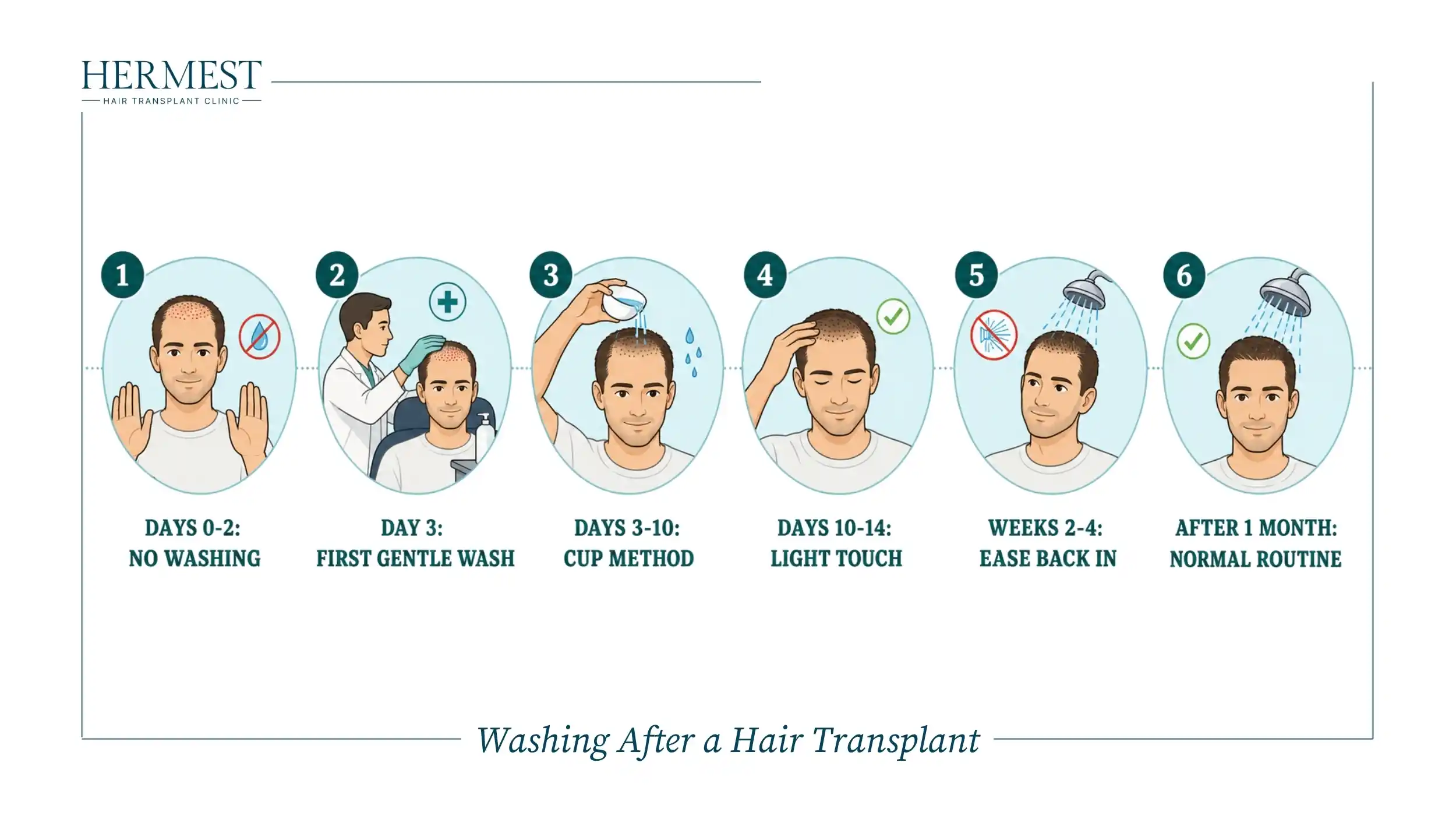
| Period after surgery | Washing approach |
|---|---|
| Days 0–2 | No washing of the grafted area; avoid contact |
| Around day 3 | First gentle wash, performed at Hermest clinic with physician-selected shampoo |
| Days 3–10 | Daily gentle washing with the cup method; pat dry, no rubbing |
| Days 10–14 | Most scabs have shed; light fingertip contact with your doctor’s approval |
| Weeks 2–4 | Gradual return to normal washing; avoid strong jets and vigorous towelling |
| After about 1 month | Usual frequency for your hair type unless your surgeon advises otherwise |
This follows Hermest’s hair transplant aftercare guide; your surgeon’s own plan always comes first.
How to Wash Grafts Safely
- Use only the gentle, pH-balanced shampoo your clinic provides or recommends.
- Mix shampoo with lukewarm water in a cup and pour it slowly over the grafts, or press lather on without rubbing; rinse the same way.
- Pat dry with a clean paper towel, and never pick scabs.
- Keep the donor area clean, following your clinic’s guidance.
Dr. Nesim Tugen says:
“In the first two weeks, washing is part of the treatment, not just hygiene. Gentle daily washing keeps the grafts clean and lets the scabs come away on their own. That is why we perform the first wash at the clinic and show every patient exactly how to continue at home.”
Shedding between roughly weeks 3 and 6 (shock loss) is expected and not caused by washing; new growth typically appears from month 3, with final results between months 6 and 12. If you’re considering a transplant, Hermest’s team can review your scalp through a free hair analysis.
Online Hair-Washing Advice: What Holds Up?
Searches like “how often should you wash your hair reddit” lead to communities such as r/HaircareScience, r/curlyhair, and r/malehairadvice, where many routines are built and which patients often follow for months before a consultation. Checked against dermatology guidance, the most repeated claims fall into three groups:
- Not supported: “Wash less and your scalp will make less oil” (hormones control sebum), “Shampoo makes your hair fall out” (it only collects already-shed hairs), and “Dirty hair grows faster” (less handling only reduces breakage).
- Partly true: “Daily washing ruins hair” (true for some textured or treated hair, not for fine or oily hair), “Flakes mean over-washing” (dry flakes can; oily, yellowish flakes usually mean dandruff), and “Curls should only be co-washed” (conditioner can’t clear heavy build-up).
- Supported: “Listen to your scalp, not a rule,” which matches AAD (American Academy of Dermatology) guidance.
Forum threads mix hair types and scalp conditions, and research has limits too: the 2021 Punyani study included only Asian adults without scalp disease, and one author was affiliated with Procter & Gamble. Persistent itch, flaking or density changes need a diagnosis, not a crowd-sourced experiment.
Frequently Asked Questions
Coily and 4C hair can often go one to two weeks, ideally not beyond two to three. Straight or fine hair usually becomes uncomfortable within two to four days. Itching, odour, or flaking is the signal to wash.
Final Takeaway: Let Your Scalp Set the Schedule
Start from your row in the texture-and-oil matrix, shampoo the scalp and condition the lengths, then adjust one day at a time: wash sooner if the scalp itches, flakes or smells, and stretch the gap if your lengths feel dry. Wash more, not less, for dandruff. If flaking persists or your hair density changes, have your scalp examined, and if you’re considering hair restoration, we can assess your hair through a free hair analysis.
Sources
- American Academy of Dermatology: Tips for healthy hair
- American Academy of Dermatology: Black hair: tips for everyday care
- American Academy of Dermatology: Do you have hair loss or hair shedding?
- American Academy of Dermatology: How to treat dandruff (Dec 2023)
- Mayo Clinic News Network: How often should you wash your hair?
- Mayo Clinic News Network: How often do kids need to shampoo
- Cleveland Clinic: The dirty truth about washing your hair
- Cleveland Clinic Newsroom: How often should you wash your hair? (Jan 2025)
- Houston Methodist: How often should you wash your hair? (Jul 2024)
- Punyani S, et al. The Impact of Shampoo Wash Frequency on Scalp and Hair Conditions. Skin Appendage Disorders, 2021;7(3):183–193.
- Hermest Clinic: Hair Transplant Aftercare