

Ben Stokes Hair Transplant: FUE, 1,800 Grafts & Results
 ChatGPT
 Claude
 Perplexity
 Grok
Grok
 Gemini


The Ben Stokes hair transplant is one celebrity transformation we don’t need to guess about. England cricket star Ben Stokes has publicly confirmed undergoing hair restoration after becoming increasingly conscious of his thinning hair.
According to Wimpole Clinic, Stokes underwent an FUE hair transplant in London in 2018. The clinic reports that Dr. Mir Malkani transplanted approximately 1,800 grafts, concentrating treatment around Stokes’ temples and crown.
That makes his case particularly useful for men researching receding hairline and crown restoration.
Stokes has also spoken publicly about the personal side of his decision. He described noticing his thinning hair when seeing himself on television and later discussed how pleased he felt after seeing his transplant results.
His story illustrates an important point. Hair restoration isn’t simply about maximizing graft numbers.
A relatively focused 1,800-graft hair transplant can create a noticeable visual improvement in the right candidate. Results depend on the size of the thinning areas, donor density, hair caliber, existing coverage, hairline design, and future progression.
In this guide, we’ll examine the Ben Stokes hair transplant before and after transformation, his confirmed FUE procedure, graft count, treatment areas, expected growth timeline, and what makes his result appear natural.
Quick Insights
- Stokes had his procedure at Wimpole Clinic in London.
- Dr. Mir Malkani performed the reported FUE procedure.
- Approximately 1,800 grafts were transplanted.
- Treatment addressed both temple recession and crown thinning.
- His exact hair transplant cost hasn’t been publicly confirmed.
- 1,800 grafts can provide meaningful coverage for selected patients.
- The same graft count won’t produce identical results for everyone.
- Hairline design, donor density, hair caliber, and existing coverage influence visual density.
- Transplanted follicles can provide long-lasting growth, but surrounding native hair may continue thinning.
- Donor preservation becomes particularly important when transplantation is performed relatively young.
Did Ben Stokes Have a Hair Transplant?
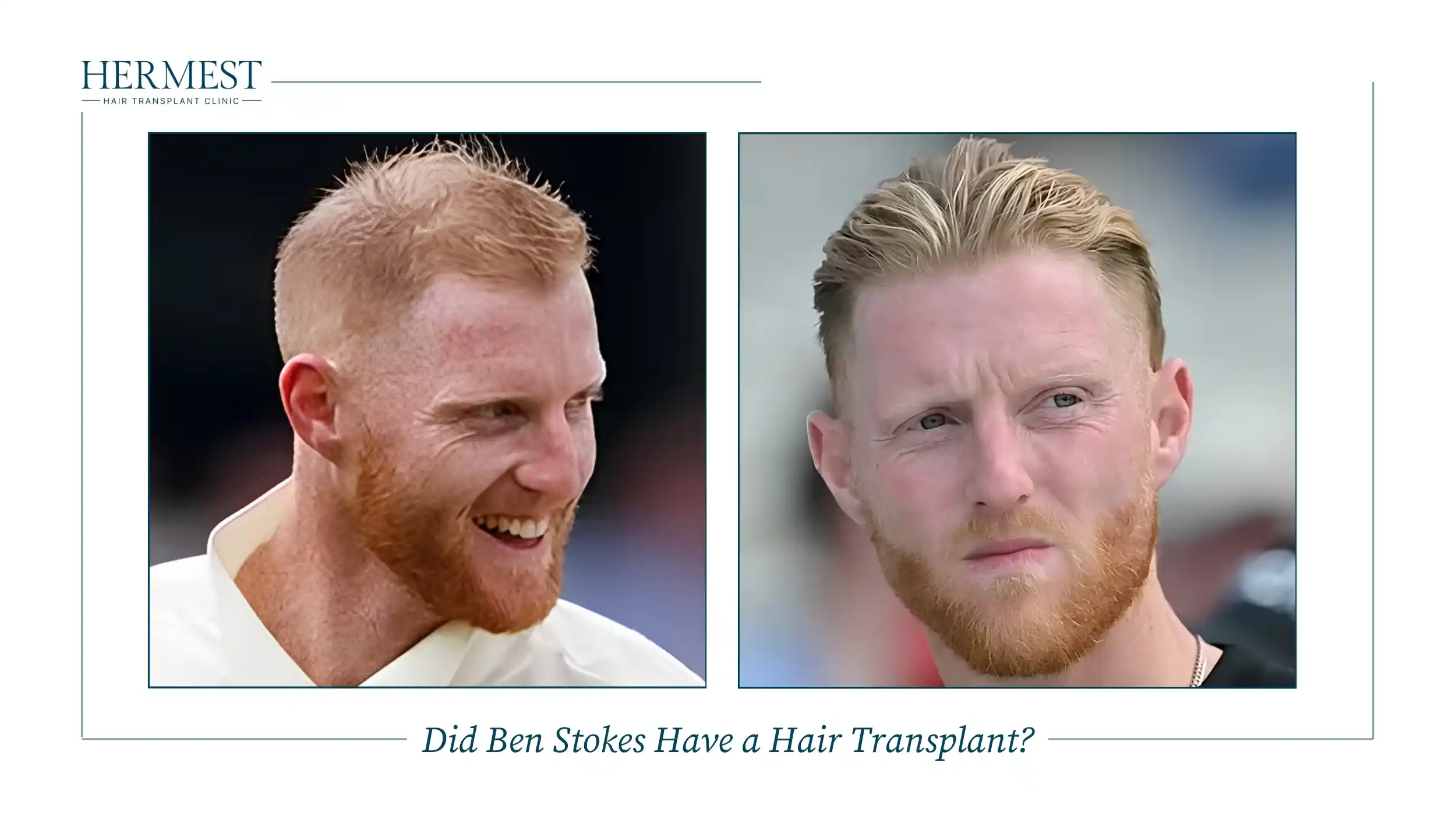
Yes. Ben Stokes had a hair transplant, and the procedure has been publicly confirmed rather than inferred from photographs. The England cricketer underwent an FUE hair transplant involving approximately 1,800 grafts.
The grafts were taken from the back of his scalp and transplanted into areas affected by temple recession and crown thinning.
When Did Ben Stokes Get His Hair Transplant?
Stokes underwent the procedure in 2018, when he was still relatively young and experiencing early signs of hair thinning.
He later explained that overhead television footage made his crown loss particularly noticeable to him. Seeing the thinning repeatedly during cricket broadcasts contributed to his decision to seek treatment.
Where Did Ben Stokes Have It Done?
The Ben Stokes FUE hair transplant was performed at Wimpole Clinic in London.
The clinic identifies Dr. Mir Malkani as the surgeon and reports these procedure details:
- Technique: FUE
- Grafts: approximately 1,800
- Treatment areas: temples and crown
- Year: 2018
These confirmed details make Stokes’ case particularly valuable compared with celebrity transformations based purely on visual speculation.
Why Did Ben Stokes Decide to Have a Hair Transplant?
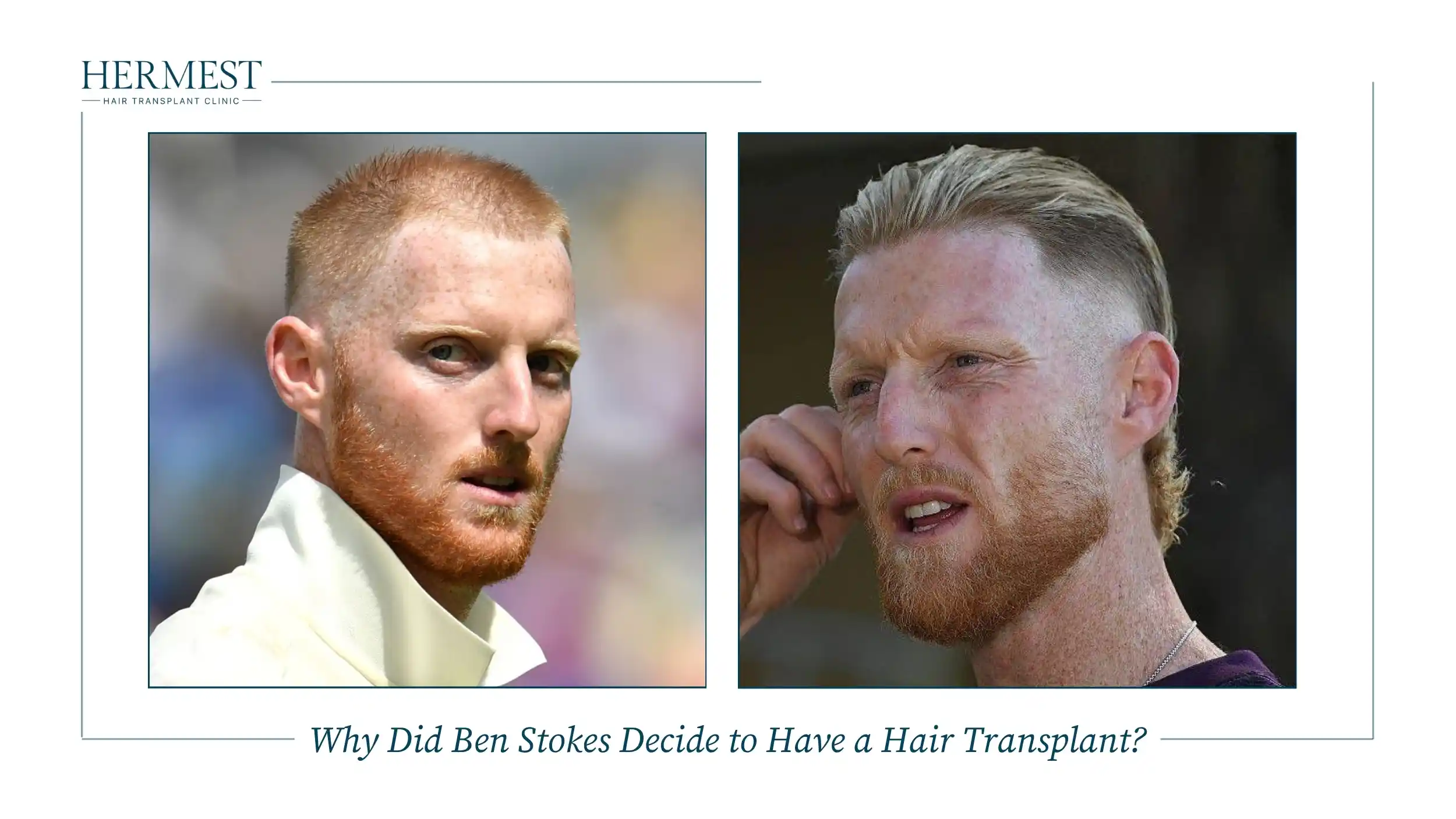
For Ben Stokes, the decision wasn’t simply about changing his hairstyle. He has spoken openly about becoming increasingly conscious of his hair loss while still relatively young.
His visibility as an international cricketer made those changes difficult to ignore.
Noticing His Hair Loss on Television
Stokes told his clinic that thinning had worried him for some time. Photographs and television footage became particular triggers.
When bowling, overhead camera angles frequently showed the top of his head. Stokes said that the more he appeared on television, the more he noticed his hair becoming thin. His teammates had noticed the changes too.
His concerns centered partly around the crown. The clinic’s pre-operative assessment also documented crown thinning, temple recession, and a slightly receding hairline.
Hair Loss and Confidence
Stokes later described small habits that developed around hiding his thinning areas. After removing a cap, for example, he would rearrange his hair to conceal the thinner spot.
Following his FUE hair transplant, he reported a significant improvement in confidence and said he stopped worrying about these everyday situations.
This personal element matters. Hair loss affects people differently, and surgery remains an individual choice rather than something every person with thinning needs.
The Ben Stokes hair restoration story also highlights the value of addressing future progression. Stokes has said his initial consultation included discussion about how his hair could change later, rather than focusing solely on his appearance at that moment.
What Type of Hair Transplant Did Ben Stokes Have?
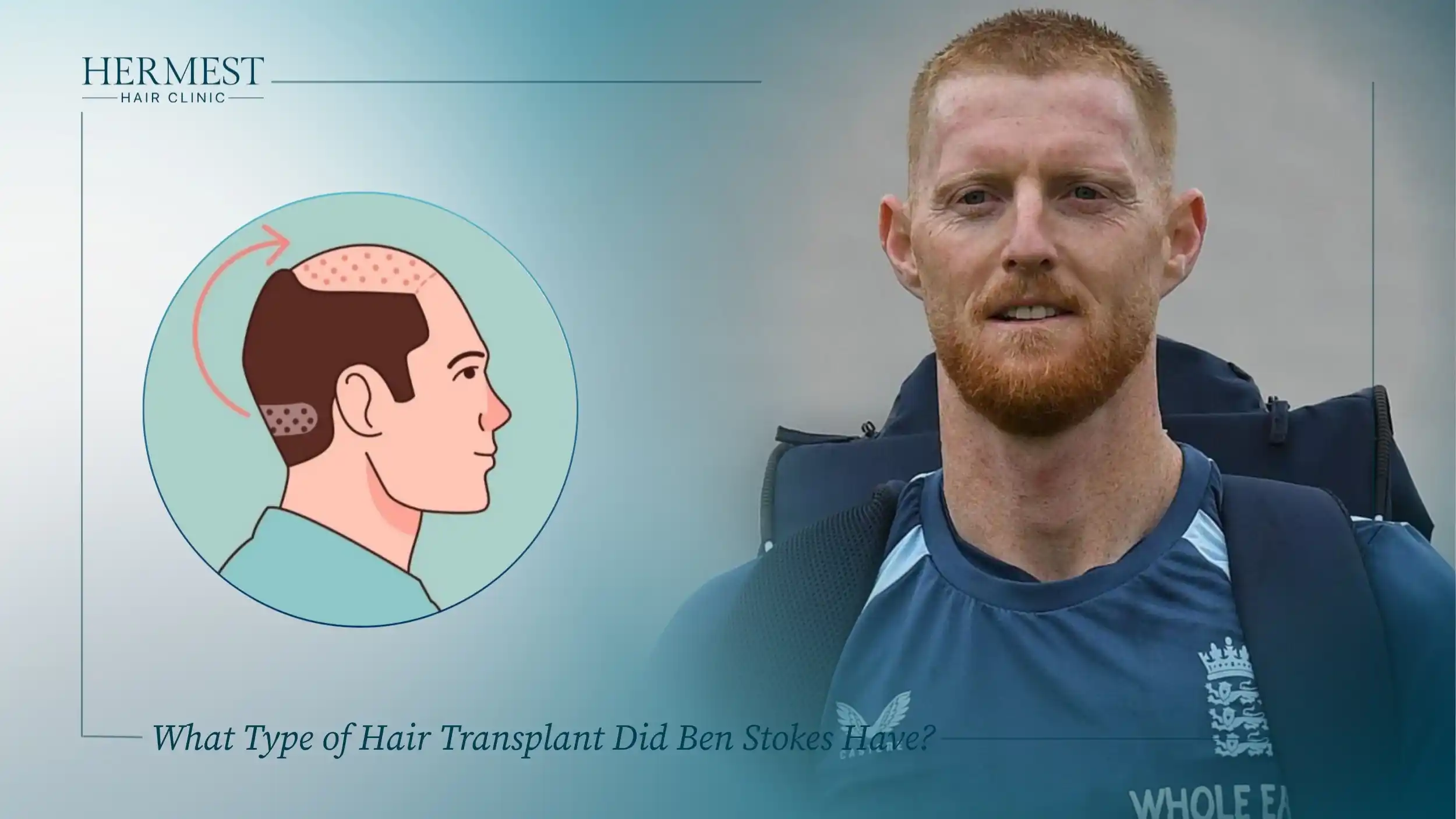
The Ben Stokes hair transplant was performed using FUE, a technique that removes individual follicular units from the donor area before placing them into thinning regions. Wimpole Clinic confirms that Stokes received approximately 1,800 FUE grafts in 2018, targeting his temples, hairline, and crown.
How Does FUE Hair Transplant Work?
During Follicular Unit Excision (FUE), follicular units are individually removed using small punch instruments. The International Society of Hair Restoration Surgery (ISHRS) explains that a follicular unit typically contains between one and four hair follicles, together with supporting structures.
The harvested grafts are then placed into carefully planned recipient sites within thinning areas.
Unlike FUT, FUE doesn’t require removing a linear strip of scalp. Instead, extraction leaves many small circular wounds throughout the donor region, which heal individually.
Why Might FUE Suit This Type of Hair Loss?
We cannot know every factor behind Stokes’ surgeon’s choice. Yet FUE can be well suited to focused restoration involving the temples and crown, particularly when donor management and hairstyle preferences favor individual graft harvesting.
Stokes’ clinic reports that his donor grafts came from the back of his scalp.
Dr. Nesim Tugen says:
“FUE is a method, not a guarantee of a natural result. For a case involving both temples and crown, we focus on donor capacity, graft distribution, hair direction, and future thinning. Those planning decisions can matter as much as the extraction technique itself.”
At Hermest, similar cases would first undergo donor and recipient assessment before determining whether Unique FUE®, DHI, or another strategy fits the patient’s individual pattern.
How Many Grafts Did Ben Stokes Have?
One of the most useful confirmed details about the Ben Stokes hair transplant is the graft count. According to his clinic, Stokes received approximately 1,800 grafts, distributed around his hairline, temples, and crown during his 2018 FUE procedure.
That number provides useful context, but 1,800 grafts doesn’t mean 1,800 individual hairs.
How Much Hair Is 1,800 Grafts?
The International Society of Hair Restoration Surgery (ISHRS) defines a follicular unit as a naturally occurring group containing one to four hair follicles. Its glossary reports an average of approximately 2.4 hairs per follicular unit.
Using that average purely as an illustration, 1,800 grafts could represent roughly 4,300 hairs. Stokes’ actual hair count would depend on the composition of his harvested grafts.
This distinction matters when comparing Ben Stokes hair transplant results with another patient’s proposed surgery.
Is 1,800 Grafts Enough?
It can be.
For someone with relatively limited temple recession and crown thinning, 1,800 carefully distributed grafts may create a noticeable cosmetic improvement. A patient with extensive baldness could require substantially more.
The appropriate graft number depends on:
- Recipient area size and existing density.
- Donor density and hair caliber.
- Hair-to-skin contrast and curl characteristics.
- Desired coverage and future hair-loss progression.
Ben Stokes Hair Transplant Before and After
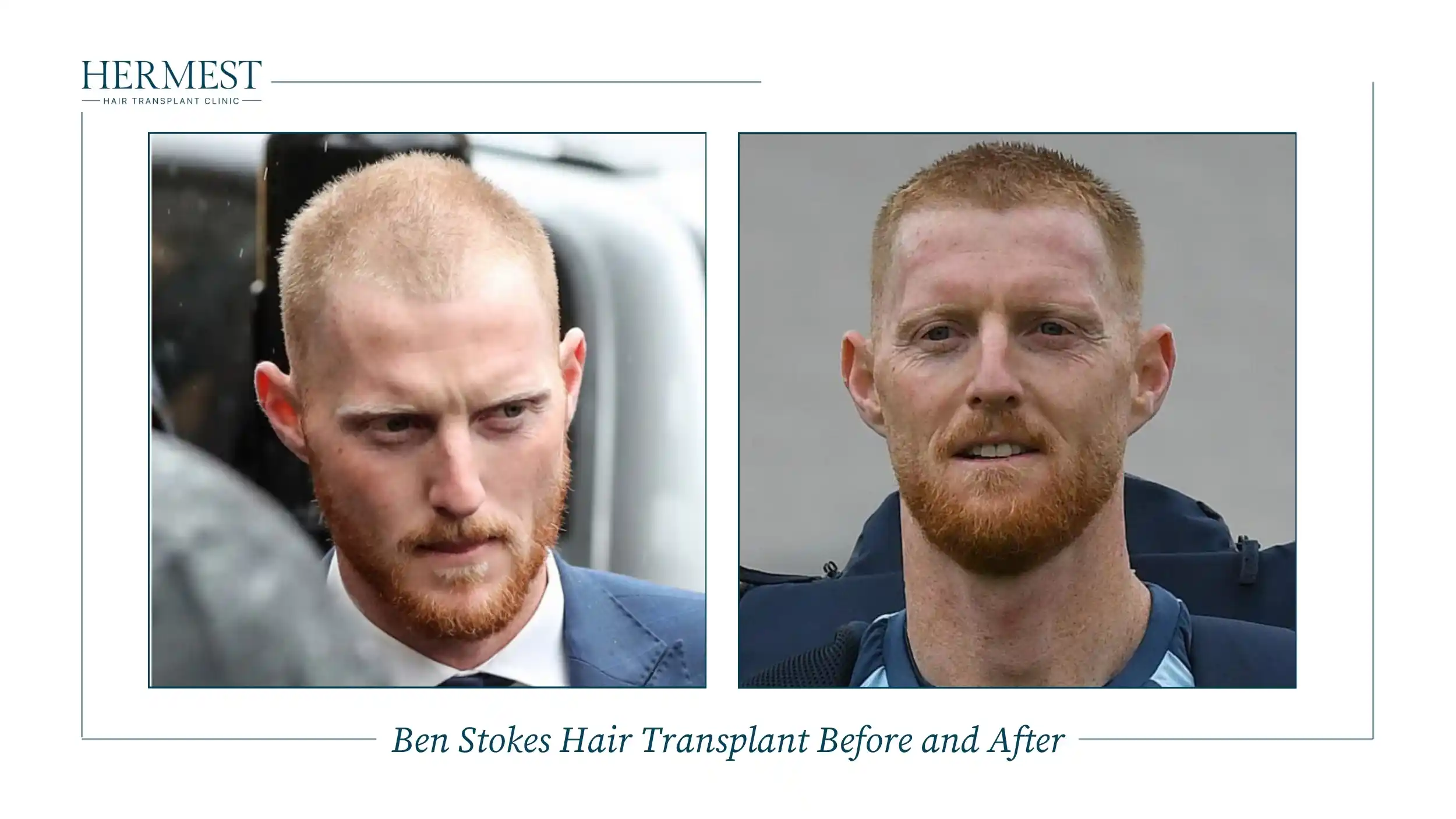
The Ben Stokes hair transplant before and after comparison shows why a relatively modest graft count can still create a noticeable change. Before surgery, Wimpole Clinic documented thinning across his crown, temple recession, and a slightly receding hairline. His 2018 procedure redistributed 1,800 FUE grafts across these areas.
The objective wasn’t to create an unusually low or dense new hairline. His later appearance shows stronger framing around the front and improved coverage through previously thinning areas.
What Changed After His FUE Procedure?
The most noticeable changes include improved temple coverage, a more defined frontal frame, and greater visual density through the treated areas.
Wimpole’s documented photographs show the progression from his pre-operative condition through healing and later growth. The clinic reports that his transplant healed within the first few weeks before new growth developed over the following months.
Why Does Ben Stokes’ Hair Transplant Look Natural?
Natural-looking transplantation isn’t simply about placing more grafts.
Hairline height, irregularity, density transitions, hair direction, and integration with existing follicles all influence the final appearance. A conservative design can be particularly valuable for younger patients whose male pattern hair loss may continue progressing.
Stokes’ result retained an adult-looking frontal shape rather than creating an unusually low juvenile hairline.
The Ben Stokes hair transplant results provide another useful lesson: dramatic visual improvement doesn’t always require an extremely large procedure. Strategic placement can matter more than chasing maximum graft numbers.
Could 1,800 Grafts Give You Results Like Ben Stokes?
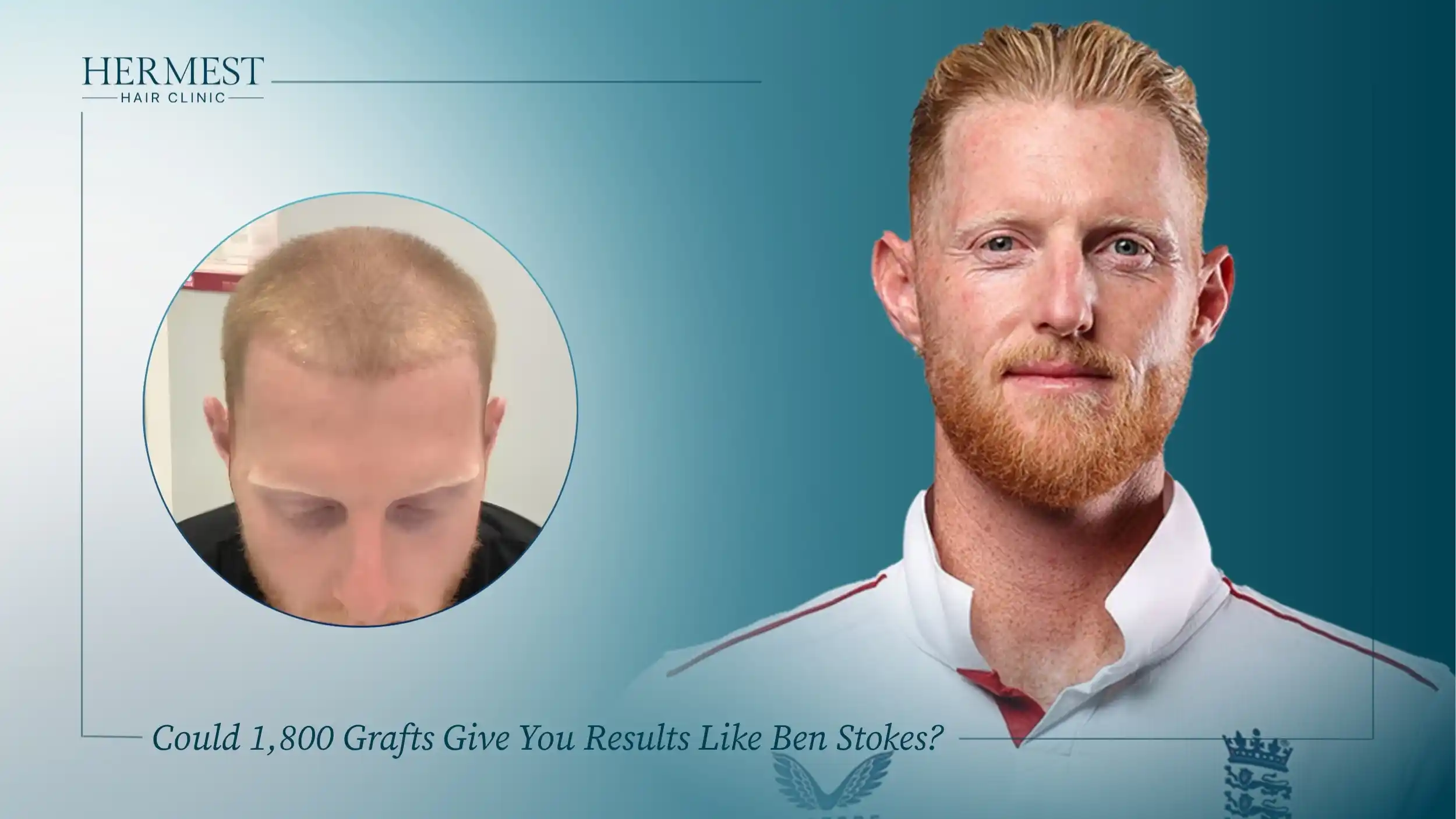
Possibly, but 1,800 grafts cannot guarantee results comparable to the Ben Stokes hair transplant. Two people receiving exactly the same graft count can achieve very different levels of coverage and visual density.
The reason is simple. Graft numbers tell only part of the story.
What Determines How Far 1,800 Grafts Can Go?
The size of the thinning area has a major influence. Concentrating 1,800 grafts around a receding hairline can produce a different visual result from distributing them across the temples and a large crown.
Hair characteristics matter too. Thicker shafts and naturally wavy or curly hair can provide greater visual coverage than very fine, straight hair.
Other factors include donor density, existing native hair, hair-to-skin contrast, follicular-unit composition, and future male pattern hair loss.
This explains why copying a celebrity’s graft number isn’t a reliable treatment strategy.
Could You Have the Same Hairline as Ben Stokes?
You could use the Ben Stokes hairline as a reference, but reproducing it exactly may not suit your face.
Hairline planning should account for age, facial proportions, existing hair, donor capacity, and expected future recession.
A younger patient also needs enough donor reserves for possible future procedures.
At Hermest, a patient with temple and crown thinning similar to Stokes would first undergo donor and recipient assessment. The medical team would then determine whether 1,800 grafts, fewer grafts, or a larger session better fits that individual pattern.
The goal isn’t to recreate Ben Stokes’ new hair.
It’s to create a natural result that fits your own hair loss, facial structure, and long-term needs.
Is Ben Stokes’ Hair Transplant Permanent?
The Ben Stokes hair transplant was designed to provide long-lasting restoration, but “permanent” needs some context. Hair transplantation moves selected follicles from a donor region into areas affected by thinning. Those transplanted follicles can continue producing hair for many years.
That doesn’t mean someone’s overall appearance can never change again.
How Long Does Transplanted Hair Last?
Hair used for FUE transplantation is typically harvested from suitable areas at the back and sides of the scalp. These donor follicles tend to be more resistant to the miniaturization associated with androgenetic alopecia.
Once successfully transplanted and established, they retain many characteristics of their donor origin.
The NHS describes hair transplantation as a procedure for moving hair to thinning or bald areas and notes that full results can take approximately 10 to 18 months to develop.
Long-term success still depends on appropriate patient selection, donor management, surgical technique, graft survival, and future hair-loss progression.
What About the Hair Around the Transplant?
This is where the distinction becomes important.
The transplanted follicles may continue growing while nearby native follicles gradually thin. The NHS warns that hair surrounding a transplant can continue becoming thinner over time.
For someone treated relatively young, future progression deserves particular attention. A good hair restoration strategy should account for that possibility from the beginning. Using every available graft to create maximum immediate density can limit options if further restoration becomes necessary years later.
The lasting lesson from the Ben Stokes hair transplant results isn’t simply that transplanted hair can survive long term. Successful restoration needs to remain natural as the patient’s existing hair changes with age.
What Can We Learn From Ben Stokes’ Hair Transplant?
The Ben Stokes hair transplant offers several useful lessons for anyone considering hair restoration. His case shows that successful transplantation isn’t necessarily about undergoing a very large procedure. Approximately 1,800 FUE grafts were used to address more than one thinning area.
Strategic planning can make a significant difference.
Graft Count Is Not a Quality Score
Patients often compare clinics by the number of grafts offered. Yet 3,000 grafts aren’t automatically better than 1,800.
The right number depends on the size of the recipient area, donor capacity, hair characteristics, existing density, and expected future loss.
Stokes’ result demonstrates how a relatively focused procedure can create substantial visual improvement in an appropriate candidate.
Donor Hair Is a Limited Resource
The donor region cannot provide unlimited follicles.
This becomes especially relevant for younger patients whose male pattern hair loss may continue progressing. Preserving grafts for possible future needs can be more sensible than pursuing maximum density during the first procedure.
Hairline Design Should Age Naturally
The Ben Stokes hairline remained relatively conservative rather than being dramatically lowered.
This principle matters when planning long-term restoration. An extremely low hairline may look appealing initially but could become harder to maintain if surrounding native hair continues thinning.
Perhaps the biggest lesson concerns expectations.
A patient shouldn’t ask for “Ben Stokes’ hair” simply because their recession appears similar. Hair caliber, donor density, follicular-unit composition, curl, contrast, and thinning area can completely change what 1,800 grafts can accomplish.
The better question is: What can my donor area safely achieve?
That approach creates a treatment plan based on your own anatomy rather than someone else’s hair transplant before and after photographs.
Frequently Asked Questions About Ben Stokes’ Hair Transplant
Yes. The Ben Stokes hair transplant is publicly confirmed. Wimpole Clinic states that the England cricketer underwent an FUE procedure in 2018 after becoming concerned about thinning around his hairline, temples, and crown.
Considering a Hair Transplant?
If your hair loss resembles Stokes’ earlier temple recession or crown thinning, celebrity photographs can provide inspiration, but they cannot determine your treatment plan.
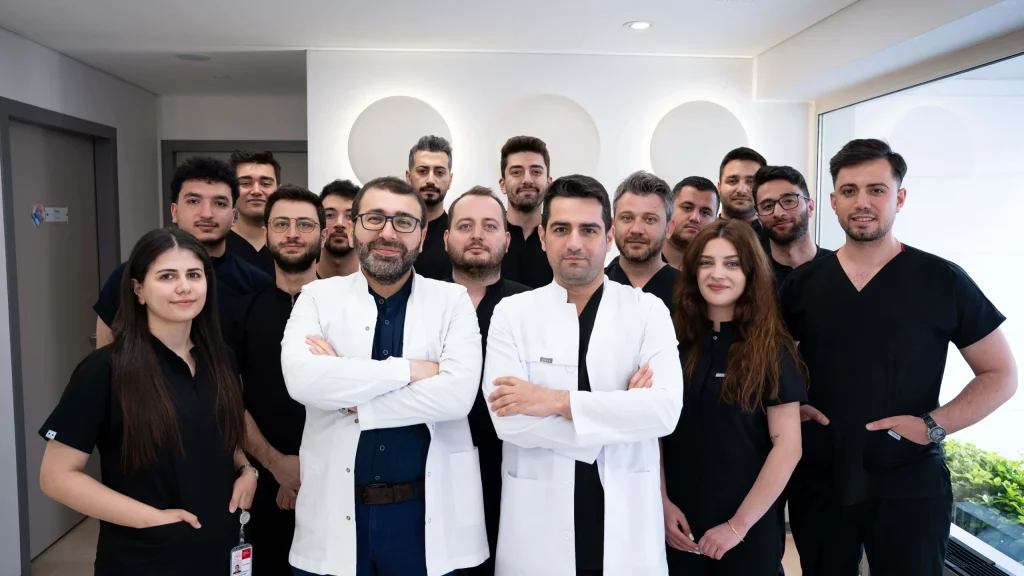
At Hermest Hair Clinic, Dr. Ahmet Murat and the medical team assess donor density, thinning pattern, hair characteristics, recipient requirements, and expected future loss before recommending a graft range.
Our Unique FUE® approach combines surgeon-led planning with individualized hairline design, donor management, the ALL-IN SAFETY PROTOCOL™ (AISP), and structured aftercare.
Contact Hermest for a personalized consultation to learn what your donor area can realistically achieve and whether FUE or DHI is suitable for your hair-loss pattern.