
Botched Hair Transplant: Signs, Infection, Repair & Turkey Risks
 ChatGPT
 Claude
 Perplexity
 Grok
Grok
 Gemini

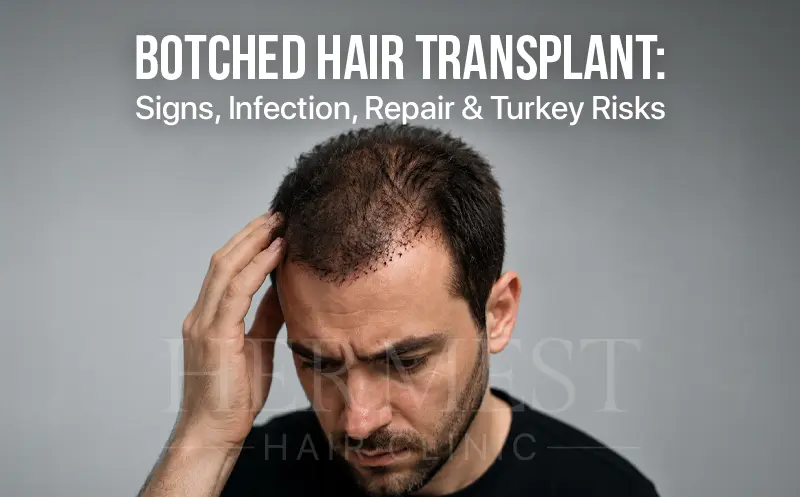
A botched hair transplant does not always mean the same thing. Some patients experience unnatural hairlines or poor density. Others face more serious complications such as infection, scarring, donor overharvesting, or tissue damage. That distinction matters.
Many people search for:
- what is botched hair transplant
- What are the signs of failed hair transplant?
- How to fix a botched hair transplant?
but many people mix temporary recovery symptoms with true surgical failures. This creates unnecessary panic.
According to International Society of Hair Restoration Surgery, modern hair transplantation can produce highly natural results when performed correctly by experienced medical teams. Problems usually appear when planning, hygiene, or surgical execution fail.
Not every disappointing result is permanent. Some issues improve with healing. Others require corrective surgery and long-term repair planning.
This guide explains:
- the difference between normal recovery and a failed procedure
- signs of poor surgical work
- botched hair transplant infection risks
- donor damage and scarring
- botched fue hair transplant complications
- botched beard hair transplant problems
- how repair surgery works
- how to avoid unsafe clinics entirely
Dr. Ahmet Murat says:
“Patients often use the word ‘botched’ too early. Some cases are temporary healing issues, while others involve serious planning mistakes. The difference must be evaluated carefully.”
This topic is emotional for many patients. Hair transplantation affects appearance, confidence, and identity. That is why understanding what actually went wrong matters far more than reacting emotionally in the first weeks after surgery.
Quick Insights
- Not every disappointing early result is permanently failed.
- A bad outcome may involve aesthetic problems, medical complications, or both.
- Common signs include unnatural hairlines, patchy density, donor overharvesting, visible scarring, and poor graft growth.
- A botched hair transplant infection can become serious if redness, swelling, pain, or discharge continue worsening after surgery.
- Infected hair follicles from a botched hair transplant should always be evaluated early to protect graft survival and scalp health.
- Many botched fue hair transplant cases are linked to poor donor management and rushed surgical execution.
- A botched beard hair transplant is often highly visible because facial hair angles and density require extreme precision.
- Repair surgery is often possible, but it is more complex than the original procedure.
- Donor preservation and long-term planning matter more than aggressive graft numbers.
What Is a Botched Hair Transplant?
Understanding what is botched hair transplant starts with separating temporary healing from true procedural failure. Not every disappointing early result is a failed surgery.
Normal recovery vs actual surgical problems
Hair transplant recovery often includes:
- redness
- swelling
- temporary shedding
- uneven early growth
These symptoms can look alarming, especially during the first few months. Many patients panic before the final result has fully developed.
According to American Academy of Dermatology, transplanted hairs commonly shed before regrowing during the recovery cycle.
That is normal.
A truly failed procedure is different.
What makes a result genuinely “botched”
A bad outcome usually involves either aesthetic failure or medical complications.
Aesthetic problems may include:
- unnatural or pluggy hairlines
- incorrect graft angles
- patchy density
- visible scarring
- donor overharvesting
Medical complications may involve:
- infection
- tissue necrosis
- persistent inflammation
- poor graft survival
This distinction is rarely explained clearly online.
Why planning mistakes matter so much
Many severe outcomes are not caused by the extraction itself. They begin during planning.
Poor donor management, unrealistic graft numbers, and rushed surgical execution can permanently affect both appearance and future repair options.
Dr. Ahmet Murat explains:
“The biggest problem in failed cases is often poor planning, not the technique itself. Once donor hair is wasted, correction becomes much harder.”
Why some patients misjudge early results
The emotional pressure after surgery is intense. Patients analyze every detail daily. This can make normal recovery fluctuations appear catastrophic.
True evaluation usually requires patience and proper medical assessment.
A disappointing result does not automatically mean permanent failure.
The real question is:
- is the issue temporary healing
- aesthetic design
- or medical damage?
Next, we’ll break down the actual signs of a failed hair transplant, including unnatural hairlines, donor damage, scarring, and persistent complications.
Signs of a Failed Hair Transplant
Patients often ask: What are the signs of failed hair transplant?
The answer depends on whether the problem is aesthetic, surgical, or medical. Some warning signs appear early. Others become visible only after full healing.
Unnatural or “pluggy” hairlines
One of the clearest indicators of poor surgical design is an unnatural hairline.
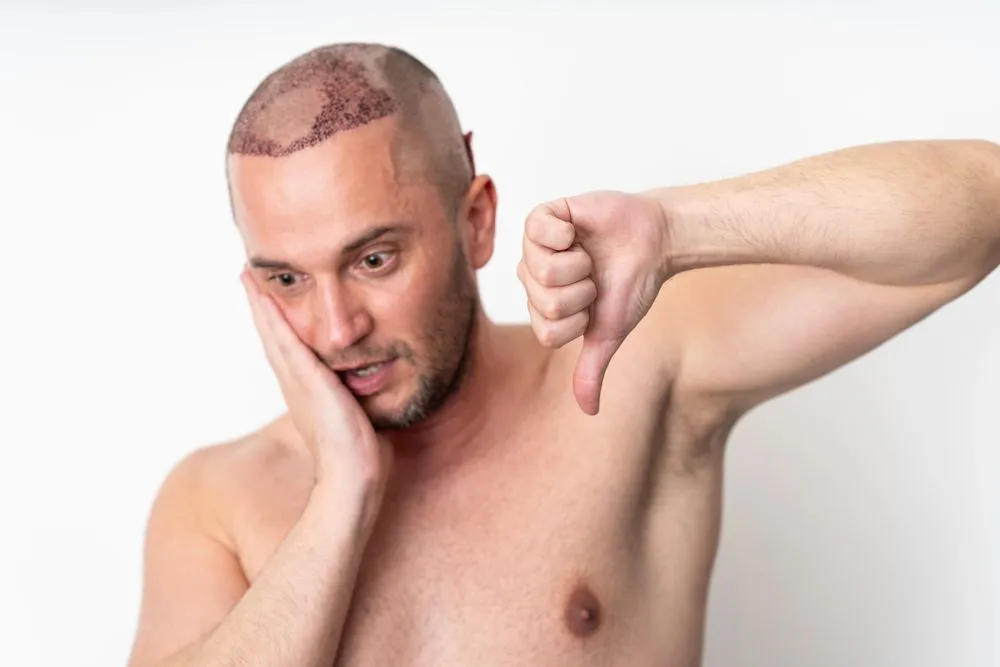
This usually happens when:
- grafts are placed in straight lines
- hair direction looks incorrect
- multi-hair grafts are used too aggressively at the front
The result can look artificial under normal lighting and become difficult to style naturally.
Modern hair restoration aims to recreate irregularity and softness. When that design principle is ignored, the transplant becomes visually obvious.
Patchy growth and poor density
Low density is another common complaint in failed procedures.
Some patients notice:
- uneven growth patterns
- empty spaces between grafts
- visible scalp despite high graft counts
This may happen because of poor graft survival, incorrect handling, or weak planning.
According to International Society of Hair Restoration Surgery, graft handling and surgical technique directly affect survival rates and final density.
Donor overharvesting
This is one of the most serious problems in a botched fue hair transplant.
Overharvesting occurs when too many grafts are extracted from the donor area without preserving natural density. The back of the scalp may start looking visibly thin or moth-eaten.
This damage can limit future repair options permanently.
Persistent redness, pain, or scarring
Temporary redness after surgery is normal.
However, prolonged inflammation, unusual pain, visible scarring, or persistent swelling may indicate deeper problems. In some cases, these symptoms can point toward infection or tissue damage.
Dr. Ahmet Murat says:
“A failed transplant is not always about appearance alone. Donor preservation and scalp health are equally important for long-term outcomes.”
Why timing matters before judging results
Many patients evaluate the transplant too early.
Hair transplantation develops gradually. Final density often takes close to a year to mature fully. This is why early panic can create confusion.
At the same time, real warning signs should never be ignored.
Next, we’ll examine one of the most serious complications directly: botched hair transplant infection, including infected follicles, poor hygiene risks, and when medical intervention becomes urgent.
Botched Hair Transplant Infection
A botched hair transplant infection is one of the most serious complications patients fear after surgery. The good news is that true infections are relatively uncommon when procedures are performed under proper medical standards.
When infections do happen, they are often linked to poor hygiene, inadequate aftercare, or unsafe surgical environments.
What causes infection after a hair transplant?
The scalp contains thousands of tiny incision sites after transplantation. If sterilization protocols are weak or aftercare instructions are ignored, bacteria can enter these areas.
Infections may develop because of:
- contaminated surgical tools
- poor clinic hygiene
- excessive touching or scratching
- improper wound cleaning during recovery
According to discussions published through PubMed and clinical hair restoration sources, most post-transplant infections remain localized when treated early.
The problem becomes more serious when symptoms are ignored.
Infected hair follicles from a botched hair transplant
Many patients search for: infected hair follicles from a botched hair transplant
This usually refers to folliculitis or localized bacterial inflammation around transplanted grafts.
Signs may include:
- painful pustules
- yellow discharge
- spreading redness
- swelling that worsens instead of improving
Small isolated pimples during recovery can be normal. Extensive inflammation is different.
When infection becomes dangerous
Severe infection can damage graft survival and surrounding tissue.
In rare situations, untreated infection may contribute to:
- tissue necrosis
- scarring
- permanent graft loss
This is why ongoing pain, fever, foul odor, or worsening redness should never be dismissed.
Dr. Ahmet Murat says:
“Most infections become manageable when recognized early. Delayed treatment is what creates serious complications.”
Why clinic safety standards matter
This is where experienced clinics separate themselves from unsafe operators.
Proper infection prevention includes:
- sterile surgical environments
- controlled graft handling
- structured aftercare systems
- close follow-up during recovery
Patients often focus only on before-and-after photos and ignore safety infrastructure completely.
Infection after hair transplant is uncommon, but it is medically significant when it occurs. Early recognition, proper treatment, and strong surgical hygiene standards are what protect long-term results.
Next, we’ll examine a major topic patients specifically search for: botched FUE hair transplant, including donor depletion, incorrect graft angles, and why poor extraction planning creates long-term damage.
Botched FUE Hair Transplant
A botched FUE hair transplant is usually not caused by the FUE technique itself. The problem comes from how the procedure is planned and performed.
FUE can produce highly natural results in experienced hands. At the same time, it can create severe long-term damage when extraction and implantation are handled poorly.
Donor overharvesting is the biggest risk
One of the most common failures in FUE procedures is donor depletion.
During extraction, individual follicles are removed from the donor zone. If too many grafts are taken from the same area without preserving spacing and density, the scalp can begin to look visibly thin.
Patients often describe this as:
- patchy donor appearance
- “moth-eaten” thinning
- transparent areas at the back of the scalp
Unlike temporary shedding, this damage can become difficult to reverse.
According to International Society of Hair Restoration Surgery, donor management is one of the most important parts of long-term hair restoration planning.
Poor graft angles create unnatural growth
Another major issue appears during implantation.
Hair grows in very specific directions and angles naturally. If grafts are placed incorrectly, the result may look artificial even when density appears acceptable.
This becomes especially visible:
- along the frontal hairline
- around temples
- under bright lighting
Patients may struggle to style the hair naturally after healing.
Why rushed surgery creates problems
Many failed FUE cases happen in high-volume “hair mill” environments where speed becomes the priority instead of precision.
In these settings:
- grafts may stay outside the body too long
- extraction becomes overly aggressive
- technicians may perform critical surgical steps without proper supervision
This increases the risk of poor graft survival and visible donor damage.
Dr. Ahmet Murat says:
“FUE requires restraint and planning. The donor area must be protected carefully because it is a limited resource for the patient’s lifetime.”
Why repair becomes difficult later
Once donor hair is overused, future corrective surgery becomes much harder.
Repair cases often require:
- redistribution of remaining donor grafts
- scar camouflage
- softer hairline redesign
That process is far more complex than the original surgery.
Next, we’ll focus on another highly searched topic: botched beard hair transplant, including unnatural angles, facial scarring risks, and density mistakes that become highly visible on the face.
Botched Beard Hair Transplant
A botched beard hair transplant is often more noticeable than a failed scalp procedure. The reason is simple: facial hair sits directly in the center of visual attention.
Small design mistakes become highly visible.
Beard transplantation requires a different level of precision compared to scalp restoration. Hair direction, angle, and density must follow natural facial growth patterns very closely.
Why beard transplantation is technically difficult
Beard hair does not grow straight outward.
The angle changes across different parts of the face:
- cheeks
- jawline
- mustache area
- under the chin
If grafts are implanted at incorrect angles, the beard may appear wiry, uneven, or artificial after healing.
This is one of the most common problems in poorly performed beard procedures.
Unnatural density patterns
Another major issue involves density placement.
Some clinics implant beard grafts too aggressively in one area while leaving other sections sparse. This creates an unnatural “plugged” appearance rather than gradual facial density.
Because facial hair frames the jawline and mouth constantly, even minor asymmetry becomes obvious during normal conversation and under natural lighting.
Facial scarring and visible texture changes
Unlike scalp skin, facial skin is more exposed daily.
Poor extraction or implantation technique may contribute to:
- visible tiny scars
- uneven skin texture
- persistent redness
- patchy beard growth
In some cases, inflammation may affect graft survival and create irregular density permanently.
According to American Academy of Dermatology, facial procedures require careful attention to healing and infection prevention because facial tissue remains highly visible throughout recovery.
Why rushed procedures create facial problems
Many failed beard procedures happen because clinics underestimate the artistic side of facial hair transplantation.
Dr. Ahmet Murat says:
“A beard transplant is not just about adding grafts. Facial harmony depends on angle control, density balance, and natural transitions.”
Why correction is more challenging on the face
Repairing a beard transplant can be difficult because the face offers less room for camouflage compared to the scalp.
Corrective work may involve:
- graft removal
- redistribution
- density softening
- scar management
That process often requires patience and multiple stages.
Next, we’ll examine a topic that generates major global search volume: why some hair transplants go wrong in Turkey, including hair mills, technician-led surgery, unrealistic graft marketing, and how patients can identify safer clinics.
Why Some Hair Transplants Go Wrong in Turkey
Searches for botched hair transplant turkey have increased partly because Turkey became one of the world’s largest hair transplant destinations. Thousands of international patients travel there every month for treatment.
Most procedures are completed safely and successfully.
The problem is that rapid industry growth also created a large number of high-volume clinics operating with very different standards.
The difference between experienced clinics and hair mills
One of the biggest misconceptions is assuming every affordable clinic is unsafe.
That is not true.
Turkey has many highly respected surgeons and internationally recognized clinics. The real risk usually comes from “hair mills,” where patient volume becomes more important than surgical quality.
In these environments:
- multiple surgeries may happen simultaneously
- consultation time becomes minimal
- technicians perform major surgical steps with limited supervision
Patients are often attracted by extremely low pricing and unrealistic graft promises.
Why unrealistic marketing creates problems
Some clinics advertise:
- unlimited graft packages
- guaranteed density
- extremely fast procedures
Hair transplantation does not work like mass production.
Every patient has a limited donor supply, unique hair characteristics, and different long-term progression patterns. Overpromising graft numbers often leads to donor overharvesting and unnatural density distribution.
Hygiene and safety standards matter more than social media
Many patients judge clinics based only on:
- influencer videos
- dramatic before-and-after photos
- price comparisons
They never ask:
- who performs extraction
- who designs the hairline
- whether the clinic is authorized for international medical tourism
According to Republic of Türkiye Ministry of Health and HealthTürkiye, authorized clinics are expected to follow regulated standards for international patient care.
Dr. Ahmet Murat says:
“Turkey is not the problem. Poor planning and unsafe clinic models are the problem. Patients should evaluate medical standards, not only marketing.”
Why patients travel to Turkey successfully every year
Turkey remains popular because experienced clinics can offer:
- strong surgical expertise
- advanced techniques
- structured international patient systems
- competitive pricing
The challenge is distinguishing experienced medical teams from volume-driven operations.
Next, we’ll answer one of the most important questions for affected patients directly: can a botched hair transplant be fixed, and what realistic repair surgery actually involves.
Can a Botched Hair Transplant Be Fixed?
Patients dealing with a failed procedure usually ask one question first:
How to fix a botched hair transplant?
In many cases, improvement is possible. But repair surgery is usually more difficult than the original transplant.
That is the reality many patients are not told early enough.
Why corrective surgery is more complex
During a primary procedure, the surgeon works with untouched donor hair and healthy scalp conditions.
Repair cases are different.
The surgeon may need to manage:
- depleted donor supply
- visible scarring
- poor graft angles
- unnatural hairline placement
- damaged scalp tissue
Every correction must work within those limitations.
This is why repair planning requires patience and long-term strategy.
What repair procedures may involve
The solution depends entirely on what went wrong.
Some patients need:
- hairline redesign
- density correction
- scar camouflage
- redistribution of remaining grafts
Others may require removal of poorly placed grafts before reconstruction can begin.
The goal is not only adding more hair. It is restoring natural appearance and balance.
Why timing matters before repair
One of the biggest mistakes patients make is rushing into another surgery too quickly.
Hair transplantation requires time to stabilize. Swelling, redness, graft growth, and scar maturation all continue developing for months after surgery.
According to experienced hair restoration specialists and discussions published through International Society of Hair Restoration Surgery, repair assessment is usually more accurate after sufficient healing has occurred.
This allows the surgeon to evaluate the true final outcome.
Dr. Ahmet Murat says:
“Repair surgery is often a process, not a single operation. The priority is preserving remaining donor resources while rebuilding natural appearance carefully.”
Why some cases improve dramatically
Many patients believe failed transplants are impossible to fix.
That is not always true.
With proper planning, experienced repair surgeons can often:
- soften harsh hairlines
- improve density balance
- camouflage donor damage
- create more natural growth patterns
The limitation is usually donor availability, not surgical possibility itself.
A bad result does not automatically mean permanent defeat.
But successful repair requires:
- realistic expectations
- careful planning
- experienced surgical judgment
Next, we’ll focus on prevention and explain how patients can avoid unsafe clinics and reduce the risk of a failed transplant from the beginning.
How to Avoid a Bad Hair Transplant
The safest way to fix a failed procedure is avoiding one in the first place.
Most cases of botched hair transplant share similar warning signs long before surgery happens. Patients often recognize those signs only afterward.
Focus on surgeon involvement, not marketing
One of the most important questions is simple:
Who actually performs the surgery?
In many unsafe clinics, patients meet the surgeon briefly, but large parts of the procedure are handled by technicians with minimal supervision.
Hair transplantation is not just graft extraction. It includes:
- donor planning
- hairline design
- angle control
- graft distribution
These decisions directly affect naturalness and long-term donor preservation.
Be careful with unrealistic graft promises
Patients are often attracted by “unlimited graft” advertisements or extremely aggressive density claims.
This creates risk.
The donor area is limited for life. Taking excessive grafts during one procedure may lead to visible thinning and permanent donor depletion later.
According to International Society of Hair Restoration Surgery, proper donor management is one of the most important principles in long-term hair restoration planning.
Verify clinic authorization and hygiene standards
Patients should check whether the clinic operates legally within international medical tourism regulations.
Authorized clinics usually maintain:
- structured sterilization protocols
- proper patient documentation
- medical follow-up systems
These factors matter far more than social media popularity alone.
Look beyond before-and-after photos
Photos can be selective.
Patients should also evaluate:
- healing quality
- donor appearance
- consistency across multiple cases
- long-term results
A transplant that looks dense initially may still age poorly if planning was weak.
Dr. Ahmet Murat says:
“Natural hair restoration depends on restraint and planning. The best results usually come from clinics that prioritize long-term strategy over aggressive marketing.”
Why rushed decisions create problems
Many failed procedures begin with emotional urgency.
Patients compare prices quickly, travel immediately, and skip detailed evaluation. Hair transplantation is permanent surgery. Fast decisions can create permanent consequences.
The safest patients are usually not the ones spending the most money.
They are the ones asking the right questions before surgery.
Frequently Asked Questions About Botched Hair Transplants
A botched hair transplant refers to a procedure that results in poor aesthetic outcomes, medical complications, or both. This may include unnatural hairlines, patchy density, visible scarring, donor overharvesting, infection, or failed graft survival. Not every disappointing early result is permanently failed, which is why proper medical evaluation matters.
Take the Next Step With a Structured Repair and Safety Approach
If you are worried about a previous procedure or considering corrective surgery, the first step is proper evaluation. Every failed case is different.
Some patients need:
- donor preservation planning
- hairline correction
- scar camouflage
- density balancing
- infection recovery management
Dr. Ahmet Murat says:
“Repair surgery starts with understanding what was lost, what can still be preserved, and what outcome remains realistically achievable.”
At Hermest Hair Transplant Clinic, repair and revision planning follows a structured approach through the clinic’s UNIQUE FUE® method and AIS (All-In Safety Protocol™) Protocol.
The focus is not simply adding more grafts.
It is restoring:
- natural appearance
- donor balance
- long-term sustainability
Each patient receives individualized analysis based on:
- donor condition
- previous graft placement
- scalp health
- future hair loss progression
If you are concerned about a failed procedure or want a professional second opinion before surgery, now is the time to evaluate your options carefully.
Request your free hair analysis and speak directly with an experienced hair restoration specialist today.