

PP405 Hair Loss Treatment: Trials, Mechanism & Timeline
 ChatGPT
 Claude
 Perplexity
 Grok
Grok
 Gemini


The search for an effective, non-invasive, and lasting hair loss treatment may be taking a major leap forward with PP405—a newly discovered molecule that targets dormant hair follicle stem cells. Developed by scientists at UCLA and currently being advanced by Pelage Pharmaceuticals, PP405 represents a new class of therapies designed to reactivate hair growth without hormones or surgery.
Unlike existing medications such as finasteride or minoxidil, PP405’s mechanism of action is rooted in cellular metabolism, offering a novel pathway to restore hair. With early clinical trial results showing promising outcomes and no systemic side effects, many are now asking: what is PP405, when will it be available, and how does it compare to current options?
This article covers everything you need to know—from science and safety to PP405 before and after results, regulatory timelines, and how it could reshape hair loss care in the years ahead.
Insights: Is PP405 the Future of Hair Loss Treatment?
- PP405 is an investigational topical molecule designed to reactivate dormant hair follicle stem cells by altering metabolic pathways—not hormones.
- Its mechanism of action targets the mitochondrial pyruvate carrier, pushing follicles into a regenerative state.
- Early clinical trial results (Phase 1 and 2a) show promising improvements in hair density, with no systemic side effects or hormone disruption.
- It may be especially useful for early-stage pattern hair loss, offering a non-hormonal alternative to finasteride or minoxidil.
- PP405 before and after studies are limited to trial data for now, but early outcomes show encouraging potential.
- PP405 release date is estimated between 2027 and 2028, depending on trial outcomes and regulatory approval.
- As of now, there is no legal way to buy PP405, and all use is limited to controlled studies.
What Is PP405 and How Does It Work?
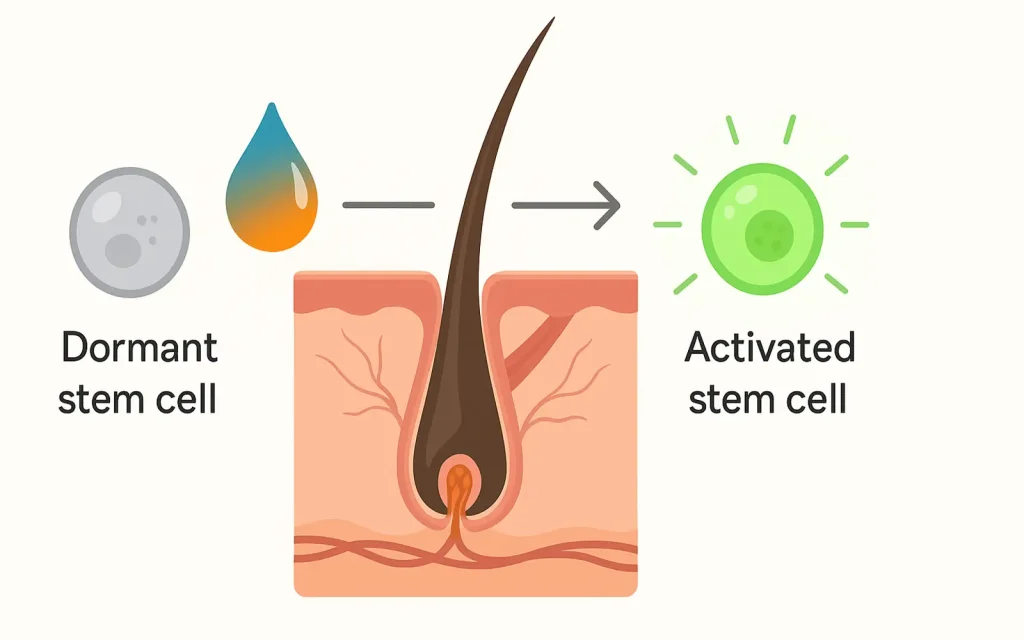
PP405 is a topical small molecule developed to treat androgenetic alopecia (male and female pattern hair loss) by reactivating dormant stem cells in the hair follicle. Unlike traditional medications that work hormonally or through vasodilation, PP405 functions by altering energy metabolism at the cellular level.
Scientific Basis:
- Mitochondrial pyruvate carrier inhibitor: PP405 temporarily blocks the entry of pyruvate into mitochondria.
- This metabolic shift pushes hair follicle stem cells from oxidative phosphorylation into a glycolytic state, mimicking the active phase of the hair cycle.
- This process increases LDH activity and Ki67 expression, which are biomarkers for cell activation and proliferation.
How does PP405 compare to other hair loss treatments?
PP405 works by reprogramming hair follicle metabolism, unlike finasteride (which blocks DHT) or minoxidil (which improves blood flow). It doesn’t alter hormones and shows no systemic absorption, making it a potential alternative for those sensitive to traditional medications.
Unlike hormone-based drugs, PP405 molecule is designed to target the root cause of inactivity in hair follicles, especially in early to moderate stages of hair loss.
PP405 Preclinical and Phase 1 Trial Results
Before entering human trials, PP405 showed impressive outcomes in laboratory and animal models. The early data positioned it as a potential hair loss treatment breakthrough, especially for patients seeking a non-hormonal option.
Preclinical Highlights:
- In mouse models, topical PP405 reactivated dormant follicles and resulted in new terminal hair growth.
- Human scalp tissue samples treated ex vivo showed increased stem cell activation markers—particularly Ki67, a key indicator of follicle cycling.
These results paved the way for a Phase 1 clinical trial launched in 2023 by Pelage Pharmaceuticals.
PP405 Phase 1 Results:
Conducted on human volunteers with androgenetic alopecia.
Treatment: 0.05% PP405 topical solution applied once nightly for 7 days.
Findings:
- Significant increase in Ki67 expression in hair follicles.
- No systemic absorption detected in blood plasma.
- No major side effects reported.
How long does it take to see results with PP405?
In early trials, some participants saw increased cellular activity within 7 days. However, visible hair growth may take 8 to 12 weeks, similar to other topical treatments. Larger Phase 2 studies are ongoing to confirm these timelines.
These findings support the continued development of PP405 as a topical hair loss therapy with a strong safety profile and a distinct biological mechanism.
Phase 2 Clinical Trials and Efficacy Update
Following promising safety and biological activity data from Phase 1, Pelage Pharmaceuticals advanced PP405 into Phase 2a clinical trials in 2024. These ongoing trials are designed to evaluate not only safety but also real-world efficacy in patients with mild to moderate hair loss.
Phase 2a Study Overview:
- Participants: Men and women diagnosed with androgenetic alopecia
- Structure: Randomized, double-blind, placebo-controlled
- Application: Topical PP405 applied nightly over 8 weeks
- Endpoint: Increase in visible hair density and follicular activity
Early Observations (as of Q2 2025):
- 31% of participants using PP405 experienced a >20% increase in hair density.
- 0% improvement was observed in the placebo group, showing a clear treatment effect.
- No systemic side effects or hormone disruption reported.
- Participants reported good tolerability and high compliance with the treatment.
Dr. Ahmet Murat comments:
“The Phase 2 data we’ve seen suggests PP405 may become a valuable non-hormonal option—especially for patients who are early in their hair loss journey and looking to avoid the side effects of finasteride.”
This trial is expected to conclude by the end of 2025. If results continue to trend positively, Phase 3 trials could follow in 2026–2027, leading to a potential market launch in the following years.
Who Is PP405 For and What Types of Hair Loss Can It Treat?
PP405 is being developed primarily to treat androgenetic alopecia—also known as male or female pattern hair loss. However, its unique mechanism of targeting follicle metabolism opens the door to broader use cases.
Since androgenetic alopecia is one of the most common Causes of Hair Loss, PP405 is being tested to address this widespread condition.
Ideal Candidates:
- Men and women experiencing early to moderate thinning. In particular, women seeking non-hormonal solutions often compare PP405 with surgical alternatives such as a Female Hair Transplant.
- Individuals with DHT sensitivity who want to avoid hormonal treatments like finasteride
- Patients who have not responded well to minoxidil
- Those seeking a non-systemic, topical-only solution
Potential Use Cases Beyond Pattern Baldness:
- Postpartum or stress-induced hair loss (e.g. telogen effluvium), where follicle dormancy—not scarring—is the issue
- Chemo-induced shedding, if dormant follicles remain
- Adjunct to hair transplant recovery, potentially stimulating surrounding follicles
Dr. Ahmet Murat notes:
“PP405 is not a magic fix for total baldness or scarred scalps. But for patients in the early stages of hair loss, it offers a metabolic reset for follicles that are still viable.”
While still in trials, PP405 may represent a safer long-term maintenance option for individuals who can’t or won’t use hormonal drugs—and could complement regenerative therapies like PRP.
For patients already considering proven surgical options, exploring the Best Hair Transplant Method remains the most effective solution available today.
PP405 vs Existing Hair Loss Treatments
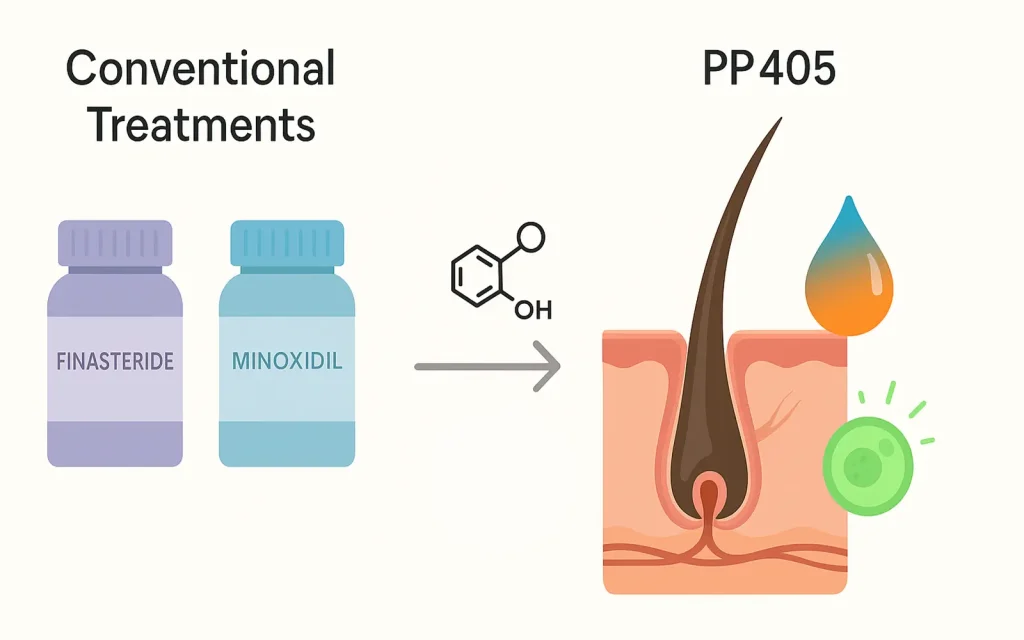
One of the most asked questions is how PP405 compares to existing treatments like finasteride and minoxidil. Each of these options works differently—and PP405 introduces an entirely new mechanism into the discussion.
Mechanism of Action Comparison:
| Treatment | How It Works | Type | Side Effects |
|---|---|---|---|
| Finasteride | Blocks DHT to prevent follicle miniaturization | Oral (systemic) | Sexual side effects, hormone disruption |
| Minoxidil | Increases blood flow to follicles | Topical | Scalp irritation, unwanted facial hair |
| PP405 | Shifts follicle metabolism to reawaken stem cells | Topical | No systemic effects (as per trials) |
How does PP405 compare to other hair loss treatment?
PP405 offers a hormone-free alternative by targeting follicle metabolism, not androgens. Unlike minoxidil, it doesn’t rely on vasodilation. Clinical trials show it activates dormant follicles without systemic side effects—ideal for early-stage hair loss.
Key Advantages of PP405:
- Non-hormonal: Safe for both men and women
- Topical: No systemic exposure detected in trials
- Complementary: May work alongside PRP, minoxidil, or post-transplant plans
- Targeted: Activates dormant—not dead—hair follicles
While PP405 is still under investigation, its mechanistic differences and favorable safety profile suggest it may become a frontline treatment—particularly for patients seeking gentler, non-invasive solutions.
PP405 Release Date, Risks, and Regulatory Timeline
Despite growing buzz around its results, PP405 is still in the clinical trial phase and is not yet approved for public use. Here’s what we know about its expected availability, safety profile, and what’s next in the regulatory process.
When Will PP405 Be Available?
- Current stage: Ongoing Phase 2a clinical trials (as of 2025)
- Next steps: Phase 2b or Phase 3 trials, followed by FDA submission
- Estimated PP405 release date: Late 2027 or 2028 (best-case scenario)
- Where to buy PP405: Nowhere yet—it’s not commercially available and cannot be legally purchased online or over the counter.
When will PP405 be available?
PP405 is still undergoing clinical trials. If results continue to be positive, the earliest possible release date would be around 2027–2028, pending regulatory approvals.
PP405 Side Effects: What We Know So Far
One of the key selling points of PP405 is its excellent safety profile in early trials.
- No systemic absorption was observed in Phase 1 trials.
- No serious adverse events were reported in the Phase 2a trial.
- As of now, no hormonal changes or DHT-related effects have been linked to its use.
Still, longer-term data from larger populations will be required before final safety conclusions can be made.
Dr. Ahmet Murat advises:
“While PP405 looks promising, we remind patients not to fall for black-market versions or unverified suppliers. Safety always comes before trend.”
PP405 Candidacy: Who Should (and Shouldn’t) Use It?
Although PP405 is not yet available for consumer use, early trial criteria and its biological mechanism provide a clear sense of who it’s likely to benefit—and who may not be the right candidate.
Ideal Candidates for PP405:
- Men and women with early-stage androgenetic alopecia
- Individuals who still have miniaturized but not completely lost hair follicles
- Patients who prefer a non-hormonal, topical alternative
- Those who experienced side effects with finasteride or minoxidil
- Individuals exploring preventive treatment in the early stages of shedding
Who May Not Be a Good Fit:
- Individuals with scarring alopecia or total baldness
- Patients with permanent follicle damage or autoimmune-related scarring
- Those expecting instant results—PP405 is still in development and may take 8–12 weeks or more to show visible effects
- People looking for a quick over-the-counter solution—PP405 where to buy is not applicable yet due to its regulatory status
Dr. Ahmet Murat explains:
“Not every type of hair loss responds to PP405. It requires viable follicles to work. Our role is to evaluate scalp health and determine if a follicle activation approach is suitable—or if surgical or regenerative methods are more appropriate.”
Candidates will eventually be screened through dermatological or trichological assessment once the product becomes available.
While PP405 is still undergoing clinical development, it represents a major shift in how we think about treating hair loss—moving from hormone manipulation and blood flow enhancement to cellular reactivation.
If you’re concerned about thinning hair and want to explore proven solutions available today, our team at Hermest Hair Clinic offers advanced diagnostics and regenerative therapies tailored to your condition.
Book a consultation now to assess your current hair health and receive a customized plan while monitoring the progress of cutting-edge options like PP405.