

Robotic Hair Transplant in Turkey: Is the Hype Real or Just Marketing
 ChatGPT
 Claude
 Perplexity
 Grok
Grok
 Gemini


In recent years, robotic hair transplant systems—particularly the ARTAS robotic hair transplant device—have gained attention for their promise of precision and automation in follicular unit extraction (robotic FUE hair restoration). Clinics and tech developers market these devices as the “future of hair restoration,” offering speed, consistency, and a modern patient experience.
However, leading experts in the field remain cautious. Dr. Ahmet Murat, the chief surgeon at Hermest Hair Clinic, highlights:
“While robotic systems like ARTAS represent impressive engineering, they have not yet matched the nuance and adaptability of a skilled human hand. The best results still come from experienced surgeons—not machines.”
At Hermest Hair Clinic in Istanbul, thousands of patients from over 62 countries are treated each year with highly personalized, manual FUE techniques. Although the clinic keeps a close eye on emerging technologies, it has not adopted robotic systems like ARTAS for one clear reason: they’re not yet efficient or adaptable enough to outperform manual transplantation.
In this article, you’ll learn:
- What robotic hair transplant systems actually do
- Why manual FUE vs robotic procedures still favor human surgeons
- A full breakdown of robotic hair transplant pros and cons
- The current robotic hair transplant cost and effectiveness
- Expert input from Dr. Ahmet Murat on where the technology stands—and where it’s going
Key Takeaways
- Robotic hair transplant systems like ARTAS offer precision in extraction but still rely heavily on human surgeons for design and implantation.
- Manual FUE vs robotic methods favor manual when it comes to hairline aesthetics, adaptability, and natural outcomes—especially for curly or fine hair.
- Robotic technology remains limited in efficiency and versatility, making it unsuitable for many real-world patients.
- Until robotic tools surpass human capabilities in both precision and design, manual hair transplant remains the gold standard.
What Is Robotic Hair Transplant?
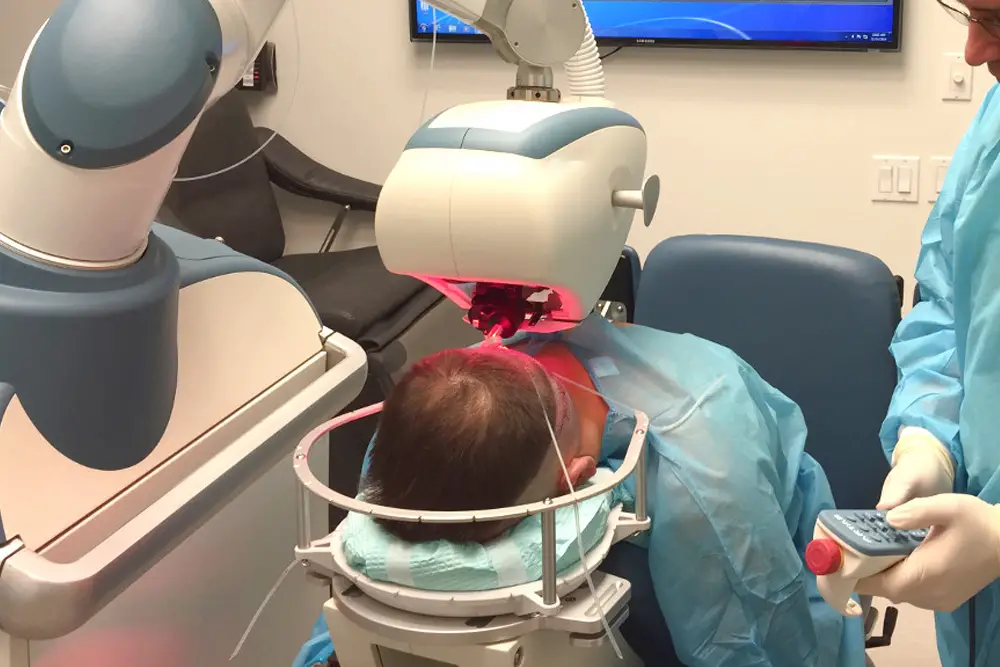
Robotic hair transplant is a form of FUE (Follicular Unit Extraction) that uses computer-guided systems—most notably the ARTAS robotic hair transplant device—to automate the process of harvesting hair follicles from the donor area. The system uses AI-assisted imaging and robotic arms to identify, extract, and sort grafts with minimal human involvement.
What Is ARTAS Robotic Hair Transplant?
ARTAS robotic hair transplant is an FDA-cleared robotic system that automates the follicle extraction step in hair restoration surgery. It uses cameras, algorithms, and a mechanical arm to harvest individual grafts, aiming to reduce fatigue and improve precision during FUE procedures.
While ARTAS is the most well-known, it still requires a human surgeon to plan the hairline, create recipient sites, and implant the grafts. The robot assists with extraction—not with the full surgery.
Limitations in Real-World Practice
At first glance, robotic systems sound like a breakthrough—but according to Dr. Ahmet Murat:
“The ARTAS system works best on straight, dark hair and flat scalps. It struggles with curly hair, irregular donor zones, or patients who require artistic refinement. That’s why most top clinics continue using manual techniques.”
In short, while robotic systems can offer efficiency for select cases, they fall short when it comes to adapting to complex scalp patterns, ethnic hair textures, and custom hairline design—areas where experienced surgeons excel.
How Robotic Hair Transplant Works
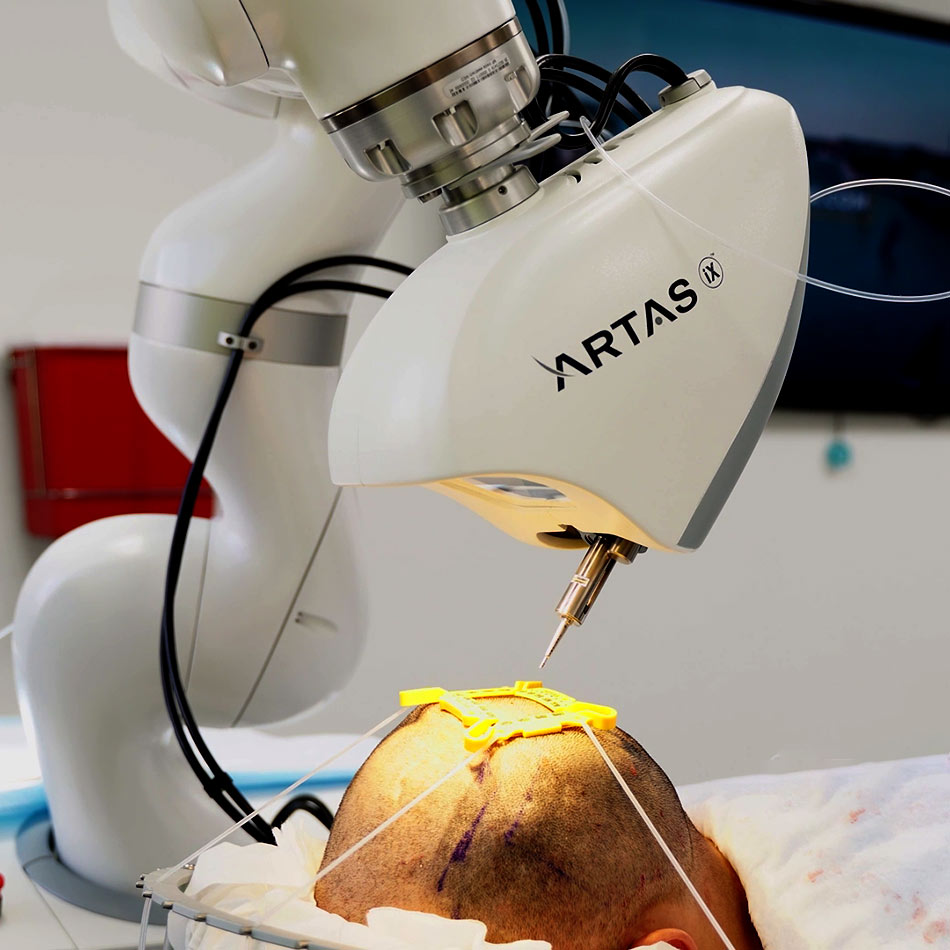
The robotic hair transplant procedure is built on the same principles as manual FUE but uses a computer-guided machine to assist with specific steps—primarily follicle harvesting. Here’s a simplified breakdown of how the ARTAS or similar systems operate:
Step-by-Step Robotic FUE Hair Restoration
- Scalp Mapping – The system scans the donor area using 3D cameras and creates a digital model to identify ideal grafts based on angle, density, and spacing.
- Automated Extraction – The robot uses a motorized punch tool to remove hair follicles. It selects each graft using its pre-programmed criteria. The surgeon monitors the process but does not manually extract the follicles.
- Graft Collection – Harvested grafts are collected into a chamber and prepared for implantation—often sorted by size and stored in a saline solution.
- Manual Implantation – The robot cannot implant follicles. This step is still done manually by the surgical team, using either forceps or Choi pens depending on the technique.
Why This Process Has Limits
While automation reduces surgeon fatigue and allows for consistent motion during extraction, it introduces several challenges:
- The robot cannot “feel” resistance the way a human hand can
- Hair direction and angulation must still be verified visually
- Curly, light-colored, or fine hair often causes mapping errors
- Recipient area design and placement—where artistry matters most—remains manual
As Dr. Ahmet Murat explains:
“Hair restoration is not just about removing and placing follicles. It’s about designing a natural look for the person’s age, face, and ethnicity. Robots don’t understand aesthetics or variation.”
Robotic Hair Transplant Pros and Cons
Automated systems like ARTAS have introduced new possibilities to hair restoration—but also new limitations. Understanding the true robotic hair transplant pros and cons helps clarify why many clinics, including Hermest, still rely on manual FUE.
Pros of Robotic Hair Transplant
- Consistency in graft extraction: The robot performs repeated motions with minimal fatigue
- Reduced surgeon strain: Especially useful in long sessions involving thousands of grafts
- Less invasive feel for the patient: No linear scar, same as traditional FUE
- Automated mapping of the donor area: Offers precision in theory for ideal extraction zones
- FDA-cleared technology: ARTAS is widely approved and used globally
Cons of Robotic Hair Transplant
- Limited adaptability: Performs poorly on curly, blonde, or fine hair
- Cannot implant grafts: Implantation is still done by hand, where precision truly matters
- Hairline design is not robotic: Aesthetic outcome depends entirely on the surgeon
- Higher cost for the same or lesser results
- Learning curve and dependency on technician calibration
Dr. Ahmet Murat summarizes it this way:
“Technology is useful—but only when it improves outcomes. At Hermest, we haven’t adopted robotic systems because our manual techniques already deliver better, more natural results. Until robotics prove they can match or exceed that, we’ll stay with what works.”
Manual FUE vs Robotic Hair Transplant: Key Differences
While both methods are based on Follicular Unit Extraction (FUE), there are fundamental differences between manual FUE and robotic hair transplant techniques—especially in terms of flexibility, control, and final result.
1. Surgeon Control
- Manual FUE: The surgeon personally controls the punch tool and adjusts to subtle scalp differences in real time.
- Robotic FUE: The system selects and punches grafts based on pre-programmed patterns. Surgeon has limited real-time input.
2. Adaptability
- Manual FUE: Easily adjusts to all hair types (curly, thin, wavy, light-colored) and non-uniform scalp angles.
- Robotic FUE: Best suited for straight, dark hair on flat donor zones. Accuracy drops with texture or angle variation.
3. Aesthetic Judgment
- Manual FUE: The surgeon directly creates the hairline and designs recipient areas with artistic and anatomical precision.
- Robotic FUE: Cannot design or implant; relies entirely on human judgment for these steps.
4. Result Quality
At Hermest, where over 20,000 patients have been treated using UNIQUE FUE®, the difference is clear.
Dr. Ahmet Murat explains: “Manual FUE offers real-time decision-making. Every graft is extracted with human touch, and every angle is adjusted instantly. That’s why our graft survival rate exceeds 99%.”
5. Cost vs Value
- Robotic systems often involve additional costs due to device investment, licensing, and maintenance.
- Manual FUE remains more cost-effective and allows the surgeon to use all available grafts strategically—minimizing waste.
Robotic Hair Transplant Cost and Effectiveness
One of the most common questions patients ask is whether robotic hair transplants are worth the cost. While the technology may seem appealing, the numbers often tell a different story.
How Much Does Robotic Hair Transplant Cost?
- United States: $9,000 – $18,000 depending on graft count and clinic
- Europe (UK, Germany): €7,000 – €15,000
- Robotic Hair Transplant in Turkey: Rarely offered due to low demand, but estimated at $4,000 – $6,000 when available
- Extra fees: Many clinics charge a premium for robotic systems compared to manual FUE
How Much Does the ARTAS Robotic Hair Transplant System Cost?
The ARTAS robotic hair transplant system costs clinics around $200,000 to $250,000, which contributes to higher patient fees compared to manual procedures.
Is Robotic Hair Transplant Effective?
- Extraction Accuracy: Generally consistent for suitable hair types (straight, dark)
- Aesthetic Outcome: Still depends entirely on the surgeon’s skill in designing and implanting
- Success Rate: Comparable to FUE—only when used in ideal candidates
- Problem Areas: Lower precision in angled grafts, curly or thin hair, and irregular scalp surfaces
Dr. Ahmet Murat cautions: “We’ve reviewed robotic cases where overharvesting or poor angulation caused issues that required correction. Machines may follow patterns—but patterns alone don’t make a good transplant.”
In short, the robotic hair transplant effectiveness largely depends on who’s operating the system—and whether the patient’s hair characteristics are compatible.
Who Should (and Shouldn’t) Consider Robotic Hair Transplant?
While robotic systems like ARTAS offer potential advantages in consistency and speed, they are not suitable for everyone. Patient selection plays a major role in determining whether robotic FUE can deliver acceptable results.
Who May Be a Candidate for Robotic Hair Transplant?
- Individuals with straight, dark hair and light skin (for optimal graft visibility)
- Patients with uniform, flat scalp structure
- Those looking for high-volume extraction in a short timeframe
- People prioritizing minimal scarring and fast recovery
- Patients who understand that implantation and hairline design will still be done manually
Who Should Avoid Robotic Hair Transplant?
- Patients with curly, wavy, or fine hair
- Those with irregular donor area angles or scarring
- Individuals expecting full artistic control over hairline shape
- Anyone assuming that the robot replaces the surgeon (it doesn’t)
- People prioritizing natural design and maximum graft survival
At Hermest Hair Clinic, robotic systems are currently not offered—and deliberately so.
Dr. Ahmet Murat emphasizes: “We see many patients who come to us for repair after robotic procedures done elsewhere. Until this technology matches the quality of hand-performed FUE, we won’t compromise on results.”
Statistics & Trends on Robotic Hair Transplant
- Over 90% of clinics worldwide still perform manual FUE, with robotic systems used in fewer than 5% of hair transplant surgeries globally. (ISHRS Global Census Report, 2023)
- The ARTAS robotic hair transplant system costs between $200,000 and $250,000, making it inaccessible for many clinics. (Venus Concept Manufacturer Data, 2024)
- Robotic hair transplant procedures cost 20–40% more on average than manual FUE sessions in the U.S. (American Board of Hair Restoration Surgery, 2023)
- Patient satisfaction with robotic procedures is lower when compared to experienced manual FUE surgeons, especially in complex cases like curved hairlines or irregular scalp types. (RealSelf Review Analysis, 2022–2024)
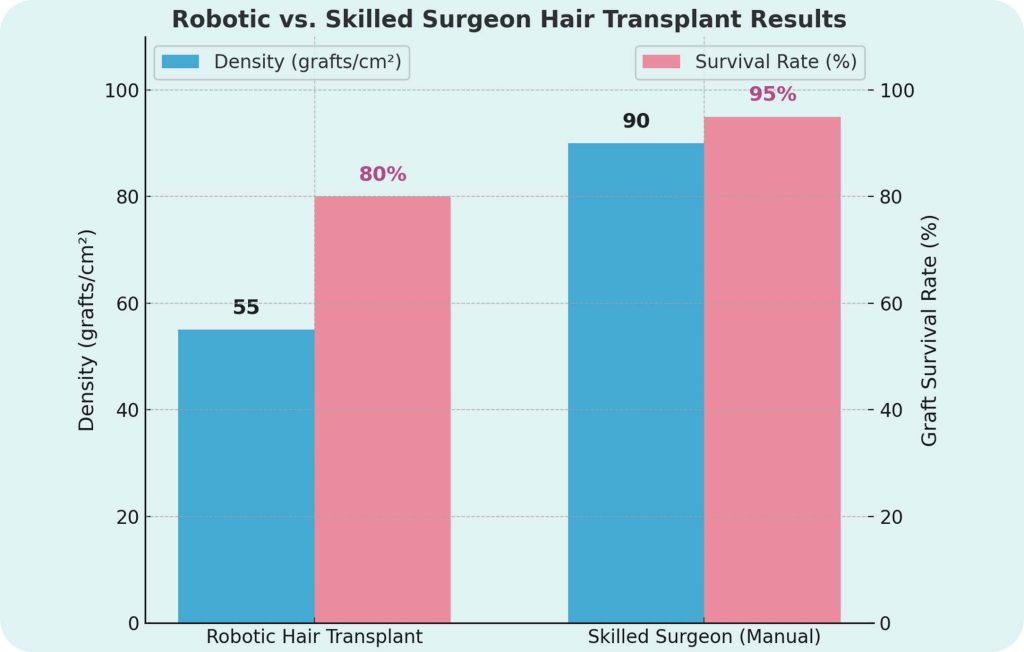
- Manual FUE has a graft survival rate of up to 99%, while robotic-assisted FUE averages between 90% and 95%, depending on patient hair type. (Journal of Dermatologic Surgery, 2023)
- ARTAS robots are most effective on dark, straight hair, with a drop in accuracy of over 30% on curly or light-colored hair. (Clinical Robotics Review, 2022)
- Turkey, despite being the world leader in hair transplants, has seen little demand for robotic systems, with fewer than 10 known clinics offering ARTAS as of 2025. (Medical Tourism Index, 2024)
- 90% of top-rated hair transplant surgeons worldwide do not use robotic systems, citing limitations in real-time control and artistry. (Hair Restoration Network Expert Survey, 2023)
- Robotic systems cannot perform implantation or design hairlines, and 100% of final aesthetic results still rely on surgeon judgment and hand execution. (ARTAS System Clinical User Manual, 2024)
- According to a 2023 industry forecast, robotic hair restoration adoption is growing slowly—only 3% CAGR (compound annual growth rate) through 2028, compared to 11% for manual FUE-based clinics. (MarketWatch Hair Restoration Devices Report, 2023)
Important Questions & Answers
What is ARTAS robotic hair transplant?
ARTAS robotic hair transplant is a computer-guided FUE system that automates the extraction of hair follicles using a robotic arm. It maps the scalp, identifies grafts, and punches them with precision, while implantation and design are still performed manually by the surgeon.
How much does ARTAS robotic hair transplant system cost?
The ARTAS system costs clinics between $200,000 and $250,000, which contributes to the higher patient pricing compared to manual hair transplant methods.
How much does robotic hair transplant system cost for patients?
A robotic hair transplant typically costs $9,000 to $18,000 in the U.S. The price depends on the number of grafts, the clinic’s pricing model, and regional factors.
What is the best robotic hair transplant system?
Currently, ARTAS is the most widely used and FDA-cleared robotic hair transplant system, but its capabilities are limited to extraction. It’s not yet considered superior to experienced manual FUE techniques.
Is robotic hair transplant better than manual FUE?
Not yet. While robots offer consistency, manual FUE still delivers better artistic control, graft survival, and natural-looking results—especially when performed by experienced surgeons like those at Hermest Hair Clinic.
What are the side effects of robotic hair transplant?
Side effects include donor area overharvesting, shock loss, misaligned graft angles, and low graft yield in cases where hair type or scalp structure is not ideal.
Can robots do the implantation step?
No. As of 2025, robotic systems cannot implant grafts or design hairlines. These critical steps are entirely performed by human hands.
Is Robotic Hair Transplant Right for You?
While robotic systems may sound appealing in theory, most patients are still best served by the skill and experience of a human surgeon. At Hermest Hair Clinic, every hairline is designed and executed with personalized care—not left to a machine.
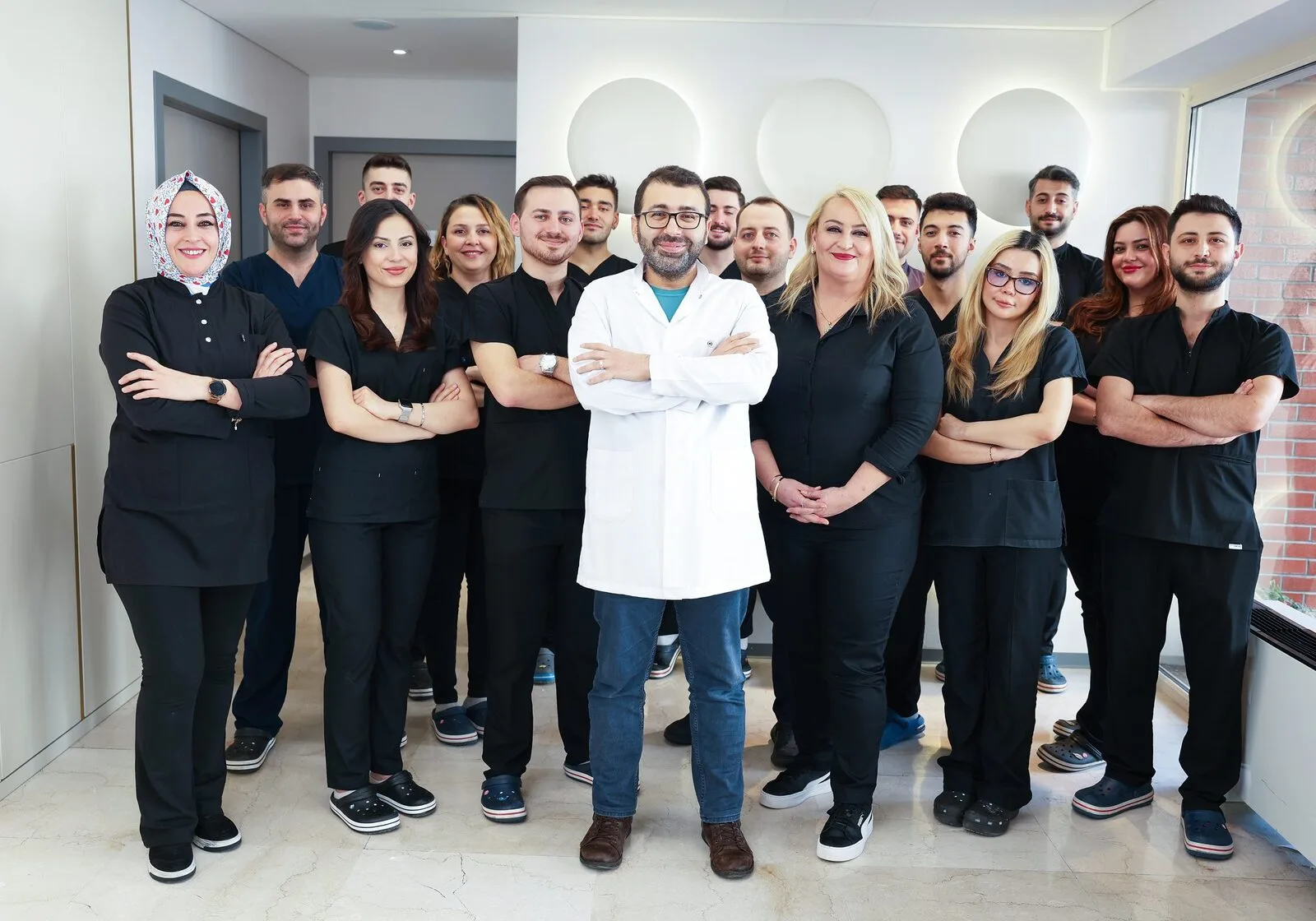
With a proven 99% graft survival rate, thousands of international patients, and industry-recognized UNIQUE FUE® technique, Hermest delivers consistent, natural-looking outcomes without relying on underperforming technologies.
- Surgeon-led procedures
- No technician outsourcing
- Transparent pricing and post-op support
- Trusted by patients from over 62 countries
The Unique FUE technique is an advanced version of the popular FUE method developed by Hermest Hair Clinic. Special microinstruments and precise implantation techniques ensure higher success rates.
Thanks to these specialized tools, hair follicles can be extracted in a precise and minimally invasive way, followed by accurate implantation. This technique promises natural results and a high graft survival rate compared to other methods.
As the name suggests, Unique truly is one of a kind – and so is the Unique FUE method. This sophisticated system was developed in collaboration with micro-surgeons, aesthetics experts, and German engineers to take the Follicular Unit Extraction (FUE method) to the next level.
The aim of this technique is to achieve natural-looking results with minimal scarring and a shorter recovery time, while maximizing the survival rate of the transplanted hair follicles.
Thinking about hair restoration? Contact us to book your free consultation and get expert guidance tailored to your needs.