

Ludwig Scale Explained: Stages, Diagnosis, Treatment Options For Women
 ChatGPT
 Claude
 Perplexity
 Grok
Grok
 Gemini

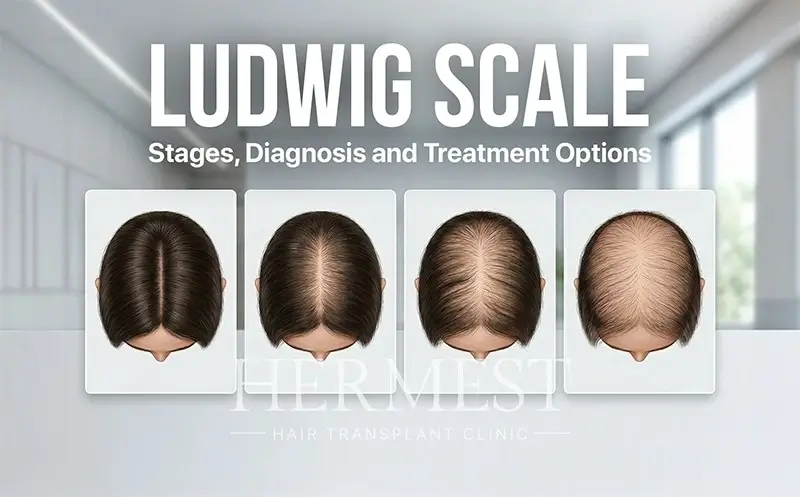
Hair thinning rarely announces itself clearly. It usually starts with a wider part, less volume at the crown, or hair that looks fine head-on but sparse under overhead light. These early changes are exactly why the Ludwig Scale exists.
The ludwig scale female hair loss system is used to classify ludwig scale female-pattern hair loss, the most common thinning pattern in women. Unlike male pattern baldness, this type of loss does not begin with temple recession. Density decreases gradually across the mid-scalp and crown, often with the frontal hairline still intact. That difference shapes every treatment decision that follows.
Terms like stage 1 hair loss female, stage 2 hair loss female, and stage 3 hair loss female appear frequently online, usually paired with charts or photos. What most explanations miss is context. Lighting, styling, wet hair, and even stress-related shedding can make hair look far worse or far better than it really is. This is why many women misclassify their stage and end up panicking or delaying appropriate care.
According to dermatology literature, the ludwig hair loss scale divides female pattern thinning into three stages based on visible scalp exposure and density loss. It is intentionally simple. But simplicity also creates gaps when it is used without clinical judgment.
Dr. Ahmet Murat explains:
“The Ludwig Scale describes appearance, not cause. Two patients can look similar and need completely different treatment paths.”
This guide focuses on what the Ludwig Scale hair loss system actually tells you, where it falls short, and how doctors use it responsibly. We will walk through each stage, explain common staging mistakes, compare Ludwig with other female hair loss scales, and show how treatment decisions change as thinning progresses.
The goal is not to label yourself. The goal is to understand what you are seeing and act with confidence instead of fear.
Quick Insights
- The Ludwig Scale is a visual system used to classify ludwig scale female-pattern hair loss, not to diagnose its cause.
- Ludwig Scale hair loss typically affects the crown and mid-scalp while the frontal hairline remains relatively preserved.
- Stage 1 hair loss female often appears as a widening part and reduced volume under overhead light.
- Stage 2 hair loss female shows clearer crown thinning with limited styling coverage.
- Stage 3 hair loss female represents advanced thinning with visible scalp exposure.
- Temporary shedding, stress-related loss, and traction alopecia can resemble early ludwig scale female hair loss and must be ruled out.
- Accurate staging requires consistent lighting, pattern stability, and clinical assessment.
- Treatment goals change by stage, from stabilization in early stages to realistic density planning in advanced stages.
- Hair transplantation is possible in selected cases but depends on donor stability, not stage alone.
- The Ludwig Scale works best as part of a broader evaluation, not as a standalone decision tool.
What is the Ludwig Scale and who is it designed for?
The Ludwig Scale is a visual classification system. It describes how female hair loss appears on the scalp, not why it happens. That distinction matters more than most people realize.
Originally described to categorize ludwig scale female-pattern hair loss, the scale focuses on thinning at the crown and mid-scalp with relative preservation of the frontal hairline. This is the classic female pattern. Density decreases from the top down, not from the front back like male pattern loss.
What the Ludwig hair loss scale actually measures
The ludwig scale hair loss system grades severity based on visible scalp exposure and overall density reduction. It does not measure shedding speed, hormone levels, or follicle health. It is a snapshot, not a diagnosis.
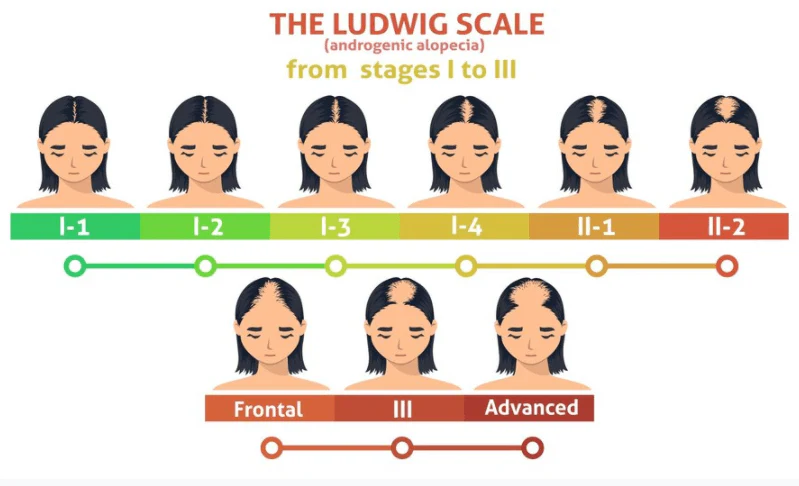
That is why two people can appear similar on the scale but require different treatments.
According to clinical literature, the Ludwig system is most useful once thinning has become patterned and persistent. It works best for long-term female pattern thinning, not sudden hair loss.
Who fits the Ludwig Scale well
The Ludwig Scale is designed for women who experience:
- Gradual thinning over the crown or mid-scalp
- A widening central part
- Preserved or only mildly affected frontal hairline
- Slow progression over years
These patients are often labeled stage 1 hair loss female early on, progressing gradually to stage 2 hair loss female or stage 3 hair loss female if untreated.
Who does not fit the Ludwig Scale cleanly
The Ludwig system is not ideal for:
- Sudden, heavy shedding after stress or illness
- Patchy hair loss
- Traction-related thinning from tight hairstyles
- Diffuse thinning with no clear pattern
Dr. Ahmet Murat explains:
“Using the Ludwig Scale on temporary shedding leads to misdiagnosis. Pattern must be stable before staging has meaning.”
Why this matters for treatment
Staging someone too early can push them toward unnecessary interventions. Staging too late can delay effective care. The scale should guide decisions, not rush them.
Once you understand whether the Ludwig Scale truly applies to you, the next step is learning how each stage actually looks in real life and how to assess it accurately.
Ludwig Scale stages explained
Once you know the Ludwig Scale applies to your pattern, the next challenge is staging it correctly. This is where most online guides fall short. Charts exist, but real hair does not behave like textbook illustrations.
Stage 1 hair loss female: early thinning that hides easily

Stage 1 hair loss female usually begins quietly. Density decreases along the central part or crown, but coverage still looks acceptable in casual settings. Under bathroom lighting or overhead sun, the scalp becomes more visible.
Common signs include:
- A part line that looks wider than before
- Hair that appears flat on top
- Scalp visibility only in certain light
At this stage, many women assume stress or seasonal shedding. That delay is common.
Dr. Ahmet Murat explains:
“Stage 1 is when intervention works best, but it is also when hair loss is easiest to deny.”
Stage 2 hair loss female: visible thinning across the crown
Stage 2 hair loss female brings clear density loss. The part widens further. Scalp visibility increases even without harsh lighting. Hairstyling becomes less forgiving.
This stage often causes emotional stress because camouflage stops working reliably. Ponytails feel thinner. Volume products lose impact.
Clinically, this is still ludwig scale female-pattern hair loss, but follicle miniaturization is more advanced.
Stage 3 hair loss female: advanced thinning with limited coverage
Stage 3 hair loss female represents significant loss of density across the crown and mid-scalp. Scalp is clearly visible at rest. Hair coverage is sparse, even with styling.
Importantly, follicles may still exist. They are miniaturized, not necessarily gone. This distinction shapes realistic treatment planning.
How to avoid mis-staging yourself
Many women stage themselves incorrectly due to:
- Wet hair inspections
- Fresh blow-drying before checking
- Harsh overhead lighting
- Comparing photos taken years apart in different conditions
Use the same lighting. Same angle. Same part. Track changes monthly, not daily.
Why accurate staging matters
Each ludwig hair loss scale stage responds differently to treatment. Early stages focus on stabilization. Later stages require combination strategies.
Now that the stages are clear, the next question is comparison. How does the Ludwig Scale differ from other female hair loss scales, and why doctors often use more than one tool?
Ludwig Scale vs other female hair loss scales
Once you understand the Ludwig Scale, a natural question follows. Why do some doctors mention other scales? And which one actually matters for treatment decisions?
The short answer is this. The ludwig hair loss scale is excellent for broad staging, but it is not always enough on its own.
Ludwig Scale vs Sinclair Scale
The Ludwig Scale divides ludwig scale female-pattern hair loss into three clear stages. This makes it easy to explain severity. The Sinclair Scale, on the other hand, focuses almost entirely on part width progression using five grades.
Doctors often prefer Sinclair for early cases like stage 1 hair loss female because it captures subtle changes better. Ludwig works well once thinning is obvious. Sinclair works better when changes are small but meaningful.
In practice, many clinicians stage with Ludwig and monitor with Sinclair.
Ludwig Scale vs Savin Scale
The Savin Scale expands on Ludwig by adding more intermediate steps and frontal pattern variations. Some clinics use it to visualize progression more precisely.
The downside is complexity. For patients, Savin often creates confusion rather than clarity. That is why ludwig scale hair loss remains the most widely referenced system in patient education.
Ludwig Scale vs Norwood Scale
The Norwood Scale is designed for men. It focuses on temples and frontal recession. Women rarely follow this pattern, which is why Norwood alone is misleading in female patients.
When women show Norwood-like recession, it usually signals a mixed or atypical pattern, not classic ludwig scale female hair loss.
Dr. Ahmet Murat explains:
“One scale never tells the full story. Ludwig gives us structure, but diagnosis requires pattern recognition and follicle evaluation.”
Why this comparison matters
Using the wrong scale can:
- Delay correct treatment
- Overestimate severity
- Push patients toward unnecessary procedures
The Ludwig Scale works best when it is part of a bigger picture, not the final word.
Next, we will look at what actually causes Ludwig-pattern thinning and how doctors separate true female pattern hair loss from conditions that only look like it.
What causes Ludwig Scale pattern thinning
Once staging is clear, the most important question is why this pattern is happening. The Ludwig Scale describes appearance, but treatment depends entirely on cause. This is where many guides oversimplify.
The biological driver behind ludwig scale female-pattern hair loss
True ludwig scale female hair loss is driven by follicle miniaturization. Over time, individual hairs grow thinner, shorter, and lighter. The follicle is still alive, but its output weakens.

Genetics play a central role. Hormones influence the process, but female pattern hair loss is not always caused by high androgen levels. Many women with normal hormone tests still develop this pattern.
According to dermatology literature, this slow miniaturization explains why stage 1 hair loss female can remain subtle for years before progressing to stage 2 hair loss female.
Dr. Ahmet Murat explains:
“Miniaturization is gradual. By the time thinning is visible, the process has been active for some time.”
Why hormones are not the whole story
Unlike male pattern baldness, ludwig scale female-pattern hair loss can progress even when hormone levels are normal. Sensitivity at the follicle level matters more than blood test results.
This is why treatment decisions should not rely on lab values alone.
Conditions that mimic the Ludwig hair loss scale
Several conditions can look like Ludwig-pattern thinning but behave very differently:
- Telogen effluvium after stress, illness, or surgery
- Nutritional deficiencies causing diffuse thinning
- Traction alopecia from tight hairstyles
- Inflammatory scalp conditions
These causes often create temporary thinning that improves once the trigger resolves. Mislabeling them as stage 2 hair loss female or stage 3 hair loss female can lead to overtreatment.
How doctors separate real pattern loss from look-alikes
Clinicians look for consistency. Miniaturization pattern. Progression over time. Scalp health. Dermoscopic findings.
Without this step, the Ludwig Scale hair loss label becomes misleading instead of helpful.
Understanding cause prevents panic. It also protects you from unnecessary treatments.
Next, we will look at how doctors actually confirm Ludwig staging in clinic and what a proper evaluation involves.
How doctors confirm the Ludwig Scale stage
By the time someone reaches this step, they usually want certainty. Charts and photos help, but the Ludwig Scale becomes truly useful only after proper clinical confirmation. This is where professional evaluation fills the gaps left by self-staging.
What happens during a proper hair loss assessment
A clinician does not rely on appearance alone. The goal is to confirm whether thinning truly follows ludwig scale female-pattern hair loss or whether another condition is imitating it.
The evaluation usually starts with:
- Visual pattern assessment across crown and mid-scalp
- Part width comparison in standardized lighting
- Hair shaft thickness variation across the scalp
In true ludwig scale hair loss, miniaturization is consistent and patterned, not random.
Dermoscopy and follicle miniaturization
Dermatoscopic examination, often called trichoscopy, allows doctors to see follicle behavior closely. Miniaturized hairs appear thinner and shorter next to normal terminal hairs. This mixed caliber pattern is a hallmark of ludwig hair loss scale progression.
This step is critical when distinguishing stage 1 hair loss female from temporary shedding. Early Ludwig changes can be subtle and are easy to miss without magnification.
Dr. Ahmet Murat explains:
“Miniaturization tells us the future. Shedding tells us the present. Confusing the two leads to wrong decisions.”
When blood tests are useful
Lab tests are not routine for every patient. They are ordered when symptoms suggest overlap with other causes. Iron deficiency, thyroid imbalance, or severe nutritional gaps can worsen thinning and mimic stage 2 hair loss female patterns.
Normal results do not rule out Ludwig-pattern loss. They simply rule out additional contributors.
When biopsy is considered
Scalp biopsy is rare and reserved for unclear cases. It is used when inflammatory or scarring conditions are suspected. Most patients with ludwig scale female hair loss never need one.
Why confirmation changes everything
Accurate staging prevents two common mistakes:
- Treating temporary shedding as permanent loss
- Delaying treatment in true stage 3 hair loss female
Once diagnosis is clear, treatment planning becomes logical instead of emotional. The next step is understanding how treatment strategies change depending on the Ludwig Scale stage and what realistic success looks like at each level.
Treatment options by Ludwig Scale stage
Once the Ludwig Scale stage is confirmed, treatment decisions become far more focused. The goal changes with severity. Early stages aim to slow progression. Later stages focus on stabilization and realistic density improvement.
Stage 1 hair loss female: slow progression and protect density
In stage 1 hair loss female, follicles are still active but beginning to miniaturize. This is the stage where non-surgical treatment has the highest impact.

Common approaches include:
- Topical minoxidil to support follicle activity
- Gentle scalp care and traction avoidance
- Monitoring progression with consistent photos
Consistency matters more than intensity. Over-treating early thinning often creates unnecessary shedding anxiety.
Dr. Ahmet Murat explains:
“Stage 1 is about preservation. If we protect follicles early, we often delay progression for years.”
Stage 2 hair loss female: stabilize and rebuild visual coverage
Stage 2 hair loss female shows clear density reduction across the crown. At this stage, treatment usually combines approaches.
Doctors may recommend:
- Continued topical therapy
- Supportive treatments to improve hair caliber
- Addressing contributing factors like iron deficiency or chronic stress
The focus shifts from prevention to visible improvement. Expectations must stay realistic. Full density return is uncommon, but stabilization is achievable.
Stage 3 hair loss female: advanced thinning and planning ahead
Stage 3 hair loss female represents advanced ludwig scale female-pattern hair loss. Coverage is limited, and scalp visibility is obvious even without harsh lighting.
Non-surgical treatments may still help slow progression, but they rarely restore meaningful density alone. At this stage, long-term planning becomes essential.
Dr. Ahmet Murat explains:
“Stage 3 requires honesty. Treatment is about improvement, not reversal.”
Options may include:
- Medical stabilization to protect remaining follicles
- Cosmetic strategies for coverage
- Careful evaluation for surgical suitability
Why stage-based treatment is important
Using the same treatment at every stage leads to disappointment. The ludwig scale hair loss system helps align expectations with biology.
The next step is understanding when surgical options may be considered and when they should be avoided entirely in women with Ludwig-pattern thinning.
Hair transplant planning in women with Ludwig Scale hair loss

Hair transplant for women is often mentioned in discussions about advanced Ludwig Scale thinning, but it is also one of the most misunderstood options for women. Surgery is never a default solution. It is a carefully selected strategy, used only when specific conditions are met.
Who may be a candidate for surgery
Women with ludwig scale female-pattern hair loss can be candidates for transplantation, but only if the donor area is stable. This usually means:
- Thinning is concentrated in the crown or mid-scalp
- The back and sides show minimal miniaturization
- Hair loss has been stable for a reasonable period
This is more common in late stage 2 hair loss female and selected stage 3 hair loss female cases.
Dr. Ahmet Murat explains:
“The most important question is not where hair is missing. It is where hair is safe to take from.”
When surgery should be avoided
Diffuse thinning across the entire scalp is a major warning sign. If donor hair is also miniaturizing, transplantation can worsen overall density. This pattern, sometimes called diffuse unpatterned alopecia, does not fit safe surgical planning.
Surgery should also be delayed when active shedding or rapid progression is present. Stabilization always comes first.
How planning differs from male hair transplants
Women rarely need hairline reconstruction. Most surgical planning focuses on improving crown coverage and visual density, not recreating a juvenile hairline.
Density goals are conservative. The aim is coverage, not maximal packing.
At Hermest, donor assessment is performed using detailed follicle analysis rather than visual estimation. This protects future options.
Dr. Ahmet Murat explains:
“In women, restraint is skill. Protecting donor reserves matters more than chasing density.”
Technique and long-term thinking
When surgery is appropriate, techniques like UNIQUE FUE® are used to preserve follicle integrity and control extraction patterns. Planning always accounts for possible future progression of ludwig hair loss scale stages.
A successful outcome is one that still looks balanced years later.
The role of surgery in a full plan
Hair transplantation is one part of a long-term strategy. Medical management usually continues afterward to protect non-transplanted hair.
Understanding these limits prevents disappointment and protects scalp health. The final step is knowing when expert guidance is needed and how to move forward with confidence.
Important questions about the Ludwig Scale
What is the Ludwig Scale used for?
The Ludwig Scale is used to classify ludwig scale female-pattern hair loss based on visible thinning at the crown and mid-scalp. It helps describe severity, not cause. Doctors use it to guide monitoring and treatment planning, often alongside other tools like trichoscopy.
Can stress or shedding be mistaken for ludwig scale hair loss?
Yes. Temporary shedding can mimic stage 1 hair loss female, especially under harsh lighting. True ludwig scale female hair loss shows consistent miniaturization over time, not sudden loss. Confirmation matters before starting long-term treatment.
How do I know if I am stage 1, stage 2, or stage 3 hair loss female?
Staging depends on scalp visibility and density, not daily shedding. Stage 1 shows a widening part, stage 2 shows clear crown thinning, and stage 3 shows advanced, obvious scalp exposure. Consistent photos and clinical assessment improve accuracy.
Does the Ludwig Scale apply to all women?
No. The ludwig hair loss scale fits patterned thinning with preserved frontal hairline. It is not ideal for patchy loss, traction alopecia, or sudden diffuse shedding. In those cases, other diagnoses should be considered first.
Can ludwig scale female hair loss stop progressing?
Progression can often be slowed, especially in stage 1 hair loss female and early stage 2 hair loss female, with appropriate treatment and monitoring. Stabilization is a realistic goal for many patients.
Is hair transplantation possible with Ludwig Scale thinning?
It can be, but only in selected cases. Donor stability is critical. Surgery is more common in later stage 2 or stage 3 hair loss female patterns and should always follow careful evaluation.
Why do doctors sometimes use other scales with the Ludwig Scale?
The Ludwig Scale is simple and effective, but some clinicians use the Sinclair or Savin scales to track subtle changes over time. Using more than one tool improves accuracy.
Should I self-diagnose using online Ludwig Scale charts?
Charts are helpful for orientation, not diagnosis. Lighting, styling, and hair texture can mislead. Professional evaluation prevents mis-staging and unnecessary worry.
Ready to move forward with clarity?
Understanding the Ludwig Scale is helpful, but real confidence comes from applying it correctly to your hair. Charts and online images can guide you, yet meaningful decisions should never rely on self-diagnosis alone.

At Hermest Hair Clinic, we evaluate ludwig scale female hair loss with a conservative, evidence-based approach. Each consultation begins with confirmation, not assumptions. Using our AIS (Advanced Inspection System), we assess pattern stability, follicle miniaturization, donor safety, and progression risk before discussing any treatment path.
Dr. Ahmet Murat explains:
“Correct staging protects patients. When we understand the pattern fully, we avoid unnecessary or premature interventions.”
When treatment is appropriate, planning focuses on long-term balance. Surgical candidates are evaluated carefully, and when surgery is suitable, the UNIQUE FUE® technique is used to protect donor integrity and support consistently high graft survival rates. For early or non-surgical cases, the priority remains stabilization, monitoring, and realistic expectations.
Whether you are in stage 1 hair loss female, navigating stage 2 hair loss female, or exploring options for advanced ludwig scale hair loss, your next step should feel informed and pressure-free.
If you want clarity grounded in experience and medical judgment, book a consultation to understand your situation fully and decide on the safest path forward.