


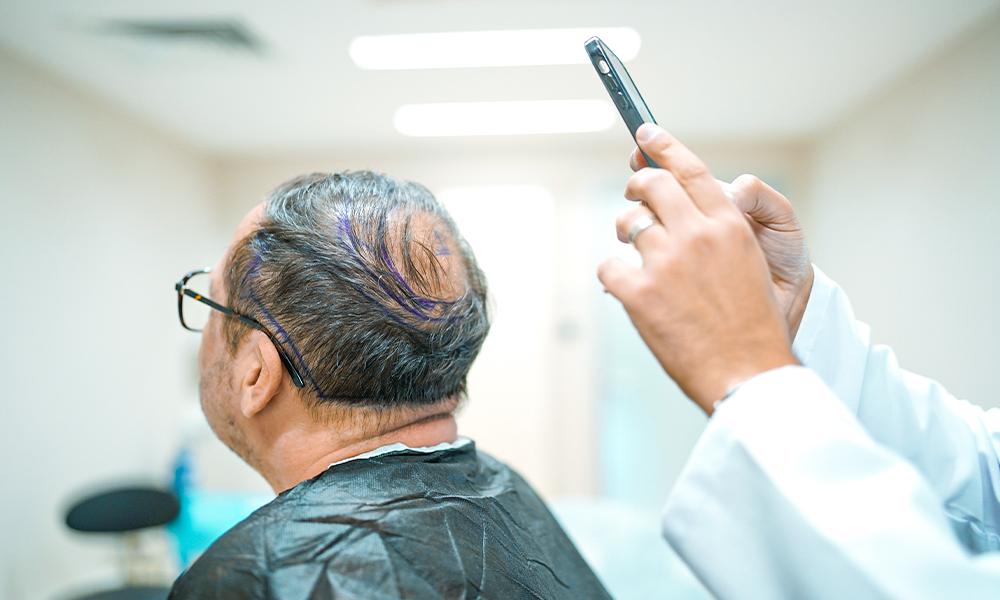
Bald Spot on Crown: Causes, Early Signs & Best Treatments
Noticing a bald spot on crown can be confusing, especially in the early stages. Many people are unsure whether they are seeing normal hair patterns or the beginning of real hair loss. This area, also known as the vertex, is one of the most common places where thinning begins.
So what is actually happening?
Vertex baldness, also called vertex alopecia, refers to hair thinning or loss at the top-back part of the scalp. It often starts subtly, making it harder to detect compared to hairline recession. According to research referenced by the National Center for Biotechnology Information, androgenetic alopecia commonly affects both the crown and temples, following predictable patterns over time.
This is why many patients first notice:
- A bald spot on top of head in photos
- Increased scalp visibility under light
- A widening circular thinning area
The challenge is that the crown is not easy to see daily.
You may not notice changes until:
- The thinning becomes more visible
- Someone points it out
- You compare older photos
That delay matters.
Because early detection gives you more options.
Dr. Ahmet Murat says: “Crown hair loss often goes unnoticed at first. By the time patients see it clearly, progression has already started. Early awareness makes a big difference in how we manage it.”
This guide will help you understand:
- what is vertex baldness and how it begins
- How to identify early crown thinning
- How it progresses over time
- The best treatment for crown hair loss at different stages
Hair loss at the crown is common.
But it is not always irreversible.
Quick Insights
- A bald spot on crown often starts subtly and is easy to miss
- Crown thinning is commonly linked to androgenetic alopecia
- Early detection gives more options to slow or manage hair loss
- The crown follows a circular thinning pattern that expands over time
- Treatment depends on whether follicles are still active
- Crown restoration is more complex than hairline work
- Monitoring changes over time helps guide better decisions
What is crown baldness (vertex hair loss)?
Crown hair loss refers to thinning that develops at the top-back of the scalp. This area is known as the vertex, and it behaves differently from the hairline.
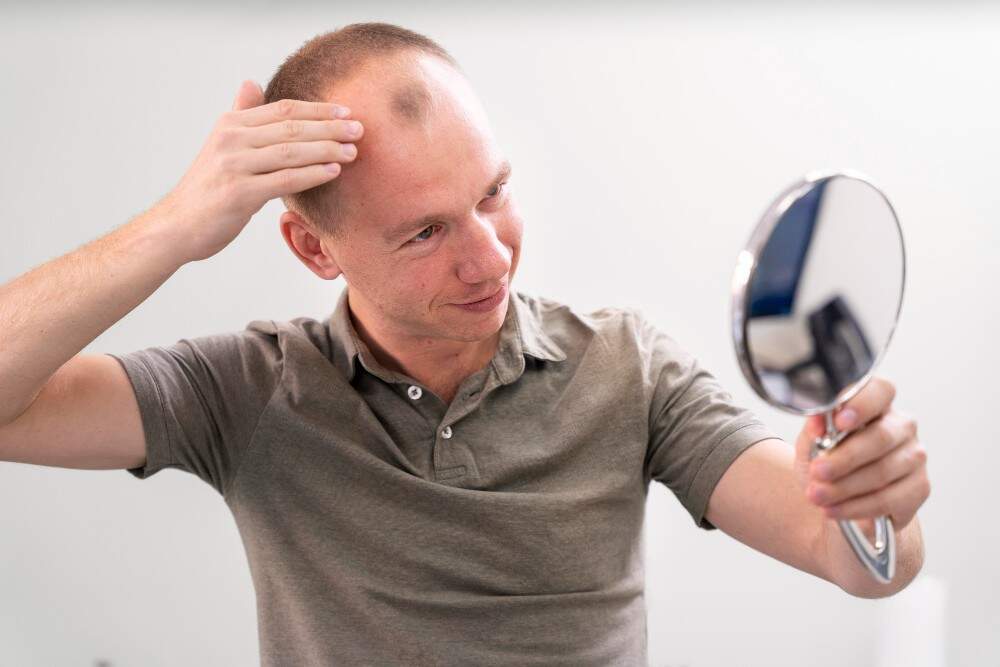
Understanding this difference helps you recognize changes earlier.
What is the crown area?
The crown sits at the highest point of your head, slightly toward the back.
It is where hair naturally grows in a spiral pattern, often called a swirl. This pattern can make it harder to tell whether you are seeing normal structure or early crown hair loss.
That is why many people confuse:
- A natural swirl
- A bald patch on head
- Early thinning
The crown is not easy to monitor daily. You usually see it in photos or mirrors from certain angles.
How vertex baldness starts
Vertex baldness usually begins gradually.
You may notice:
- Slight reduction in density
- Increased scalp visibility under light
- A soft thinning circle forming
This stage often goes unnoticed.
According to dermatology data referenced by the American Academy of Dermatology, androgenetic alopecia causes follicles to shrink over time, producing thinner hair before stopping growth completely.
This process is called miniaturization.
It happens slowly.
Why it is hard to notice early
The crown is one of the last places people check.
You may:
- Focus more on your hairline
- See your hair mostly from the front
- Miss subtle changes in density
Lighting also plays a role. Bright light can make the scalp more visible, creating confusion.
This is why many patients ask: “Is this normal or am I balding?”
Dr. Ahmet Murat explains: “The crown is deceptive. Early thinning can look like a normal hair pattern. We rely on comparison and density changes, not just visual shape.”
Clarity comes from observation over time.
What causes a bald spot on the crown?
A bald spot on crown does not appear suddenly. It develops over time due to changes at the follicle level. Understanding the cause helps you choose the right approach early.
Genetics and androgenetic alopecia
The most common cause is androgenetic alopecia.

This is a genetic condition that affects how hair follicles respond to hormones. According to research referenced by the National Center for Biotechnology Information, this type of hair loss follows predictable patterns, often starting at the crown or temples.
If family members experienced crown thinning, your risk is higher.
This is not random.
It follows a pattern.
DHT and follicle miniaturization
The key hormone involved is DHT (dihydrotestosterone).
In sensitive follicles:
- DHT shortens the growth cycle
- Hair becomes thinner with each cycle
- Eventually, growth stops
This process is called miniaturization.
It explains why:
- Hair density gradually decreases
- The bald patch on head expands slowly
- The area becomes more visible over time
The crown is particularly sensitive to DHT.
That is why vertex baldness often starts there.
Lifestyle and secondary factors
Genetics is the main driver, but other factors can influence progression.
These include:
- Stress
- Poor scalp health
- Inflammation
- Nutritional deficiencies
These do not cause hair loss alone, but they can accelerate it.
Patients often search why is my crown thinning when they notice sudden changes. In many cases, the process has been developing quietly for months or years.
Dr. Ahmet Murat says: “Hair loss at the crown is usually progressive, not sudden. What patients see is often the result of changes that started earlier.”
The important point is this.
You cannot change genetics.
But you can influence progression.
Early signs of crown balding
Crown thinning rarely starts as a clear bald spot. It develops gradually, often without obvious warning. This is why many people miss the early phase.
Recognizing the signs early gives you more control.
Thinning vs natural hair swirl
The crown naturally has a swirl pattern.
This can make it difficult to tell the difference between:
- A normal hair pattern
- Early vertex hair loss
A natural swirl:
- Looks consistent over time
- Does not expand
- Maintains density around it
Early thinning behaves differently.
You may notice:
- The swirl looks wider than before
- Hair around the center appears less dense
- The scalp becomes slightly more visible
This is often the first subtle sign of a bald spot on top of head forming.
Increased scalp visibility
Lighting reveals more than mirrors.
Early crown thinning becomes noticeable when:
- Under bright light
- In photos taken from above
- After hair is wet
You may see:
- A faint circular area
- More scalp reflection than before
- Reduced coverage in the same spot
This is one of the clearest indicators of crown balding.
Changes in hair texture and density
Hair does not disappear overnight.
Before visible loss:
- Strands become thinner
- Hair feels less dense when touched
- Styling becomes slightly harder
This stage often goes unnoticed.
According to dermatology insights referenced by the American Academy of Dermatology, follicle miniaturization leads to gradual thinning before hair stops growing.
Dr. Ahmet Murat explains: “We often detect crown thinning before patients see it clearly. Texture and density changes appear earlier than visible bald spots.”
How to confirm early crown thinning
A simple method:
- Take photos from the top every few months
- Compare under similar lighting
- Look for gradual widening or thinning
Early detection creates options.
How crown hair loss progresses over time
Crown thinning does not stay the same. It follows a gradual pattern that becomes more visible over time. Understanding this progression helps you act at the right moment.
Small thinning spot
The process usually starts subtly.
At this stage:
- Hair density decreases slightly
- The swirl area looks wider
- Scalp becomes more visible under light
This is often mistaken for a normal pattern. Many patients ignore it. But this is the best time to act.
Expanding circular bald area
As vertex baldness progresses, the thinning area becomes more defined.
You may notice:
- A clear circular or oval shape
- Reduced coverage in the center
- Hair becoming finer around the edges
This is when the bald patch on head becomes noticeable even without strong lighting.
The change is gradual, but visible.
Connection with frontal hair loss
In later stages, crown and hairline changes may connect.
This leads to:
- Larger areas of thinning across the top
- Reduced density between front and crown
- More advanced patterns similar to higher Norwood stages
According to clinical data referenced by the National Center for Biotechnology Information, androgenetic alopecia often progresses in both the vertex and frontal regions over time.
This is not always simultaneous.
Some patients:
- Lose crown density first
- Others notice hairline recession first
Why progression matters
Hair loss at the crown is progressive.
Without intervention:
- The thinning area expands
- Density continues to decrease
- Regrowth becomes more difficult
Dr. Ahmet Murat says: “The crown is one of the areas where timing matters most. Early-stage thinning can often be managed, but advanced stages require more complex planning.”
Progression is predictable.
But not inevitable.
Can crown baldness be stopped or reversed?
This is one of the most important questions patients ask when they notice a bald spot on crown. The answer depends on timing and follicle condition.
Hair can be preserved. In some cases, it can improve.
Early-stage crown thinning
At the beginning, follicles are still active.
Hair is:
- Thinner
- Shorter
- Less dense
But not gone.
This stage offers the best chance to slow or even partially reverse vertex baldness.
You may see improvement when:
- The follicles are still producing hair
- The thinning area is not fully smooth
- Density loss is recent
This is when intervention is most effective.
Medical treatment options
Several treatments target the underlying process.
Common approaches include:
- Topical solutions that support hair growth
- Medications that reduce DHT impact
- Scalp therapies that improve circulation
These aim to:
- Slow progression
- Strengthen existing hair
- Improve density over time
According to dermatology research referenced by the American Academy of Dermatology, early treatment increases the likelihood of maintaining existing hair.
Results vary between individuals.
When regrowth is limited
As the condition progresses, follicles may become inactive.
At this stage:
- Hair stops growing in certain areas
- The scalp becomes smoother
- Regrowth becomes less likely
This does not mean nothing can be done.
It means expectations change.
Treatments may maintain surrounding hair but not fully restore the area.
Practical perspective
Patients often ask:
- how to stop crown hair loss
- how to regrow hair on crown
The answer depends on timing.
Dr. Ahmet Murat explains: “If follicles are still active, we can often improve density. If they are gone, we shift focus to restoration rather than regrowth.”
This is the key distinction.
Preservation vs restoration.
Best treatments for crown hair loss
Treatment depends on the stage of thinning and follicle activity. The goal is either to preserve existing hair or restore lost areas.
Understanding the options helps you choose the right approach.
Medications and topical treatments
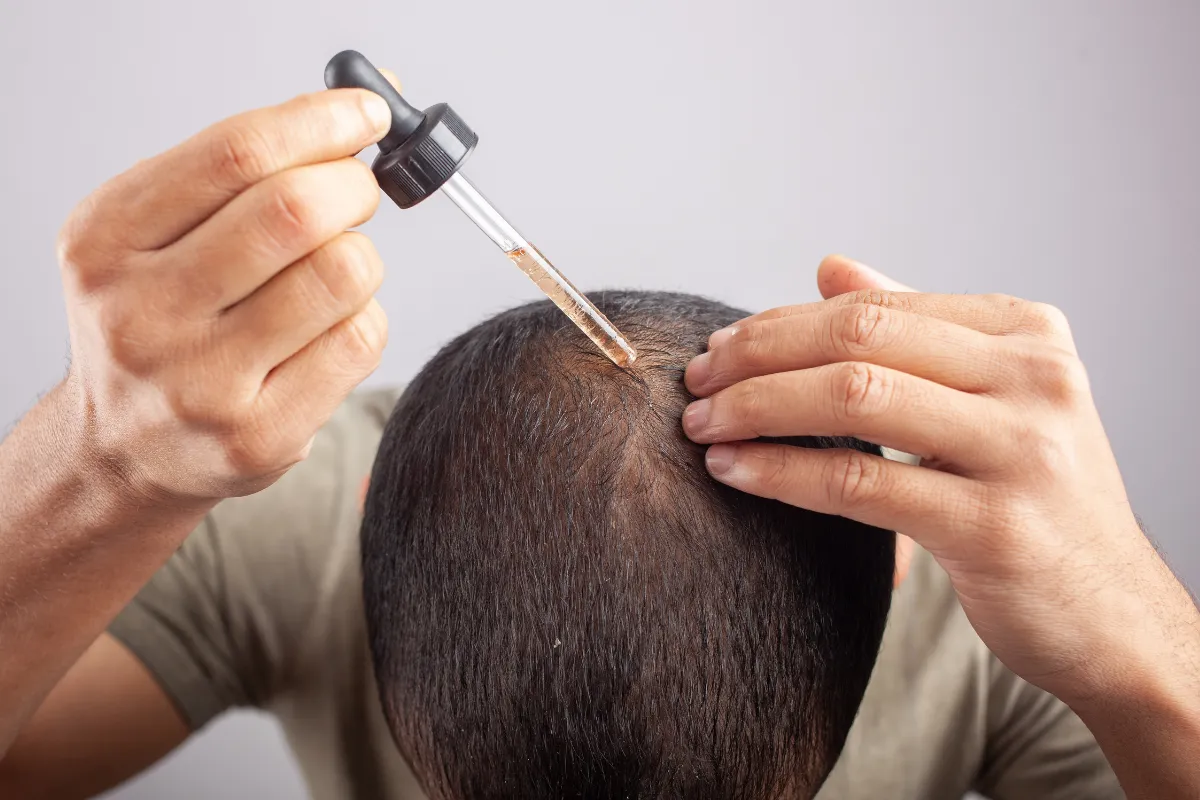
These are usually the first line of treatment.
They aim to:
- Slow progression
- Support follicle activity
- Improve density in thinning areas
Patients often search best treatment for crown hair loss when they notice early changes.
These treatments work best when:
- Hair is thinning, not fully gone
- The area still has active follicles
- Intervention starts early
Consistency matters more than intensity.
PRP and supportive therapies

Platelet-rich plasma (PRP) and similar treatments are used to support scalp health.
They may help:
- Improve blood flow
- Stimulate weaker follicles
- Support existing hair growth
These treatments are often used alongside medical options rather than alone.
Results vary, but they can support overall density.
Hair transplant for crown area
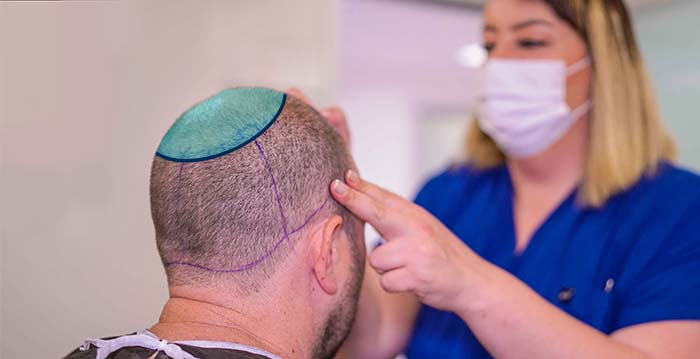
When hair loss becomes more advanced, restoration may be considered.
A crown hair transplant focuses on:
- Filling the thinning area
- Restoring density
- Blending with surrounding hair
The crown requires careful planning.
Unlike the hairline, it has:
- A circular growth pattern
- Specific angle requirements
- Higher graft demand
According to clinical insights referenced by the International Society of Hair Restoration Surgery, crown restoration often requires more grafts due to its structure.
Choosing the right approach
Treatment depends on:
- Stage of crown hair loss
- Donor area strength
- Long-term progression pattern
Dr. Ahmet Murat says: “The crown is one of the most technical areas to treat. Planning density and direction correctly makes the difference between natural and artificial results.”
There is no single solution.
The right approach depends on timing.
When should you take action for crown hair loss?
Timing shapes outcomes more than most people expect. Acting too late limits options. Acting too early without a plan can create other issues.
The goal is to act at the right moment.
Early vs late stage decisions
In early stages:
- Hair is thinning but still present
- Follicles are active
- Density can still be supported
This is the best time to slow progression and preserve existing hair.
In later stages:
- The thinning area becomes more defined
- Hair stops growing in certain zones
- Restoration becomes the main option
At this point, treatments shift from preservation to reconstruction.
When to see a specialist
You do not need to wait for a visible bald spot on crown.
You should consider evaluation when:
- You notice increased scalp visibility
- Hair feels thinner in the crown area
- Photos show gradual changes over time
Early assessment helps clarify:
- Whether thinning is progressive
- What stage you are in
- What options are available
This removes uncertainty.
Monitoring progression
Tracking changes gives you control.
Simple steps include:
- Taking photos every few months
- Checking density under consistent lighting
- Comparing changes over time
According to dermatology insights referenced by the American Academy of Dermatology, early detection and monitoring improve management of hair loss conditions.
Practical perspective
Patients often delay action.
They wait until:
- The area becomes clearly visible
- Density loss is advanced
By then, options become more limited.
Dr. Ahmet Murat explains: “We prefer to see patients early. When we understand the pattern early, we can guide them with more effective and less invasive solutions.”
Early action gives flexibility.
Waiting reduces it.
Crown vs hairline balding: what’s the difference?
Hair loss does not look the same in every area. The crown and hairline follow different patterns, progress differently, and often require different treatment approaches.
Understanding this helps you interpret what you are seeing.
Key differences in pattern
Hairline recession usually starts at the temples.
You may notice:
- A receding frontal line
- An “M-shaped” pattern
- Gradual backward movement
Crown thinning behaves differently.
It typically appears as:
- A circular thinning area
- A bald spot on top of head
- Gradual expansion outward
These patterns can develop independently or together.
Which progresses faster?
There is no single answer.
Some patients experience:
- Early crown hair loss with a stable hairline
- Hairline recession first with a strong crown
- Both areas progressing at the same time
According to clinical observations referenced by the National Center for Biotechnology Information, androgenetic alopecia can affect multiple regions with different progression speeds.
This is why comparing yourself to others can be misleading.
Differences in treatment approach
Treatment planning is not the same for both areas.
Hairline restoration focuses on:
- Natural framing of the face
- Precise angle and direction
- Lower graft numbers
Crown restoration requires:
- Circular implantation patterns
- Higher graft density
- Strategic distribution
This makes crown work more complex in many cases.
Why this comparison matters
Many patients focus only on the hairline. They overlook the crown.
This can lead to:
- Imbalanced results
- Uneven density over time
- Need for additional procedures later
Dr. Ahmet Murat says: “The crown and hairline must be planned together. Ignoring one area can affect the overall harmony of the result.”
Hair loss is not just local.
It is a pattern.
FAQs about bald spot on crown and vertex baldness
What is vertex baldness?
Vertex baldness refers to hair thinning or loss at the crown area, located at the top-back of the scalp. It is a common pattern of androgenetic alopecia and often appears as a circular thinning spot that gradually expands over time.
Is a bald spot on crown always hair loss?
Not always. A natural hair swirl can sometimes look like a bald spot on crown, especially under bright light. The difference is that true thinning shows reduced density over time, while a normal swirl remains stable.
Why is my crown thinning first?
The crown area is more sensitive to DHT, a hormone linked to androgenetic alopecia. According to dermatology insights from the American Academy of Dermatology, certain scalp regions are more affected by hormonal changes, which is why crown thinning can appear early.
Can crown hair loss grow back?
It depends on the stage. If follicles are still active, treatments may improve density and slow progression. If the area is fully bald, regrowth is less likely, and restoration options may be considered instead.
How do I know if my crown is thinning?
You can check by taking photos from above and comparing them over time. Look for increased scalp visibility, reduced density, or a widening circular area.
What is the best treatment for crown hair loss?
The best treatment for crown hair loss depends on the stage. Early thinning may respond to medical treatments, while more advanced stages may require procedures such as hair transplantation for density restoration.
Does crown baldness get worse over time?
Yes, in most cases it progresses gradually. Without intervention, the thinning area can expand and connect with frontal hair loss patterns over time.
Is crown baldness harder to treat than hairline loss?
In many cases, yes. The crown requires more grafts and careful planning due to its circular growth pattern. This makes treatment more complex compared to the hairline.
Take the next step with a clinic experienced in crown restoration
Crown hair loss requires a different level of planning. The circular growth pattern, higher graft demand, and long-term progression make this area more complex than it looks.
At Hermest Hair Transplant Clinic, the focus is not just filling a bald spot on crown, but creating a result that remains natural over time. Each case is evaluated based on crown density, donor capacity, and how your hair loss is likely to progress.

Hermest uses its UNIQUE FUE® technique, designed for precise graft extraction and controlled placement. In crown procedures, angle and direction matter even more, and this technique allows for natural swirl patterns that match your existing hair. The process is supported by the AIS / AISP (All-In Safety Protocol), ensuring graft protection, sterile conditions, and consistent medical standards.
What makes the approach different:
- Doctor-led planning focused on both crown and overall hair pattern
- Strategic graft distribution to create natural density in circular areas
- Careful donor management to preserve future options
- Long-term design that keeps balance as hair loss evolves
Hermest has been recognized with the European Awards in Medicine 2025, reflecting its consistency in patient outcomes and clinical quality.
Dr. Ahmet Murat says: “The crown is one of the most technical areas in hair restoration. When direction, density, and planning come together correctly, the result looks natural from every angle.”
If you are noticing thinning at the crown or want to understand your options, a personalized evaluation can give you clarity.
Start with a free hair analysis and consultation at Hermest Hair Transplant Clinic and build a plan that works for both today and the years ahead.