


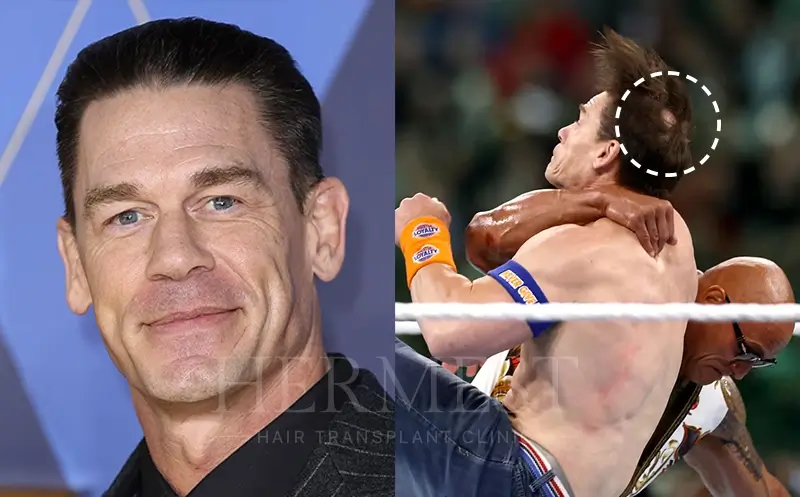
John Cena Hair Transplant: Crown Restoration, Grafts, & Results
The John Cena hair transplant story is not rumor anymore. It is confirmed, discussed openly, and closely watched by millions. When a global public figure admits to hair restoration, it changes how people think about male pattern baldness, confidence, and treatment choices.
For years, John Cena hair loss was visible mainly at the crown. Fans noticed the growing John Cena bald spot during matches and TV appearances. His frontal hairline stayed strong, but the vertex area gradually thinned. This pattern is common. It matches a typical Norwood Stage 3 Vertex progression, where the crown loses density before the front recedes.
In 2024, Cena publicly confirmed undergoing a hair transplant, stating it was a personal decision linked to confidence and constant public attention. Media outlets like Entertainment Weekly reported that he chose treatment after years of being aware of the issue. That transparency made the topic mainstream.
People searching did John Cena get a hair transplant are usually asking something deeper. They want to know:
- Is crown hair loss fixable
- Does surgery actually work
- What results are realistic
Cena’s case answers those questions in a practical way. He did not rebuild a dramatic hairline. He improved density where it was needed. That is how most successful procedures are planned.
Dr. Ahmet Murat explains:
“The best hair transplant is the one nobody notices as surgery. It should look like your own hair simply returned.”
This article breaks down:
- John Cena hairline and crown analysis before surgery
- What technique he likely used
- His recovery timeline and visible results
- What his case teaches about real-world hair restoration
The goal is simple. Turn a celebrity example into useful guidance you can apply to your own situation, without hype or unrealistic promises.
Did John Cena get a hair transplant?
Short answer: yes. The John Cena hair transplant is publicly confirmed. In late 2024, Cena shared in interviews that he chose surgery after years of noticing John Cena hair loss at the crown and hearing comments about his John Cena bald spot. Coverage from outlets like Entertainment Weekly echoed his statement and the timing of the procedure.
What he actually confirmed
Cena described the decision as personal and confidence-driven. He did not frame it as vanity. He framed it as control over an issue that had been visible for years. That honesty matters. It also answers the most searched question: did John Cena get a hair transplant—yes, and he spoke about it directly.
Dr. Ahmet Murat explains:
“When a patient understands the pattern and the limits, the decision becomes calm and rational. That is when surgery works best.”
Why he chose surgery now
The pattern behind John Cena hair loss is typical crown thinning. The frontal hairline remained strong. The vertex, however, lost density under lights and cameras. Crown loss is hard to camouflage. Powders help temporarily. Styling helps slightly. Neither restores density.
Public pressure accelerates decisions. Athletes and actors face high-definition cameras, harsh lighting, and constant scrutiny. That combination makes John Cena bald spot changes appear more pronounced than in daily life.
Timing and context
The reported timeline places the procedure in 2024, with early regrowth visible months later. That aligns with standard recovery for a john cena hair transplant focused on the crown:
- Early shedding in the first 1–3 months
- Initial regrowth around month 4–6
- Noticeable density by month 9–12
The key takeaway is not the date. It is the approach. He targeted the problem area, preserved the hairline, and accepted a realistic density plan.
John Cena hair loss pattern before transplant (crown vs hairline)
Before the John Cena hair transplant, his pattern followed a very specific and common path. The John Cena hairline remained stable and strong for years. The visible change happened at the crown, where thinning gradually increased under bright lighting.
Crown thinning vs hairline preservation
In most public appearances, John Cena hair loss appeared as a clear vertex thinning pattern. The front remained intact. The top and crown lost density. This combination creates contrast, making the thinning area more noticeable on camera.
This pattern aligns with male pattern baldness focused on the crown, often classified as a Norwood Stage 3 Vertex. It is one of the most frequent patterns seen in clinical practice.
Common characteristics of this pattern include:
- Circular thinning at the crown
- Gradual expansion of the thinning zone
- Minimal or no recession at the temples
- Normal hairline framing the face
This explains why the John Cena bald spot looked more prominent over time while his overall hairstyle stayed similar.
Dr. Ahmet Murat explains:
“Crown thinning progresses quietly. Patients often notice it later because it is not in the mirror’s direct view.”
Why crown thinning looks worse on camera
Lighting plays a big role. Overhead lighting increases scalp reflection. Sweat, water, or styling products can separate hair fibers, exposing more scalp. In sports environments like WWE arenas, this effect is amplified.
That is why many people searching john cena hair loss notice dramatic differences between photos taken in studio lighting versus outdoor or candid settings.
What stage was he likely at?
Based on visible density loss and preserved frontal hairline, Cena’s pattern most closely matched:
- Norwood Stage 3 Vertex
- Early to moderate crown thinning
This stage is ideal for surgical correction because donor hair is still strong and the thinning area is localized.
Understanding this pattern explains why his transplant focused on density restoration rather than hairline reconstruction.
John Cena before and after hair transplant (what actually changed)
When people search john cena before and after hair transplant, they expect a dramatic transformation. His case is different. The change is controlled, targeted, and natural. That is exactly how a crown-focused transplant should look.
What changed at the crown
Before surgery, the John Cena bald spot showed clear scalp visibility under bright lights. After the John Cena hair transplant, that same area appears denser, with reduced shine and better coverage.
The improvement is not about creating thick, teenage density. It is about restoring enough coverage so the scalp is no longer the focus.
Visible improvements include:
- Reduced crown shine under overhead lighting
- More even hair distribution across the vertex
- Better blending with surrounding native hair
These changes make the John Cena hair loss pattern far less noticeable in motion and on camera.
Dr. Ahmet Murat explains:
“Crown transplants are about camouflage. When density is placed correctly, the eye stops focusing on the scalp.”
What did not change
His John Cena hairline remained essentially the same. There is no sign of frontal reconstruction. This is important. It confirms that the procedure targeted the vertex only.
This approach preserves donor resources and maintains a natural appearance as hair continues to age.
Early vs mature results
Like all transplants, results developed gradually:
- First months: shedding phase after implantation
- Months 4–6: early regrowth begins
- Months 9–12: visible density improvement
- 12+ months: final blending and thickening
This timeline aligns with typical follicular unit growth cycles described in clinical literature and ISHRS patient guidance.
Why his result looks natural
The success of the john cena hair transplant is not in how much hair was added, but how it was placed. Direction, angle, and density planning determine whether a result looks surgical or natural.
His outcome shows careful planning and realistic expectations, which is why it works on screen and in real life.
What technique did John Cena likely choose (FUE or DHI)?
The John Cena hair transplant focused on the crown. That detail alone gives strong clues about the technique used. Most modern crown procedures rely on refined FUE-based methods, sometimes combined with DHI-style implantation for precise angle control.
Why FUE is the most likely base technique
FUE (Follicular Unit Extraction) is widely used for crown restoration. It allows surgeons to harvest individual follicular units with minimal scarring and then place them in a spiral pattern that matches natural crown growth.
For a case like John Cena hair loss at the vertex, FUE offers:
- Flexible graft selection for different hair calibers
- Low visible scarring for short hairstyles
- Controlled placement density across a circular area
These advantages fit a public figure who keeps his hair short and needs a natural look from all angles.
Dr. Ahmet Murat explains:
“Crown work requires careful angulation. The direction must follow the natural swirl, or the result will look artificial even with good density.”
Where DHI-style implantation fits
DHI (Direct Hair Implantation) is not always a separate procedure. It can be a placement method within an FUE plan. DHI implanter pens allow surgeons to control angle and depth precisely, which is useful in the crown where hair grows in multiple directions.
In many modern clinics, surgeons combine FUE extraction with DHI-style placement to improve orientation and survival of grafts.
Estimated graft numbers for his crown
Based on the size of the John Cena bald spot and visible density improvement, a realistic estimate would be:
- 1,800 to 2,500 grafts for crown coverage
- Lower density in the center, higher density in the transition zones
This range matches typical graft counts reported by ISHRS surgeons for vertex restoration.
Why crown transplants require precision
Unlike the hairline, the crown has a spiral growth pattern. Density must be layered gradually. Overpacking can damage blood supply. Underpacking leaves visible gaps.
The likely success of the john cena hair transplant reflects careful density planning, proper graft angle, and respect for long-term donor management.
Hair transplant recovery timeline (based on John Cena’s case)
The John Cena hair transplant followed the same biological timeline seen in most modern FUE-based procedures. Understanding this timeline helps set realistic expectations and prevents unnecessary anxiety during early phases.
Month 1–3: shedding phase (the “shock loss” period)
After implantation, transplanted hairs often shed. This is normal. The follicles remain alive under the skin and prepare for new growth.
During this stage, many patients worry the procedure failed. This is the moment when searches for john cena before and after hair transplant increase the most, because visible results are not yet present.
Typical experience:
- Redness and small scabs during first 10–14 days
- Shedding of implanted hairs by week 3–6
- Crown area may look similar or slightly thinner than before
Dr. Ahmet Murat explains:
“Shedding is not loss. It is a reset. The follicle is entering a new growth cycle.”
Month 4–6: early regrowth begins
Around the fourth month, new hair begins to appear. These early hairs are thin and soft. Density is still low, but coverage starts improving gradually.
In crown cases like John Cena hair loss, this stage can feel slow. The crown area naturally takes longer to show visible density compared to the hairline.
Month 6–9: visible improvement
Hair shafts begin to thicken. Coverage improves under normal lighting. The John Cena bald spot becomes less reflective and less noticeable.
Patients often start styling their hair more confidently during this stage.
Month 9–12: final density and blending
This is when most of the visible change happens. Hair texture matures, direction blends with native hair, and overall density stabilizes.
By the one-year mark, the final result of a john cena hair transplant is usually visible.
Why crown recovery takes longer
The crown has a different blood supply and growth pattern compared to the frontal area. Growth cycles are slightly delayed, and density layering takes time to look natural.
Why celebrities like John Cena choose hair transplants
Public figures live under constant visual scrutiny. Cameras, lighting, and close-ups amplify small changes. That pressure plays a real role in decisions like the John Cena hair transplant.
Public image and on-camera reality
High-definition cameras exaggerate crown thinning. Overhead lighting increases scalp reflection. Sweat during performance separates hair fibers. Together, these factors make John Cena hair loss look more pronounced on screen than in daily life.
For athletes and actors, appearance is part of the job. Consistency matters. A visible John Cena bald spot can become a talking point that distracts from performance.
Dr. Ahmet Murat explains:
“For public figures, stability is the goal. A controlled, natural result removes the distraction without changing identity.”
Confidence and role versatility
Hair loss can affect casting and public perception. Even when talent is not in question, producers often prefer a stable look across projects. Addressing crown thinning helps maintain continuity for long-term roles and brand image.
This is why many people searching did John Cena get a hair transplant are really asking whether surgery can restore confidence without looking artificial. His outcome suggests it can, when planned conservatively.
Changing stigma around male hair restoration
Open discussions from public figures reduce stigma. Years ago, men hid procedures. Today, many speak openly about them. This shift encourages more realistic conversations about options and limits.
Search trends for john cena hair transplant and john cena before and after hair transplant reflect this change. People are no longer just curious. They are evaluating their own options.
Why crown cases are common in celebrities
Crown thinning is harder to conceal under lights and movement. Hairline changes can be styled. The crown cannot. That is why many celebrity procedures target the vertex first.
The key takeaway is simple. The decision is less about vanity and more about control, consistency, and confidence in a highly visible profession.
What you can learn from the John Cena hair transplant
The John Cena hair transplant is useful as a case study. It shows what realistic planning looks like for crown thinning and how small, precise changes can make a big visual difference.
Crown vs hairline planning
His John Cena hairline stayed intact. The procedure focused on the vertex. That choice preserves donor hair and avoids an unnatural, over-dense front with a weak crown behind it.
If your concern matches John Cena hair loss—strong front, thinning crown—planning should mirror that logic:
- Prioritize the crown swirl and transition zones
- Blend into existing hair rather than chasing maximum density
- Keep donor reserves for future changes
Dr. Ahmet Murat explains:
“Balance wins. A moderate crown density that blends well looks better than an overpacked area that draws attention.”
Graft strategy and realistic density
Crown work often uses 1,800–2,500 grafts, placed in a spiral pattern with gradual density changes. The center receives lighter coverage. The edges receive higher density to create a natural transition.
This is why results from a john cena hair transplant look natural on camera and in motion. Direction and angle matter as much as graft count.
Recovery expectations you can rely on
Expect the same timeline:
- 1–3 months: shedding phase
- 4–6 months: early regrowth
- 9–12 months: visible density and blending
Crown areas grow slower than hairlines. Patience is part of the process.
When surgery makes sense
You are a good candidate when:
- Thinning is localized (crown or mid-scalp)
- Donor area is stable and strong
- Loss has stabilized over time
- Expectations focus on coverage, not “full density”
When to avoid or delay
Delay surgery if:
- You have active shedding or diffuse thinning
- Donor hair shows miniaturization
- The pattern is still changing quickly
Use Cena’s example as a guide: targeted correction, conservative density, long-term thinking. That approach protects both your look now and your options later.
Who is a good candidate for a crown hair transplant
The John Cena hair transplant is a strong example of a well-selected case. Not every patient with thinning at the crown should move straight to surgery. The decision depends on pattern, donor strength, and stability over time.
Pattern matters more than speed
Crown restoration works best when hair loss is localized. The typical profile looks like John Cena hair loss before treatment:
- A defined John Cena bald spot at the vertex
- A stable John Cena hairline at the front
- Gradual change over years, not sudden shedding
This pattern allows surgeons to focus grafts where they will have the most visible impact.
Dr. Ahmet Murat explains:
“Crown work succeeds when the borders are clear. We need a defined area to rebuild, not a moving target.”
Donor area quality and density
Strong donor hair at the back and sides is the foundation. Surgeons assess:
- Hair caliber (thicker shafts create better coverage)
- Density per square centimeter
- Signs of miniaturization in the donor zone
If donor hair is weak or thinning, surgery may reduce overall density rather than improve it.
Stability over time
Timing matters. The pattern should be stable before planning a john cena hair transplant–type procedure. Rapid, ongoing loss can outpace transplanted grafts and create imbalance.
A stable pattern typically shows:
- Consistent crown size over 12–18 months
- No active shedding spikes
- Predictable progression rate
Expectations and coverage goals
Crown transplants aim for coverage and natural blending, not maximum density. The goal is to reduce scalp visibility and restore a balanced look in normal lighting.
Patients who understand this tend to be happiest with their results.
When to delay or avoid surgery
Surgery should be postponed if:
- Thinning is diffuse across the whole scalp
- Shedding is active or recent
- Medical causes of hair loss are not yet addressed
FAQs about the John Cena hair transplant
Did John Cena confirm he had a hair transplant?
Yes. The John Cena hair transplant was publicly confirmed in 2024. In interviews reported by outlets such as Entertainment Weekly, he explained that he chose the procedure after years of noticing John Cena hair loss at the crown and feeling self-conscious about the visible thinning.
What type of hair loss did John Cena have?
His pattern was consistent with crown-focused male pattern baldness. The John Cena hairline stayed strong, while the vertex area thinned over time. This is often described as a Norwood Stage 3 Vertex pattern, a common stage for patients seeking crown restoration.
How many grafts did John Cena likely need?
Based on the size of the John Cena bald spot and the visible density change after surgery, a realistic estimate is 1,800–2,500 grafts. This range is typical for crown restoration procedures reported by ISHRS surgeons.
What technique was likely used?
While his exact method was not publicly detailed, the result suggests a modern FUE-based approach, possibly combined with DHI-style implantation for better angle control in the crown’s spiral pattern. This approach allows natural direction and blending.
Are crown hair transplants permanent?
Transplanted follicles are generally permanent, as they come from donor areas resistant to androgenetic hair loss. However, surrounding native hair may continue thinning, which is why long-term planning is important.
Is a crown transplant right for everyone with hair loss?
No. Ideal candidates have localized crown thinning, strong donor density, and stable hair loss patterns. Diffuse thinning or active shedding may require medical treatment first.
Thinking about a crown transplant like John Cena?
The John Cena hair transplant shows how targeted crown work can improve density without changing your identity. The key is not chasing numbers. It is choosing the right moment, the right plan, and the right technique for your pattern.
At Hermest Hair Clinic, we start with clarity. Using our AIS (Advanced Inspection System), we assess your crown pattern, donor strength, and progression risk before suggesting any procedure. Many patients do not need surgery yet. Some do. The decision should be calm and evidence-based.
Dr. Ahmet Murat explains:
“Crown restoration is about balance. We place density where it matters and protect donor reserves for the future.”
When surgery is appropriate, we plan conservatively. Our UNIQUE FUE® technique focuses on natural swirl direction, controlled density, and high graft survival, so the result blends under normal lighting and on camera. Medical support continues after the procedure to protect your existing hair.
You do not need to guess your stage or copy a celebrity plan. You need an honest evaluation and a long-term strategy that fits your hair.
If you want to understand whether your crown thinning can be improved—and how to do it safely — book a consultation with Hermest Hair Clinic and get a clear, personalized plan.