


8000 Grafts Hair Transplant: Cost, Feasibility & Planning Guide

 Medically reviewed by Dr. Ahmet Murat, MD
Written by Mehmet Y. — Updated on September 19th, 2025
An 8000 grafts hair transplant is one of the largest procedures available in hair restoration, typically chosen by men with advanced baldness patterns (Norwood stage 6–7). While most transplants range between 2000–4000 grafts, an 8000 grafts session—or more often, a two-stage procedure—can provide full coverage for patients with extensive hair loss.
This guide explains everything you need to know: whether such a high number of grafts is realistically possible, what the cost of 8000 grafts looks like in Turkey compared to the USA or Europe, what kind of coverage and density you can expect, and how long recovery and final results may take.
By the end, you’ll understand if an 8000 grafts hair transplant is the right solution for you, what alternatives exist if your donor capacity is limited, and how to make informed decisions when choosing a clinic.
Quick Insights: 8000 Grafts Hair Transplant
- 8000 grafts hair transplant is rare and usually requires two sessions for safety and graft survival.
- This equals around 16,000–32,000 hairs, depending on graft quality.
- Turkey offers the most cost-effective option at $6,000–$10,000, compared to $25,000–$35,000 in the USA.
- Best candidates are patients with advanced baldness (Norwood 6–7) and strong donor reserves.
- Sapphire FUE and DHI are the preferred techniques for high graft counts.
- Donor management is critical—beard and chest hair may be used to supplement scalp donor supply.
- Recovery takes 12–18 months for full results, with visible growth starting after 3–4 months.
- Choosing an accredited, experienced clinic significantly reduces risks like donor depletion or unnatural density.
- Alternatives to 8000 grafts include smaller transplants + PRP/exosome therapy + medications.
- Careful planning with a qualified surgeon is essential to balance coverage, safety, and long-term results.
What is an 8000 Grafts Hair Transplant?
An 8000 grafts hair transplant refers to a procedure that uses approximately 8000 follicular units extracted from the donor area and implanted into balding zones. Since each graft typically contains 1–4 hairs, this translates into roughly 16,000–20,000 hairs. For patients with advanced baldness, this level of coverage can help restore a near-full head of hair.
Is it Really Possible?
In reality, harvesting 8000 grafts in one sitting is not common. The average safe donor supply ranges from 5000–6000 grafts for most men. Reaching 8000 often requires:
- Multiple sessions (usually 2, spaced 6–12 months apart).
- Expanded donor sources such as beard or chest hair when scalp donor is insufficient.
- High-volume techniques like Sapphire FUE or DHI performed by expert surgeons with strong support teams.
Who Might Need It?
- Men at Norwood 6–7 baldness levels who want maximum coverage.
- Patients with strong donor density capable of supporting a large extraction.
- Individuals who want full restoration of the frontal, mid-scalp, and crown areas.
Why Clinics Market “8000 Grafts”
Some clinics advertise high graft numbers to attract patients, but it’s essential to distinguish between safe extractions and overharvesting. Removing too many grafts at once can cause permanent thinning in the donor area. Always verify if the clinic uses safe protocols and provides before-and-after evidence of large cases.
8000 Grafts — Coverage & Feasibility
An 8000 grafts hair transplant sounds impressive, but you shoulg understand what it means in practical terms. Each graft contains 1–4 hairs, so 8000 grafts can equal 16,000–20,000 hairs. For patients with advanced baldness, especially those at Norwood stage 6 or 7, this number may be necessary to achieve meaningful coverage.
Is 8000 grafts possible in one session?
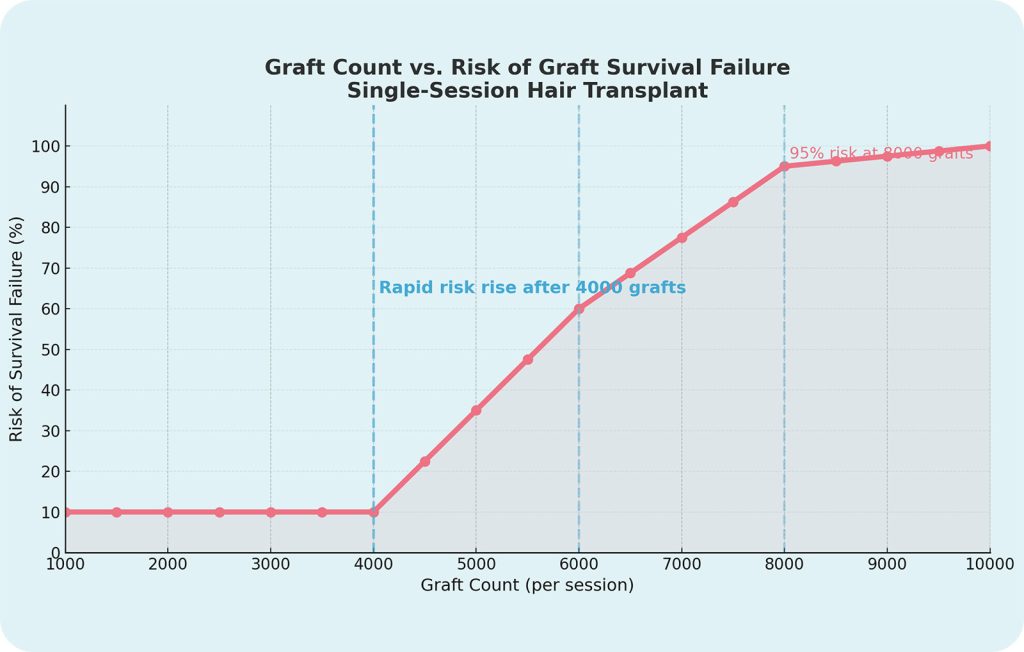
In most cases, no. Extracting and implanting 8000 grafts in a single sitting would require more than 14–16 hours of surgery, raising the risk of graft desiccation, patient fatigue, and lower survival rates.
Most reputable clinics, including leading centers in Turkey, USA, and Europe, perform 8000 grafts in two sessions spaced a few months apart. This ensures higher graft survival and patient safety.
What does 8000 grafts cover?
- Hairline + mid-scalp + partial crown for very advanced cases.
- Full crown coverage if donor supply is exceptional.
- Density restoration across large areas for patients with long-standing baldness.
The donor area challenge
Even when patients want 8000 grafts, the donor area may not allow it.
- Average donor capacity ranges between 5000–7000 grafts for most men.
- Only patients with exceptionally dense donor zones (above 80 FU/cm²) can provide enough for 8000 grafts without overharvesting.
- For others, combining scalp + beard + chest hair may be necessary.
Expert insight – Dr. Ahmet Murat:
“Patients often believe 8000 grafts means a guaranteed cure for baldness. In reality, donor area limitations and natural design principles mean not every case is suited. At Hermest Hair Clinic, we carefully measure donor density and design sessions that balance maximum coverage with long-term safety.”
8000 grafts is possible—but rarely in one session, and not every patient is a candidate. Careful assessment of donor capacity, surgical planning, and realistic expectations are essential.
Cost of 8000 Grafts in Turkey vs Other Countries
When patients consider an 8000 grafts hair transplant, one of the first questions is: how much does it cost, and where is it most affordable? Prices vary dramatically depending on the country, technique, and clinic reputation.
Average cost per graft
- Turkey: $0.75 – $1.30 per graft
- USA: $3 – $8 per graft
- UK & Western Europe: $2.70 – $6.50 per graft
- Germany: $3 – $5.50 per graft
For 8000 grafts, this translates into:
- Turkey: $6,000 – $10,400
- USA: $24,000 – $64,000
- UK/Europe: $21,600 – $52,000
- Germany: $24,000 – $44,000
Why Turkey dominates in affordability
- Economies of scale: Turkey performs over 1 million hair transplants annually, allowing clinics to keep costs significantly lower.
- All-inclusive packages: Leading clinics in Turkey bundle airport transfers, hotel stays, medications, and aftercare support into the quoted price.
- Experience: Turkish surgeons regularly perform mega sessions (5000–8000 grafts), making them highly skilled in high-volume procedures.
Does lower cost mean lower quality?
Not automatically. The real factor is choosing a licensed, accredited clinic. Risks are higher with black-market centers offering cheap 8000 graft promises, such as:
- Overharvesting and donor exhaustion
- Low survival rates of grafts
- Non-physicians conducting surgeries
Dr. Ahmet Murat emphasizes:
“At Hermest, we carefully evaluate each case. If a patient’s donor supply cannot safely support 8000 grafts, we recommend a staged approach instead of risking long-term damage. Safety comes first, always.”
Cost vs value
The price gap between Turkey and the USA or Europe can exceed $30,000–$40,000 for the same number of grafts. For most patients, this makes Turkey the preferred choice—as long as the clinic applies international medical standards.
Techniques for High-Volume Transplants
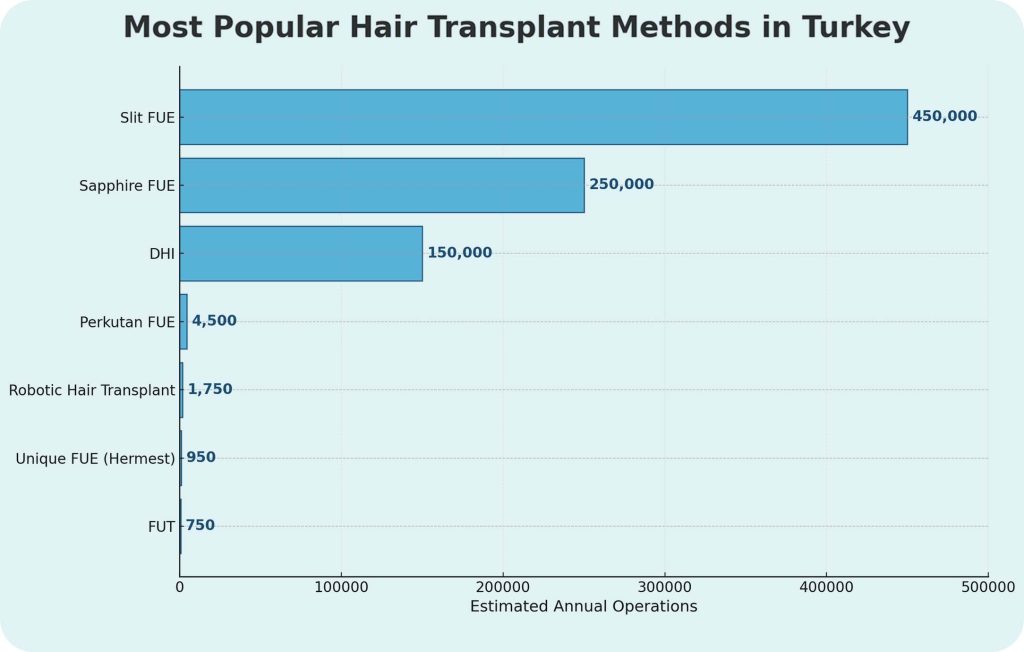
An 8000 grafts hair transplant is a rare and complex procedure that requires careful planning and advanced techniques. Unlike smaller sessions (2000–4000 grafts), reaching such high numbers often demands the use of optimized methods and, in many cases, multiple sessions for safety and natural results.
FUE (Follicular Unit Extraction)
- Still the most widely used technique for large sessions.
- Each graft is extracted individually with micro-punches.
- Allows for precise placement across large bald areas like crown + hairline combined.
- Advantage: less visible scarring, flexible for high graft counts.
Sapphire FUE
- A refinement of FUE, using sapphire blades for channel opening.
- Offers higher density and natural direction of growth, especially for hairlines.
- Faster healing thanks to smaller, smoother incisions.
- Often combined with standard FUE to maximize graft survival in mega sessions.
DHI (Direct Hair Implantation)
- Uses Choi Implanter Pens to place grafts directly without creating pre-made channels.
- Advantage: better control of angle and density, especially useful for frontal hairline.
- Limitation: slower implantation process, so for 8000 grafts, DHI is usually used only in critical cosmetic areas rather than the entire scalp.
Multi-Session Strategy
Since 8000 grafts in one sitting can be too taxing on the donor area and patient, most top clinics prefer a staged approach:
- Session 1: 4000–4500 grafts (targeting front + mid-scalp).
- Session 2: 3000–3500 grafts (crown + density improvement).
- Spacing: typically 6–12 months apart to allow donor healing.
Dr. Ahmet Murat explains:
“Patients often ask if 8000 grafts can be done in one go. While technically possible, it carries higher risks of graft loss and donor overharvesting. At Hermest, we recommend splitting into two safe sessions with a clear growth plan.”
By using a hybrid approach—FUE + Sapphire FUE + selective DHI—clinics can achieve natural density across large bald areas while protecting long-term donor supply.
Who’s a Candidate for 8000 Grafts? Donor Area & Planning
Not every patient is a suitable candidate for an 8000 grafts hair transplant. The main factors determining eligibility are the extent of hair loss, the capacity of the donor area, and overall health considerations.
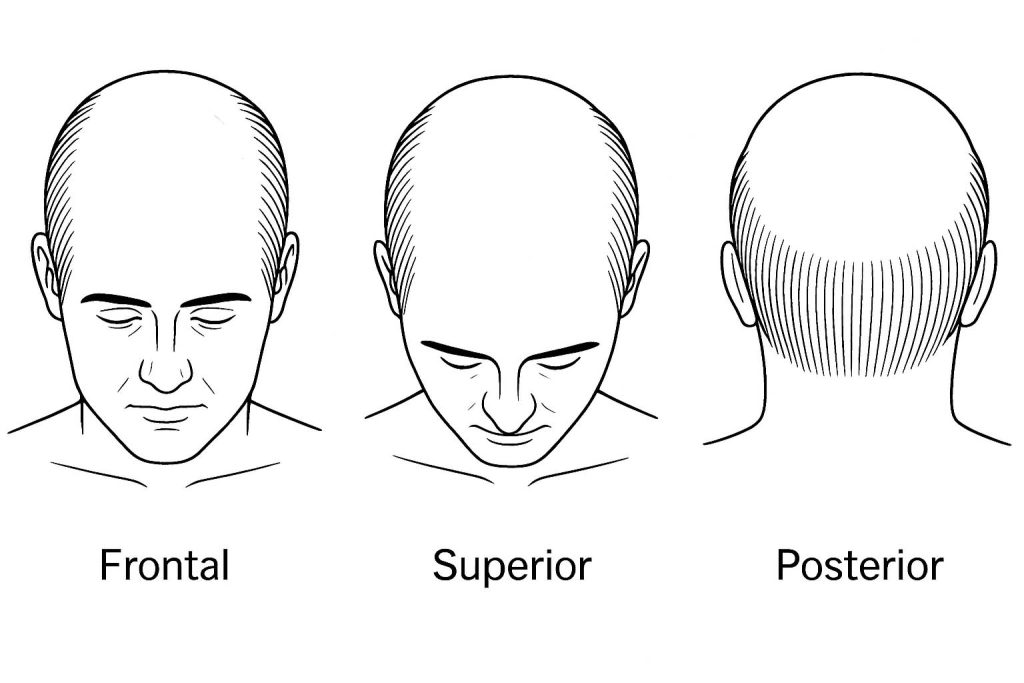
Norwood Scale & Baldness Stage
- Norwood 6–7 patients (extensive baldness covering front, mid-scalp, and crown) are the ones who typically need such high graft counts.
- For moderate hair loss (Norwood 3–5), 2000–4000 grafts are usually sufficient, making 8000 unnecessary.
Donor Area Limitations
- On average, a healthy donor area can provide 5,000–7,000 grafts safely over a lifetime.
- Extracting 8,000 grafts from one donor area often risks overharvesting, leading to thinning at the back and sides.
- To achieve this number, multiple sessions and sometimes beard or body hair grafting are combined with scalp donor hair.
Age & Hair Characteristics
- Younger patients (under 25) are usually not ideal, as hair loss may still progress, making planning difficult.
- Patients with thicker hair shafts, dark hair, and lower contrast with skin tone achieve better visual coverage with fewer grafts.
- Those with fine or light hair may need closer to 8000 grafts for acceptable density.
Health & Medical Considerations
- Candidates must be in good health (no uncontrolled diabetes, clotting disorders, or severe skin conditions).
- Smoking, poor circulation, or scalp scarring can reduce graft survival.
Dr. Ahmet Murat highlights:
“Patients often request 8000 grafts without realizing the donor area’s natural limits. At Hermest, we carefully measure each patient’s capacity with advanced analysis to avoid long-term damage. Sometimes a staged 5000 + 3000 graft approach is safer and more sustainable.”
Recovery & Timeline for 8000 Grafts
Recovering from an 8000 grafts hair transplant requires patience and realistic expectations, as the process takes longer than smaller procedures. Because such a high graft count is usually performed in two sessions, the recovery timeline should be considered in stages.
Immediate Recovery (First 2 Weeks)
- After each session, patients experience redness, swelling, and scabbing in both the donor and recipient areas.
- With 8000 grafts, the scalp surface affected is much larger, meaning the healing process may feel more intense.
- Most patients return to light activities within 7–10 days per session.
Short-Term Growth Phase (1–3 Months)
- Transplanted hairs typically shed around week 3–4 — this is normal and called “shock loss.”
- By the end of the 3rd month, new follicle activity begins, but visible hair growth is still minimal.
Visible Results (6–12 Months)
- Noticeable coverage usually appears between 6–8 months, with density improving steadily.
- Patients who undergo two-stage transplants may see uneven growth until both procedures have matured.
- At 12 months, the majority of results become apparent, but refinement continues.
Final Results (12–18 Months)
- For an 8000 grafts transplant, the final look may take up to 18 months, especially if multiple donor sources (beard or body hair) are used.
- Hair thickens, texture normalizes, and styling options expand.
Recovery Considerations
- Because of the graft volume, patients must follow strict aftercare: avoiding scratching, sun exposure, smoking, or heavy exercise.
- Some clinics offer PRP therapy or exosome treatments to speed healing and improve graft survival.
Dr. Ahmet Murat notes:
“Large-scale hair transplants require meticulous aftercare. At Hermest, we provide structured follow-up and advanced supportive treatments to help patients achieve uniform growth and natural density, even with 8000 grafts.”
Alternatives & Risks of 8000 Grafts
An 8000 grafts hair transplant is not always the best or safest solution. While it promises extensive coverage, it comes with risks and limitations that patients must carefully consider.
Risks of High Graft Counts
- Donor Depletion: Extracting too many follicles can permanently thin the donor area, leaving visible patches.
- Survivability Limits: Not all 8000 grafts will survive; graft survival rates may drop when pushing the limits.
- Extended Surgery Stress: Multiple long sessions increase risks of scalp trauma, infection, and longer healing times.
- Uneven Growth: With staged sessions, hair may grow at different speeds, making results look temporary uneven.
When 8000 Grafts May Not Be Ideal
- Patients with low donor capacity may not have enough scalp hair to safely provide 8000 grafts.
- Advanced Norwood stage 7 baldness often requires alternative strategies since scalp-only grafts may not achieve full coverage.
- Some patients may experience better outcomes with smaller, strategically placed transplants for a natural appearance.
Alternatives to 8000 Grafts
- Combination Therapy: Using beard or chest hair as supplemental donor sources to reduce pressure on scalp donor area.
- Staged Transplants: Splitting into two or more sessions (e.g., 4000 + 4000 grafts) for higher survival and safer recovery.
- Adjunct Treatments: Incorporating PRP, exosomes, or stem cell therapy to improve hair thickness without excessive grafting.
- Medical Therapy: Minoxidil, finasteride, and low-level laser therapy (LLLT) can maintain existing hair and reduce the need for mega sessions.
Dr. Ahmet Murat advises:
“Not every patient is a candidate for 8000 grafts. Our role is to design a long-term plan that balances density, donor preservation, and natural results. Sometimes a combination of transplant and regenerative therapy is the smarter path.”
While 8000 grafts may sound appealing, it isn’t suitable for everyone. Safer alternatives—like staged sessions, donor mixing, and regenerative treatments—often provide better long-term results with fewer risks.
FAQs About 8000 Grafts Hair Transplant
Is 8000 grafts hair transplant possible in one session?
In most cases, an 8000 grafts hair transplant cannot be done in a single session because it puts extreme stress on the donor area and reduces graft survival rates. Surgeons usually divide the procedure into two or more sessions to protect graft quality and ensure natural results.
How much does 8000 grafts hair transplant cost in Turkey?
The average cost of 8000 grafts in Turkey ranges from $6,000 to $10,000, depending on the clinic, surgeon experience, and whether techniques like Sapphire FUE or DHI are used. This is significantly more affordable compared to the USA, where costs can exceed $25,000–$35,000.
How many hairs does 8000 grafts represent?
Each graft typically contains 1–4 hairs, so 8000 grafts equal around 16,000–32,000 hairs. The exact coverage depends on hair thickness, donor quality, and placement strategy.
Who is a good candidate for 8000 grafts?
Patients with advanced baldness (Norwood stage 6–7) and strong donor reserves may qualify for 8000 grafts. However, a surgeon must carefully assess donor availability, hair characteristics, and long-term planning to confirm candidacy.
How many sessions are required for 8000 grafts?
Most patients need two sessions of 4000 grafts each for safe distribution and optimal healing. Rare cases may involve more than two sessions, depending on donor strength and patient goals.
What technique is best for high-graft transplants?
Modern clinics favor Sapphire FUE or DHI for large sessions because they provide higher graft survival, reduced trauma, and faster healing compared to older methods.
How long does recovery take after 8000 grafts?
Initial healing usually takes 7–10 days, but full recovery and hair growth results appear within 12–18 months, with staged procedures extending the total timeline.
Can beard or chest hair be used to reach 8000 grafts?
Yes, beard and body hair are often used as supplementary donor sources when the scalp donor area is insufficient. This approach helps achieve higher graft counts without overharvesting the scalp.
Are there risks with 8000 graft procedures?
The main risks include donor depletion, reduced graft survival, and unnatural density if not planned properly. Choosing an accredited clinic with experienced surgeons minimizes these risks.
What are the alternatives if 8000 grafts are not possible?
Alternatives include lower graft transplants with PRP, exosome therapy, or long-term medical treatments like finasteride and minoxidil. For some, a combination strategy gives better, sustainable results.
Conclusion: Is 8000 Grafts Right for You?
An 8000 grafts hair transplant is one of the most advanced solutions available for severe hair loss. But achieving natural, safe, and lasting results requires expert planning, modern techniques, and a clinic that treats every patient with the highest medical standards.
At Hermest Hair Clinic, we combine Sapphire FUE and DHI techniques with our ALL IN SAFETY PROTOCOL™, ensuring every graft is placed with precision and long-term donor health in mind. With trusted medical partners in the USA, UK, and Germany, we provide international patients with seamless consultation, surgery, and follow-up care.
Book your free consultation today and find out if an 8000 grafts transplant or a staged approach is right for you. Take the first step toward restoring your confidence with natural, permanent results.