


Norwood 5 Explained: Grafts, Density & Hair Transplant Options
Reaching Norwood 5 changes how you think about hair loss. At this stage, most people are no longer asking if they are losing hair. They are asking what they can do about it. Searches like Norwood 5 hair loss, Norwood 5 hair transplant, and how many grafts Norwood 5 become common because the pattern is now clearly visible.
Norwood 5 baldness shows a larger area of loss than earlier stages. The frontal hairline has receded deeply. The crown has expanded. The bridge of hair between the two zones becomes thin or disappears. This creates a wider bald area across the top of the scalp.
According to the American Academy of Dermatology, androgenetic alopecia progresses gradually over time. Norwood 5 represents an advanced stage of that progression, where both the front and crown are significantly affected.
At this point, styling tricks no longer hide the pattern. Patients start thinking about coverage, density, and long-term restoration. Some hope medication can reverse everything. Others want immediate surgery with maximum density. The best outcomes usually come from a balanced plan that combines realistic expectations, medical stabilization, and carefully planned transplantation.
A common misunderstanding online is that Norwood 5 can be restored to full density in one procedure. That is rarely realistic. The goal is a natural, balanced look that fits your donor capacity and future progression.
Dr. Ahmet Murat explains:
“At Norwood 5, the goal is not to recreate teenage density. The goal is to restore a natural frame that will still look correct ten years later.”
This guide explains what Norwood 5 means, how it progresses, and how to plan treatment and transplant options correctly.
Quick Insights
- Norwood 5 is an advanced stage with a large top area affected, where the hairline and crown are close to merging.
- A typical Norwood 5 hairline shows deep temple recession and a weak or absent mid-scalp bridge.
- Norwood 5 hair loss can still progress to Norwood 6 or 7 depending on genetics and DHT sensitivity.
- Medication like finasteride and minoxidil can help slow further loss and protect remaining hair, but cannot regrow fully bald areas.
- A Norwood 5 hair transplant focuses on restoring the hairline and mid-scalp first, with crown coverage planned carefully.
- Most patients need 4,000–6,500 grafts, often with a staged approach for optimal density and donor preservation.
- You cannot maximize both full coverage and high density everywhere; strategic planning is required.
- The donor area is limited, so careful graft allocation is essential for long-term natural results.
- Long-term success depends on maintenance, monitoring, and future planning, not just the initial procedure.
What is Norwood 5?
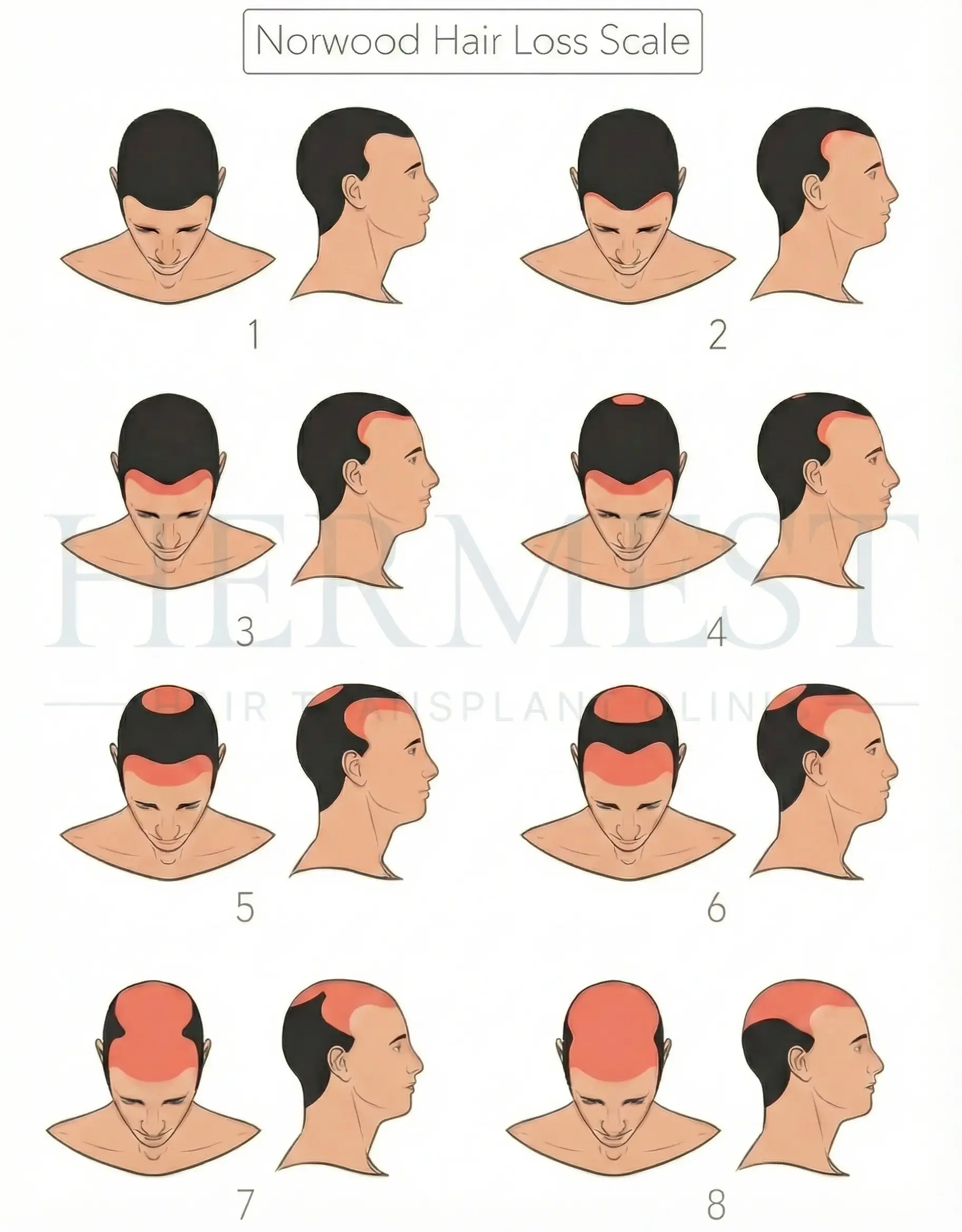
Norwood 5 describes a stage where frontal recession and crown baldness have expanded and nearly meet. People searching Norwood 5 hairline or Norwood 5 hair loss usually notice that the hair across the top has thinned into a wide area, leaving only a thin bridge or scattered density between the front and crown.
Norwood scale explained simply
The Norwood scale tracks male pattern hair loss from early recession to advanced baldness. It focuses on how the hairline moves and how the crown changes.
On this scale:
- Norwood 4 shows separate frontal recession and crown thinning
- Norwood 5 shows these areas enlarging and almost connecting
- Norwood 6 shows the front and crown fully merging into one bald zone
According to clinical descriptions used by the American Academy of Dermatology, this pattern reflects continued progression of androgenetic alopecia rather than simple aging or a mature hairline.
Norwood 5 hairline and crown pattern
A typical Norwood 5 hairline is deeply recessed with a weaker central forelock. The crown bald area is wider and more visible from above. The remaining hair between the two zones often looks thin and fragile.
Common features include:
- Deep temple recession forming a strong M shape
- Large crown bald spot or diffuse thinning
- Narrow or thinning bridge between front and crown
At this stage, density in the mid-scalp often drops as well.
Why Norwood 5 feels different
With Norwood 5 baldness, the loss is no longer isolated to one zone. It affects the entire top of the scalp. This is why many people begin searching for Norwood 5 treatment or Norwood 5 hair transplant options.
Dr. Ahmet Murat explains:
“Norwood 5 is where the pattern becomes global. We must design the front, middle, and crown together to achieve a natural look.”
Is Norwood 5 advanced hair loss?
Norwood 5 is generally considered an advanced stage of male pattern hair loss. It sits between moderate loss and the most extensive stages. People searching Norwood 5 hair loss often want to understand how serious it is and what their options look like at this point.
Differences from Norwood 4 and Norwood 6
At Norwood 4, the frontal hairline and crown are separate. A band of hair still connects them. At Norwood 5, that bridge becomes thinner and may start breaking apart. The bald areas on the top of the scalp expand and come close to merging.
At Norwood 6, the connection is gone. The entire top area becomes one continuous bald zone.
In simple comparison:
- Norwood 4: two separate areas of loss
- Norwood 5: areas expanding and nearly connecting
- Norwood 6: full connection across the top
According to pattern descriptions referenced by the American Academy of Dermatology, this shift reflects ongoing androgenetic alopecia moving into more extensive stages.
Why Norwood 5 requires long-term planning
At this stage, restoration must consider both current coverage and future progression. Using too many grafts too early can limit options later. Planning must balance:
- Hairline design
- Mid-scalp connection
- Crown coverage
This is why people searching Norwood 5 hair transplant need a strategy rather than a quick fix.
Dr. Ahmet Murat explains:
“At Norwood 5, we plan for what your hair will look like in ten years. A natural result depends on respecting donor limits and designing density carefully.”
What “advanced” means for treatment
Advanced does not mean untreatable. It means restoration requires:
- Careful graft allocation
- Realistic density expectations
- Possible staged procedures
Can Norwood 5 progress further?
For many patients, Norwood 5 hair loss is not the final stage. The pattern can continue into Norwood 6 or even Norwood 7 over time. Understanding this progression helps you plan treatment and transplant strategy correctly.
Genetic progression risks
The main driver of progression is genetic sensitivity to DHT. According to the American Academy of Dermatology, androgenetic alopecia follows inherited patterns that often mirror close family members.
If relatives reached Norwood 6 or 7, your risk of further progression is higher. If they stabilized earlier, your pattern may remain closer to Norwood 5.
Key risk factors include:
- Family history of advanced baldness
- Early onset of hair loss
- Fine or low-density hair characteristics
- High follicle sensitivity to DHT
Timeline expectations
Hair loss usually progresses slowly. Movement from Norwood 5 to Norwood 6 often takes years, not months. Some patients remain stable at Norwood 5 for long periods, especially with medical support.
Typical progression patterns:
- Slow gradual expansion of crown and top
- Long stable phases with minimal change
- Occasional periods of faster thinning
Searches like Norwood 5 progression timeline reflect how variable this can be.
Signs progression is continuing
You may be progressing if you notice:
- The bridge between front and crown disappearing
- Crown area widening further
- Mid-scalp density thinning significantly
Tracking photos over months helps confirm real change.
Dr. Ahmet Murat explains:
“We watch how the mid-scalp behaves. When that bridge weakens, the pattern is moving forward.”
Why this matters for planning
If progression is likely, transplant design must preserve donor hair for future sessions. A short-term plan can lead to long-term imbalance.
Medical treatment at Norwood 5
At Norwood 5, medical therapy still has a role. It does not restore large bald areas. It helps slow progression and protect remaining native hair. Many patients searching Norwood 5 treatment ask if medication is still worth it at this stage. In many cases, it is.
What medication can still do
Medication works on miniaturizing follicles that are still alive. At Norwood 5, the mid-scalp, the bridge area, and parts of the crown often still contain active follicles. These zones can benefit from stabilization.
Common benefits at this stage include:
- Slowing further recession at the hairline edges
- Maintaining the mid-scalp bridge for longer
- Improving thickness in partially thinned crown areas
According to the American Academy of Dermatology, treatments such as finasteride and minoxidil can help maintain existing hair in androgenetic alopecia.
Where medication cannot restore hair
Medication cannot bring back hair in areas where follicles are already inactive. Fully bald zones at Norwood 5 hairline or crown usually require surgical restoration for visible coverage.
Medication alone is limited when:
- The top is already a large bald zone
- The crown has no visible hair density
- The mid-scalp bridge has disappeared
The role of combination planning
At Norwood 5, the most effective approach often combines:
- Medical therapy to preserve remaining hair
- Hair transplant to restore lost areas
This approach protects both present and future appearance.
Dr. Ahmet Murat explains:
“Medication at Norwood 5 is about protection. It keeps your existing hair stable so the transplant result remains balanced.”
Why starting treatment still matters
Even late in the process, stabilization can:
- Improve transplant planning
- Reduce future graft requirements
- Extend the lifespan of your results
Hair transplant at Norwood 5 – realistic expectations
At Norwood 5, a transplant can restore a strong frame to the face and improve overall scalp coverage. The key is understanding what is achievable with your donor supply and hair characteristics. People searching Norwood 5 hair transplant or how many grafts Norwood 5 often expect a single-session, full-density solution. Real planning focuses on balance and long-term stability.
How many grafts Norwood 5 requires
Graft numbers vary by area size, hair thickness, and target density. Most patients fall into a range that allows strong frontal work and partial crown coverage.
Typical planning ranges:
- 4,000–5,000 grafts for frontal hairline and mid-scalp
- 5,000–6,500 grafts when adding crown coverage
- Larger cases staged across two sessions for safety
According to guidance used in surgical planning by the International Society of Hair Restoration Surgery, graft allocation must match donor capacity and future loss risk.
Coverage vs density trade-offs
At Norwood 5 hair loss, you cannot maximize both coverage and density everywhere. You must choose where density matters most visually.
Common strategies include:
- High density in the frontal hairline for facial framing
- Medium density through the mid-scalp to connect zones
- Lighter density in the crown for a natural swirl pattern
This creates a balanced, natural look from all angles.
One session vs staged procedures
Many patients ask if Norwood 5 hair transplant can be done in one session. In some cases, yes. In many cases, a staged approach produces better density and protects donor supply.
Two-stage planning is often used when:
- The crown area is large
- The donor density is moderate
- The patient wants higher density in the front
What a successful Norwood 5 result looks like
A good result restores a natural hairline, reconnects the mid-scalp, and softens the crown contrast. It does not aim to recreate teenage density.
Dr. Ahmet Murat explains:
“At Norwood 5, success is balance. When the hairline and crown look proportionate, the result appears natural.”
Donor area planning for Norwood 5 patients
At Norwood 5, donor management becomes the most important part of the entire plan. The donor area is a finite resource. Every graft used today affects what you can do in the future. Patients searching Norwood 5 hair transplant often focus on coverage first, but long-term success depends on how carefully the donor is managed.
Donor limitations at Norwood 5
The donor zone sits in the back and sides of the scalp, where follicles are more resistant to DHT. According to surgical principles described by the International Society of Hair Restoration Surgery, these grafts can retain their resistance after transplantation.
However, the donor supply is limited. Overharvesting can lead to visible thinning in the back of the scalp and restrict future procedures.
Key donor variables include:
- Donor density and hair caliber
- Scalp elasticity and extraction distribution
- Future progression risk toward Norwood 6 or 7
Long-term donor preservation strategy
At Norwood 5 hair loss, planning must consider the next decade, not just the next year. Many patients will require additional grafts later to maintain balance as hair loss progresses.
A strong donor strategy typically includes:
- Using grafts conservatively in the first session
- Prioritizing the frontal hairline and mid-scalp
- Reserving grafts for future crown or density refinement
Why donor planning shapes your final result
Patients often focus on hairline design, but donor planning determines whether your result will stay natural long-term. Poor planning can lead to patchy density or an unnatural contrast between zones.
Dr. Ahmet Murat explains:
“At Norwood 5, donor management is everything. A well-preserved donor allows us to maintain a natural look as your pattern evolves.”
Technique choice and donor safety
Modern FUE-based techniques allow precise extraction patterns that reduce visible donor thinning. Careful spacing and controlled harvesting protect the donor area for future use.
Realistic results for Norwood 5
At Norwood 5, a transplant can rebuild a natural frame and improve overall coverage. The goal is not to recreate teenage density. The goal is a balanced, natural appearance that fits your donor capacity and future pattern.
Density expectations for Norwood 5
Hair density is planned strategically. Higher density is placed where it matters most visually, and lighter density is used in larger areas.
Typical density distribution:
- Higher density in the frontal hairline and forelock
- Medium density in the mid-scalp connection zone
- Lower density in the crown for a natural swirl effect
This allocation uses grafts efficiently and creates a natural look from all angles.
According to planning principles referenced by the International Society of Hair Restoration Surgery, density must be matched to donor availability and long-term goals.
Coverage vs fullness
At Norwood 5 hair loss, surgeons must choose between wider coverage and thicker density. Trying to maximize both can exhaust the donor supply and reduce long-term options.
Two common outcome styles:
- Wider coverage with moderate density across the top
- Focused coverage with stronger density in the frontal zone
The right approach depends on hair thickness, color contrast, and personal styling habits.
Crown restoration limitations
The crown requires many grafts to appear dense. Many patients choose partial crown coverage first, with the option to enhance it later.
What a successful Norwood 5 result looks like
A successful Norwood 5 hairline restoration should:
- Frame the face naturally
- Blend smoothly into the mid-scalp
- Reduce contrast with the crown area
Dr. Ahmet Murat explains:
“A natural Norwood 5 result is about harmony. When the front, middle, and crown look balanced, the result feels complete.”
Long-term maintenance after Norwood 5 restoration
After restoring Norwood 5 hair loss, maintenance protects your result over time. A transplant places permanent grafts, but native hair can still thin. Long-term success depends on stabilization, scalp care, and regular monitoring.
Medical stabilization after Norwood 5 treatment
Ongoing therapy helps protect remaining native hair around the transplant zones. This keeps the overall look balanced as years pass.
Common maintenance plan:
- Finasteride to reduce DHT impact on native follicles
- Minoxidil to support follicle activity and thickness
- Periodic follow-ups to monitor density and progression
According to the American Academy of Dermatology, continuous treatment improves long-term stability in androgenetic alopecia.
Medication does not harm transplanted grafts. It supports the surrounding hair that still exists in the mid-scalp and crown.
Scalp care and lifestyle support
Healthy scalp conditions support stronger hair growth and better appearance.
Helpful habits include:
- Gentle washing and regular scalp hygiene
- Sun protection for exposed scalp areas
- Avoiding harsh chemical treatments
- Balanced nutrition and stress control
These habits support both transplanted and native hair.
Monitoring your hair over time
Even after treatment, hair can change slowly. Tracking photos every few months helps you see real changes early.
Watch for:
- Mid-scalp thinning returning
- Crown expansion
- Reduced density at the edges of transplanted zones
Dr. Ahmet Murat explains:
“Maintenance keeps your transplant looking natural for years. Protecting your existing hair is part of the result.”
Planning for future sessions
Some patients choose a second procedure later to increase density or expand crown coverage. Good maintenance delays or reduces the need for that.
FAQs about Norwood 5 hair loss and treatment
Can Norwood 5 be reversed without surgery?
True reversal is not realistic once large areas are bald. Medication can slow progression and improve thinning zones, but it cannot recreate follicles where hair is already gone. Visible restoration at Norwood 5 usually requires a transplant.
How many grafts are needed for Norwood 5?
Most patients need 4,000 to 6,500 grafts depending on area size, hair thickness, and density goals. Some cases require a second session to improve crown coverage or increase density.
Is Norwood 5 considered severe hair loss?
Yes, it is an advanced stage of male pattern baldness. There is still donor hair available in many patients, but planning must be careful and long-term.
Can the crown be fully restored?
It can be improved, but full density is not always possible in one session. Many patients choose partial crown restoration first and enhance it later if donor supply allows.
Is one transplant session enough for Norwood 5?
Sometimes, but not always. One session can restore the frontal zone and part of the mid-scalp. Larger crown areas often require a staged approach.
Will hair loss continue after a transplant?
It can. A transplant restores current loss but does not stop future progression. This is why medical maintenance is often recommended after surgery.
Is Norwood 5 a good stage for a transplant?
Yes, many Norwood 5 patients are strong candidates when donor density is good and expectations are realistic.
Take the next step with a personalized Norwood 5 plan
At Norwood 5, the difference between an average result and a natural, long-lasting result comes down to planning. You need a strategy that restores your hairline, connects the mid-scalp, and manages the crown without exhausting your donor supply.
At Hermest Hair Transplant Clinic, each Norwood 5 hair transplant is designed with long-term balance in mind. The team uses UNIQUE FUE® for precise, controlled graft extraction and the AIS Protocol to optimize placement angles, density distribution, and natural hairline transitions. The goal is not just coverage today, but a result that still looks correct as your hair pattern evolves.
With a personalized plan, you receive:
- A detailed scalp and donor assessment
- A realistic graft and coverage strategy
- Clear expectations for density and crown restoration
- Guidance on medical support to protect your existing hair
Dr. Ahmet Murat explains:
“At Norwood 5, success is about balance over time. When we design the front, middle, and crown together, the result stays natural as the years pass.”
If you are exploring Norwood 5 treatment options, the next step is a tailored evaluation. Share your photos and goals with the Hermest team and receive a clear, honest plan built around your hair characteristics, donor capacity, and long-term outlook.